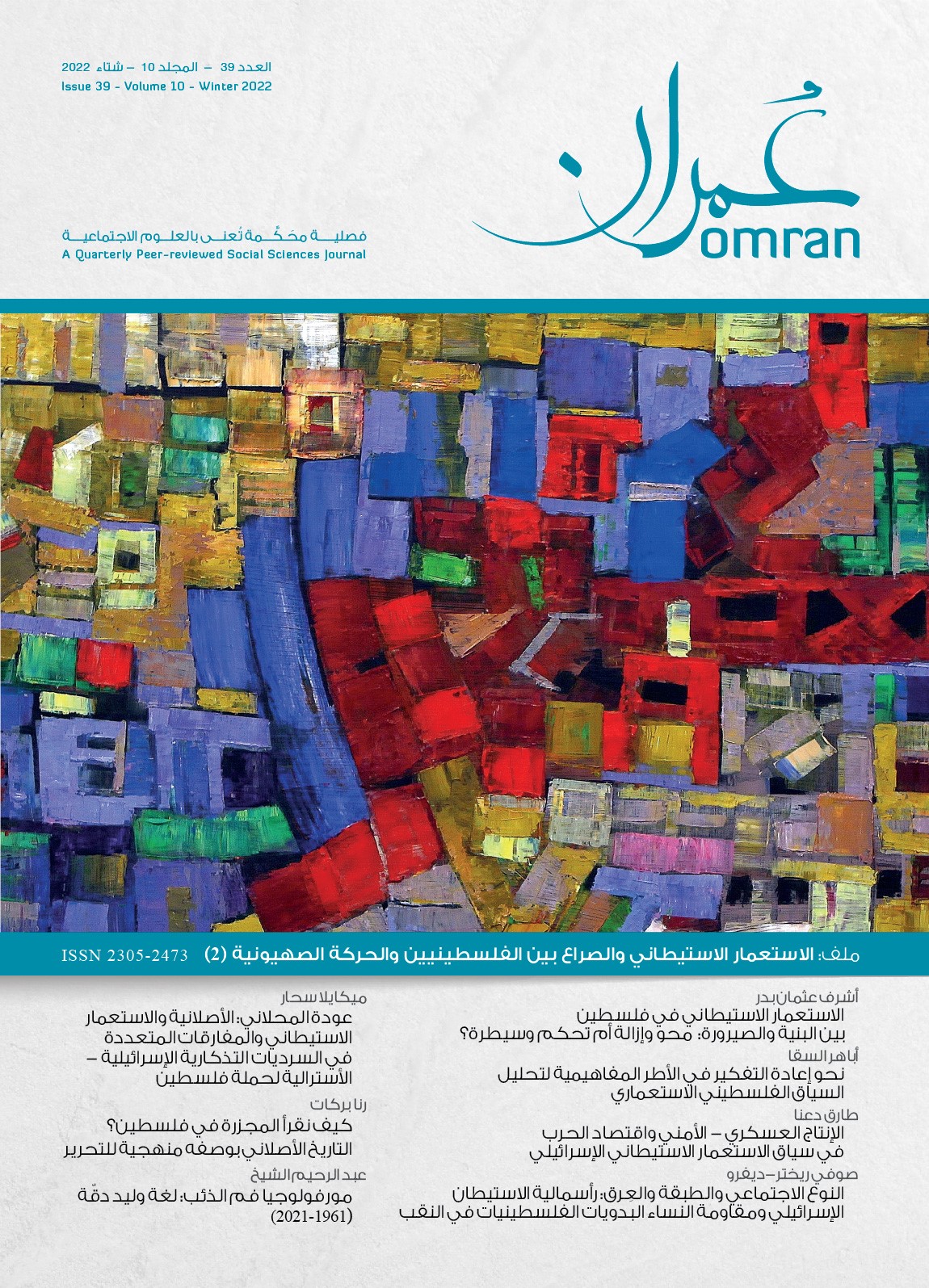
النوع الاجتماعي والطبقة والعِرق: رأسمالية الاستيطان الإسرائيلي ومقاومة النساء البدويات الفلسطينيات في النقب
DOI:
https://doi.org/10.31430/ctmn4354الكلمات المفتاحية:
الرأسمالية الاستيطانية، النقب، فلسطين، الجندر، التقاطعيةالملخص
تنشغل هذ الدراسة باستظهار طبيعة تأثير الاستعمار الاستيطاني الإسرائيلي، أو الرأسمالية الاستيطانية كما تُمفهمها الدراسة، في مجموعة نساء بدويات فلسطينيات ينتمين إلى جيل النكبة، وكيف تعاملن معه وقاومنه، ودليلي إلى ذلك العمل الميداني الإثنوغرافي الذي أجريته في النقب في المدة 2014-2018. وبفضل بقاء هذه المجموعة من النساء على هامش المشروع الإسرائيلي الرأسمالي الاستيطاني، احتفظن بفضاءاتهنّ الاجتماعية والثقافية والسياسية البديلة الخاصة بهنّ، فكنَّ قادرات على مواجهة منطقه الإقصائي. ثمة تصورات ضيقة الأفق عن الاستعمار الاستيطاني، تتجاهل العمل المأجور بوصفه شكلًا من أشكال المحو الإيجابي، لا يمكنها أن تحيط بما تفعله اليوم الرأسمالية الاستيطانية الإسرائيلية في فلسطين بشأن مسائل متقاطعة كالنوع الاجتماعي والطبقة والعِرق.
المراجع
- تنشر عمرانالنسخة العربية من هذا المقال في هذا العدد، في حين ستُنشر النسخة الإنكليزية لاحقًا في: Mikko Joronen & Mark Griffiths (eds.), Encounters with Colonial Power: Emergent Spaces of Violence and Struggle in Palestine (Lincoln: University of Nebraska Press, [forthcoming]).
- Shirly Seidler, "Minister: Israel Looking at Ways to Lower Bedouin Birthrate," Haaretz , 29/9/2014, accessed on 31/12/2021, at: https://bit.ly/3qsO7Vx
- Nur Masalha (ed.), Catastrophe Remembered: Palestine, Israel and the Internal Refugees: Essays in Memory of Edward W. Said (London: Zed Books, 2005), p. 125.
- أستعمل مصطلح النَّقب في هذه الدراسة لأنّها مستعملة من أبناء مجتمعها. ولغرض الاطلاع على مناقشة تفصيلية للمصطلح، ينظر: Richard Ratcliffe, "Introduction," in: Mansour Nasasra et al., (eds.), The Naqab Bedouin and Colonialism: New Perspectives (London: Routledge, 2014).
- Mansour Nasasra & Emily Bellis, "The Role of Bedouin Youth and Women in Resistance to the Israeli Prawer Plans in the Naqab," Middle East Critique , vol. 29, no. 4 (2020), p. 398.
- Ilan Pappe, The Ethnic Cleansing of Palestine (Oxford: One World, 2006); Ilan Pappe, "The Forgotten Victims of the Palestine Ethnic Cleansing," in: Nasasra et al., (eds.).
- إسماعيل أبو سعد، عرب النقب: الواقع الراهن وتحديات المستقبل (بئر السبع: مركز النقب للتطوير الإقليمي، 2010)، ص.117
- Emanuel Marx, The Bedouin of the Negev (Manchester: Manchester University Press, 1967); Ghazi Falah, "Israeli State Policy toward Bedouin Sedentarisation in the Negev," Journal of Palestine Studies , vol. 18, no. 2 (1989), pp. 71– 91; Mansour Nasasra, "The Politics of Non–cooperation and Lobbying: The Naqab Bedouin and Israeli Military Rule, 1948–67," in: Nasasra et al., (eds.).
- Ghazi Falah, "How Israel Controls the Bedouin in Israel," Journal of Palestine Studies , vol. 14, no. 2 (Winter 1985), pp. 35–51; Falah, "Israeli State Policy toward Bedouin Sedentarisation in the Negev."
- هناك سبع وثلاثون قرية في النّقب غير معترف بها وإحدى عشرة قرية معترف بها جزئيًا. ولا تدعم الحكومة الإسرائيلية بنيتها التحتية. ينظر: Alexandre Kedar, Ahmad Amara & Oren Yiftachel, Emptied Lands: A Legal Geography of Bedouin Rights in the Negev (Stanford: Stanford University Press, 2018), p. 11; وتدافع كتابات كثيرة عن عمليات التهجير المستمرة وهدم المنازل في القرى غير المعترف بها، ينظر من بينها: "As Requested by the Prime Minister’s Office: The National Council for Planning and Building, in an Exceptional Move, Cancels its Decision Recognize Two Arab Bedouin Villages in the Naqab (Negev)," The Legal Center for Arab Minority Rights in Israel (Adalah), 22/11/2010, accessed on 2/1/2022, at: https://bit.ly/3JwdEGe; "Nomads against their will: The Attempted Expulsion of the Arab Bedouin in the Naqab: The Example of Atir–Umm al–Hieran," The Legal Center for Arab Minority Rights in Israel (Adalah), 16/2/2012, accessed on 2/1/2022, at: https://bit.ly/3EpMmgU
- ينظر: Rhoda Ann Kanaaneh, Birthing the Nation: Strategies of Palestinian Women in Israel (Berkeley: University of California Press, 2002); Ahmad H. Sa’di, "Ominous Designs: Israel’s Strategies and Tactics of Controlling the Palestinians during the First Two Decades," in: Elia Zureik, David Lyon & Yasmeen Abu–Laban (eds.), Surveillance and Control in Israel/ Palestine (London: Routledge, 2011), pp. 83–98; Ahmad H. Sa’di, Thorough Surveillance: The Genesis of Israeli Policies of Population Management, Surveillance and Political Control towards the Palestinian Minority (Manchester: Manchester University Press, 2014).
- Michel Foucault, "The Birth of Biopolitics," in: Michel Foucault, Ethics, Subjectivity, and Truth, Paul Rabinow (ed.) (New York: New Press, 1997), pp. 73–79; ينظر أيضًا: Sa'di, "Ominous Designs".
- حريٌّ بنا ملاحظة أنه في حين يصف خطاب الدولة في إسرائيل ظاهرة تعدد الزوجات ﺑالممارسة البدوية الثقافية "التقليدية" و"المتخلفة"، فإنّ سياساتها الفعلية متناقضة وربما تشجع هذه الظاهرة بدلً من أن تحاربها. ينظر مثلً: Rawia Abu Rabia, "Redefining Polygamy among the Palestinian Bedouins in Israel: Colonialism, Patriarchy, and Resistance," Journal of Gender, Social Policy & the Law , vol. 19, no. 2 (2011); Sonia Bolous, "National Interests versus Women’s Rights: The Case of Polygamy among the Bedouin Community in Israel," Women & Criminal Justice , vol. 31, no. 1 (2021), pp. 53–76. وهذا التناقض الواضح يمثل جوهر مشروع الدولة التحديثي بوصفه استجابة للمخاوف الديموغرافية في الوقت الذي تنعت فيه البدو بالمتخلفين.
- Silvia Federici, "Wages against Housework," in: Ellen Malos (ed.), The Politics of Housework (Gloucestershire: New Clarion Press, 1995); Silvia Federici, Caliban and the Witch: Women, the Body and Primitive Accumulation (Brooklyn: Atonomedia, 2014).
- Patrick Wolfe, Settler Colonialism and the Transformation of Anthropology: The Politics and Poetics of an Ethnographic Event (London/ New York: Cassell, 1999); Patrick Wolfe, "Settler Colonialism and the Elimination of the Native," Journal of Genocide Research , vol. 8, no. 4 (2006), pp. 387–404; لا يتيح المجال هنا مراجعة الكتابات المتكاثرة عن الاستعمار الاستيطاني في فلسطين. ولغرض الاطلاع على طبعات كتب خاصة أو أبحاث، ينظر: Omar Jabary Salamanca et al., "Past is Present: Settler Colonialism in Palestine," Settler Colonial Studies , vol. 2, no. 1 (2012), pp. 1–8; Marcelo Svirsky (ed.), "Collaborative Struggles in Australia and Israel–Palestine," Settler Colonial Studies, vol. 4, no. 4 (2014); Lorenzo Veracini (ed.), "Special Issue: Settler Colonialism and Israel–Palestine," Settler Colonial Studies , vol. 5, no. 3 (2015); David Lloyd & Patrick Wolfe, "Settler Colonial Logics and the Neoliberal Regime," Settler Colonial Studies , vol. 6, no. 2 "Settler Colonial Logics and the Neoliberal Regime" (2016), pp. 109– 118; Francesco Amoroso, Ilan Pappé & Sophie Richter–Devroe (eds.), "Special Issue on Settler Colonialism in Palestine," International Journal of Postcolonial Studies , vol. 21, no. 4 (2019).
- ينظر على سبيل المثال: Nira Yuval–Davis, Gender and Nation (London: Sage, 1997); Lila Abu–Lughod (ed.), Remaking Women: Feminism and Modernity in the Middle East (Princeton: Princeton University Press. 1998).
- ينظر الأعمال الآتية على الرغم من أنها لا تتبنى مسألة النوع الاجتماعي: Oren Yiftachel, "Epilogue: Studying Naqab/ Negev Bedouins: Toward a Colonial Paradigm?" HAGAR Studies in Culture, Polity and Identities , vol. 8, no. 2 (2008), pp. 83–108; Nasasra, et al.; Kedar, Amara & Yiftachel. وهي أعمال تتعقب المشروع الإسرائيلي الاستعماري الاستيطاني من خلال مصادرة الأراضي في النقب ونزع الملكية والتهجير.
- ينظر (:1 Sai Englert, "Settlers, Workers, and the Logic of Accumulation by Dispossession," Antipode , vol. 52, no. 6 (2020), pp. 1647–1666.
- Wolfe, "Settler Colonialism and the Elimination of the Nat i ve," p. 388; ينظر أيضًا: Lorenzo Veracini, Settler Colonialism: A Theoretical Overview (London: Palgrave Macmillan, 2010); Sara Salazar Hughes, "Unbounded Territoriality: Territorial Control, Settler Colonialism, and Israel/Palestine," Settler Colonial Studies , vol. 10, no. 2 (2020), pp. 216–233.
- مخَّضتُ البيانات الإثنوغرافية من خلال منهج المشاركة، والمقابلات المفتوحة، والأحاديث غير الرسمية. ودارت جميع المقابلات والمحادثات باللغة العربية، وقمت بتسجيلها أو بتدوين بعض الملاحظات. ولقد استمرت غالبًا بضع جلسات وساعات وأيام، وغيرت جميع أسماء من قابلتهم لضمان حمايتهم. ومع أنّ النساء اللواتي تشير إليهنّ هذه المقالة متقدماتٌ في العمر (فوق الستين عامًا)، فإنهنّ ينحدرن من خلفيات قبَليّة ومناطقية مختلفة. ولا يجب أن يُنظر إلى هذه العيّنة على أنها تمثل "نساء النَّقب البدويات"، ولا أرمي إلى التغلغل في خلفياتهنّ المختلفة ولا تحليلها منهجيًا. إنما كان هدف هذا البحث إثنوغرافيًا، من خلال ممارسات النساء وأشكال فاعليتهنّ (وليس من خ لاا أصوات مهيمنة)، والطرق التي تسلكها السياسة الرأسمالية الاستيطانية الإسرائيلية في فلسطين. ولكوني باحثة من خارج أهل البلاد، فإني أعدُّ سياسة التضامن مسألة بالغة الأهمية للبحث في فلسطين وعنها ولأجلها. ينظر: Sophie Richter–Devroe, Women’s Political Activism in Palestine: Peacebuilding, Resistance, and Survival (Chicago: University of Illinois Press, 2018), pp. 20–27. أود أن أقدم جزيل الشكر لكل أولئك النساء اللواتي وافقن على المساهمة في هذا المشروع، ولكل من قدم لي يد المساعدة والضيافة في أثناء عملي الميداني في النَّقب لا سيما العائلة التي استضافتني. تلقّى هذا البحث تمويلً من زمالة بحثية مبكرة أقامها معهد البحث للفنون والإنسانيات (2016–2014) وكانت بعنوان "النوع الاجتماعي والاستعمار الاستيطاني: التواريخ الشفاهية لنساء النقب". وأشكر ما قدمه معهد البحث للفنون والإنسانيات من دعم مادي. وأنا وحدي أتحمل الأخطاء كلها.
- ينظر (:2 Shirin M. Rai, "Women and the State in the Third World: Some Issues for Debate," in: Shirin M. Rai & Geraldine Lievesley (eds.), Women and the State: International Perspectives (London: Taylor and Francis, 1996); Kumari Jayawardena, Feminism and Nationalism in the Third World (London: Zed Books, 1986). وللاطلاع على سياقات الشرق الأوسط، ينظر: Abu–Lughod (ed.), Remaking Women ; Deniz Kandiyoti, "Identity and its Discontents: Women and the Nation," Millenium: Journal of International Studies , vol. 20, no. 3 (1992), pp. 429–443.
- Nadera Shalhoub–Kevorkian, Militarization and Violence against Women in Conflict Zones in the Middle East: A Palestinian Case–Study (Cambridge: Cambridge University Press, 2009); Islah Jad, Palestinian Women’s Activism: Nationalism, Secularism, Islamism (Syracuse: Syracuse University Press, 2018); Richter–Devroe, Women’s Political Activism in Palestine.
- Lorenzo Veracini, "‘Settler Colonialism’: Career of a Concept," The Journal of Imperial and Commonwealth History , vol. 41, no. 2 (2013).
- ينظر: Jamil Hilal, "Imperialism and Settler Colonialism in West Asia: Israel and the Arab Palestinian struggle," Utafi , vol. 1, no. 1 (1976), pp. 51–70; Elia T. Zureik, Palestinians in Israel: A Study of Internal Colonialism (London: Routledge/ Kegan Paul, 1979); Edward W. Said, The Question of Palestine (London: Routledge, 1979); Fayez A. Sayegh, "Zionist Colonialism in Palestine," Settler Colonial Studies , vol. 2, no. 1 (2012 [September 1965]), pp. 206–225; Ghazi Falah, "The Geopolitics of ‘Enclavisation’ and the Demise of a Two–State Solution to the Israeli–Palestinian Conflict," Third World Quarterly , vol. 26, no. 8 (2005), pp. 1341–1372.
- Baruch Kimmerling, Zionism and Territory: The Socio–territorial Dimensions of Zionist Politics (Berkeley: University of California Press, 1983).
- Maxime Rodinson, Israel: A Colonial–Settler State? (New York: Monad Press, 1973).
- Gershon Shafir, Land, Labor, and the Origins of the Israeli–Palestinian Conflict 1882–1914 (Cambridge: Cambridge University Press, 1989); Gershon Shafir, "Zionism and Colonialism: A Comparative Approach," in: Michael Barnett (ed.), Israel in Comparative Perspective: Challenging the Conventional Wisdom (New York: State University of New York Press, 1996).
- Rosemary Sayigh, The Palestinians: From Peasants to Revolutionaries (London: Zed Books, 2007).
- ينظر: Hilal; Rodinson.
- Shafir, Land ; Shafir, "Zionism and Colonialism."
- ينظر أيضًا نقد لوكمان الموجه إلى تحليل شافير، الذي يسلط الضوء على دور العنف والإكراه اللذَين يستعملهما الصهاينة من أجل "مستوطنة نقية:" Zachary Lockman, "Land, Labor and the Logic of Zionism: A Critical Engagement with Gershon Shafir," Settler Colonial Studies , vol. 2, no. 1 "Past is Present: Settler Colonialism in Palestine" (2012), pp. 9–38; Shafir, Land.
- Wolfe, "Settler Colonialism and the Elimination of the Native"; Wolfe, Settler Colonialism and the Transformation of Anthropology.
- Wolfe, "Settler Colonialism and the Elimination of the Native," p. 388.
- Lorenzo Veracini, "The Other Shift: Settler Colonialism, Israel and The Occupation," Journal of Palestine Studies , vol. 42, no. 2 (2013), pp. 26–42.
- Wolfe, Settler Colonialism and the Transformation of Anthropology , p. 1.
- Shannon Speed, "Structures of Settler Capitalism in Abya Yala," American Quarterly , vol. 69, no. 4 (2017), pp. 783–790; Englert.
- Federici, Caliban and the Witch.
- Gary Fields, "Landscaping Palestine: Reflections of Enclosure in a Historical Mirror," International Journal of Middle East Studies , vol. 42, no. 1 (2010), p. 66.
- تفهم فيديريتشي اصطياد الساحرات "مبادرةً سياسيةً واسعة" قدمت لها الكنيسة "دعامة ميتافيزيقية وأيديولوجية"، ينظر: Federici, Caliban and the Witch , p. 168. بهذا تدرك الدور الأيديولوجي الذي اضطلعت به الكنيسة، ولكنها تحدد التحولات الاقتصادية والاجتماعية والسياسية من الإقطاع إلى الرأسمالية أسبابًا رئيسة لاصطياد الساحرات في القرون الوسطى.
- ينظر: Yuval–Davis.
- Federici, Caliban and the Witch , p. 174.
- Ibid.; Silvia Federici, Re–enchanting the World: Feminism and the Politics of the Commons (Oakland: PM Press/ Kairos, 2019). لمفهوم المشاعيات تراث طيب في الكتابات الماركسية حول التسييج. فلقد بيّنت لوكسمبورغ، مثل، كيف أن الاستغلال الرأسمالي يحتاج إلى مصادرة المشاعات وتفكيك ما سمته "الاقتصاد الطبيعي، من أجل استغلال الأرض موردًا لتراكم رأس المال. Rosa Luxemburg, The Accumulation of Capital (New York: Routledge, 2003). وأظهر هارفي بعد عقود من ذلك كيف أن "التراكم عن طريق نزع الملكية" النيوليبرالي يهاجم المشاعات بطرق مختلفة. David Harvey, The New Imperialism (Oxford: Oxford University Press, 2003).
- ينظر: Fields, p. 65.
- آمنة، مقابلة شخصية، رهط، 2016؛ ينظر كذلك: Sophie Richter–Devroe, "Oral Traditions of Naqab Bedouin Women: Challenging Settler–Colonial Representations Through Embodied Performance," Journal of Holy Land and Palestine Studies , vol. 15, no. 1 (2016), pp. 31–57.
- ينظر: Paul Kohlbry, "Owning the Homeland: Property, Markets, and Land Defense in the West Bank," Journal of Palestine Studies , vol. 47, no. 4 (2018), pp. 30–45; Ahmad Amara, "The Negev Land Question: Between Denial and Recognition," Journal of Palestine Studies , vol. 42, no. 4 (2013), pp. 27–47.
- ينظر: Fields, p. 70.
- Yiftachel, "Epilogue"; Nasara et al. (eds.); Kedar, Amara & Yiftachel.
- بينما تم تخطيط البلدات السبع لأغراض الترحيل القسري للسكان المحلّنيين وضمّ أراضيهم، فإنّ الأمر جرى على نحو مختلف من حيث دقة التخطيط والترتيبات.
- Ismael Abu Saad, "State–Directed ‘Development’ as a Tool for Dispossessing the Indigenous Palestinian Bedouin– Arabs in the Naqab," in: Mandy Turner & Omar Shweiki (eds.), Decolonizing the Palestinian Economy: De–Development and Beyond (London: Palgrave Macmillan, 2014), p. 142.
- Thabet Abu–Ras, "Land Disputes in Israel: The Case of the Bedouin of the Naqab," Adalah Newsletter , vol. 24 (April 2006), accessed on 2/1/2022, at: https://bit.ly/32zTbz9; Abu Saad, "State–Directed 'Development'."
- أم فايز، مقابلة شخصية، شقيب السلام،.2016
- ينظر: Sophie Richter–Devroe, "Biography, Life History and Orality A Naqab Bedouin Woman’s Narrative of Displacement, Expulsion and Escape in Historic Southern Palestine, 1930–1970," Journal of Women of the Middle East and the Islamic World , no. 14 (2016), pp. 310–341; Sarab Abu–Rabia–Queder, "Land, Identity and History: New Discourse on the Nakba of Bedouin Arabs in the Naqab," in: Nasasra et al. (eds.).
- Steven C. Dinero, "Female Role Change and Male Response in the Post–Nomadic Urban Environment: The Case of the Israeli Negev Bedouin," Journal of Comparative Family Studies , vol. 28, no. 3 (Autumn 1997), p. 28; Aleksandra Biernacka, Sarab Abu–Rabia–Queder & Gideon M. Kressel, "The Connective Strategies of Bedouin Women Entrepreneurs in the Negev," Journal of Arid Environments , vol. 149 (2018), pp. 62–72.
- Sari Hanafi, "Explaining spacio–cide in the Palestinian Territory: Colonization and the State of Exception," Current Sociology , vol. 61, no. 2 (2012), pp. 190–205.
- Lloyd & Wolfe, p. 116.
- ينظر أيضًا: Eyal Weizman, Hollow Land: Israel’s Architecture of Occupation (London: Verso, 2007); Cédric Parizot, "Viscous Spatialities: The Spaces of the Israeli Permit Regime of Access and Movement," South Atlantic Quarterly , vol. 117, no. 1 (2017), pp. 21–42; Julie Peteet, Space and Mobility in Palestine (Bloomington: Indiana University Press, 2017); Julie Peteet, "Closure’s Temporality: The Cultural Politics of Time and Waiting," South Atlantic Quarterly , vol. 117, no. 1 (2018), pp. 43–64; Helga Tawil–Souri, "Uneven Borders, Coloured (Im)mobilities: ID Cards in Palestine/ Israel," Geopolitics , vol. 17, no. 1 (2012), pp. 153–176.
- Rema Hammami, "Destabilizing Mastery and the Machine: Palestinian Agency and Gendered Embodiment at Israeli Military Checkpoints," Current Anthropology , vol. 60, no. 19 (2019), pp. 87–97; Mark Griffiths & Jemima Repo, "Women’s Lives Beyond the Checkpoint in Palestine," Antipode , vol. 52, no. 4 (2020), pp. 1104–1121.
- ينظر: Sarab Abu–Rabia–Queder, Avigail Morris & Heather Ryan, "The Economy of Survival: Bedouin Women in Unrecognized Villages," Journal of Arid Environments , vol. 149, no. 2 (2019), p. 82; Richter–Devroe, "Biography," pp. 327–329. ثمة حقل بحثي نسوي ثري يتتبع التقاطعات بين الأبوية والاحتلال والاستعمار الاستيطاني الإسرائيلي. وهذا العمل يبين سياسات إسرائيل المختلفة. بخصوص العسكرة والعنف، ينظر: Shalhoub–Kevorkian; Rana Nashashibi, "Violence against Women: The Analogy of Occupation and Rape (The Case of the Palestinian People)," in: Ulrike Auga & Christina von Braun (eds.), Gender in Conflicts: Palestine–Israel–Germany (Berlin: LIT Verlag, 2006), pp. 183–190; وسياسات ولوائح الزواج: Mark Griffiths & Mikko Joronen, "Marriage Under Occupation: Israel’s Spousal Visa Restrictions in the West Bank," Gender, Place and Culture: A Journal of Feminist Geography , vol. 26, no. 2 (2019), pp. 153–172; وتعدد الزوجات "والتحديث" والسياسات الديموغرافية: Kanaaneh; Abu–Rabia–Queder, "Redefining Polygamy Among the Palestinian Bedouins in Israel." والسيطرة على الحركة في المكان أو تجميدها: Richter–Devroe, Women’s Political Activism in Palestine , pp. 109–115.
- حول تقوية السيطرة الأبوية على النساء الفلسطينيات، ينظر: Gillian Lewando–Hundt, "Women’s Power and Settlement: The Effect of Settlement on the Position of Negev Bedouin Women," Master Dissertation, University of Edinburgh, Scotland, 1978; Longina Jakubowska, "Finding Ways to Make a Living," Nomadic Peoples , vol. 4, no. 2 (2000), pp. 94–105; Dinero.
- Yiftachel, "Epilogue," p. 7.
- ينظر: Abu–Rabia–Queder, "Redefining Polygamy Among the Palestinian Bedouins in Israel."
- أم ناصر، مقابلة شخصية، شقيب السلام،.2014
- Abu–Rabia–Queder, Morris & Ryan.
- Richter–Devroe, "Oral Traditions of Naqab Bedouin Women."
- Abu–Rabia–Queder, "Land"; Sarab Abu–Rabia–Queder, "Memory, Belonging and Resistance: The Struggle over Place among the Bedouin–Arabs of the Naqab/ Negev," in: Tovi Fenster & Haim Yacobi (eds.), Remembering, Forgetting and City Builders (London: Routledge, 2016); Richter–Devroe, "Biography." حظي دور الذاكرة والتاريخ المحلّنيين في فلسطين بوصفهما طريقة لمقاومة ممارسات وخطابات المحو الإسرائيلية بانتباه كثير من الباحثين، وللاطلاع على طرق التركيز على ذاكرة النكبة، ينظر: Ahmad H. Sa’di & Lila Abu–Lughod (eds.), Nakba: Palestine, 1948, and the Claims of Memory (New York: Columbia University Press, 2007); وعلى تركيز خاص على الذاكرة في سياق الفلسطينيين في إسرائيل، ينظر: Nadim N. Rouhana & Areej Sabbagh–Khoury, "Memory and the Return of History in a Settler–colonial Context: The Case of the Palestinians in Israel," Interventions , vol. 21, no. 4 (2019), pp. 527–550.
- ينظر: Mansour Nasasra, "The Ongoing Judaisation of the Naqab and the Struggle for Recognising the Indigenous Rights of the Arab Bedouin People," Settler Colonial Studies , vol. 2, no. 1 "Past is Present: Settler Colonialism in Palestine" (2012), pp. 81–107.
- صبحة، مقابلة شخصية، اللقية،.2015
- ينظر: Ahmad Amara, "Beyond Stereotypes of Bedouins as ‘Nomads’ and ‘Savages’: Rethinking the Bedouin in Ottoman Southern Palestine, 1875–1900," Journal of Holy Land and Palestine Studies , vol. 15, no. 1 (2016), pp. 59–77; Salman Abu Sitta, "The Denied Inheritance: Palestinian Land Ownership in Beer Sheba." Paper Presented to the International Fact–Finding Mission, Regional Council of Unrecognized Villages, Negev, 2009; Falah, "How Israel Controls the Bedouin in Israel."
- Ibid.; Lockman, p. 12; Englert, p. 1655.
- Hilal; Andy Clarno, "Neoliberal Colonization in the West Bank," Social Problems , vol. 65, no. 3 (August 2018), pp. 323–341; Kohlbry.
- Englert, p. 1654.
- Kathleen Abu Saad, "Indigenous Data Matter: Spotlight on Negev Bedouin Arabs," The Lancet , vol. 388, no. 10055 (October 2016), accessed on 2/1/2022, at: https://bit.ly/3Frtlfj; ينظر أيضًا: Suleiman Abu–Bader & Daniel Gottlieb, Poverty, Education and Employment in the Arab Bedouin Society: A Comparative View (Jerusalem: Van Leer Institute, 2009); Sarab Abu–Rabia–Queder, "The Biopolitics of Declassing Palestinian Professional Women in a Settler–Colonial Context," Current Sociology , vol. 67, no. 1 (2019), pp. 141–158.
- ينظر: Michael Fin & Callie Maidhof, "Seltzer Colonialism," MERIP , 3/17/2015, accessed on 2/1/2022, at: https://bit.ly/3HkW1Hz
- Biernacka, Abu–Rabia–Queder & Kressel, p. 65; ينظر أيضًا: Abu–Bader & Gottieb.
- Abu–Rabia–Queder, "The Biopolitics of Declassing Palestinian Professional Women in a Settler–Colonial Context."
- ينظر: Federici, "Wages against Housework"; Maria Mies, Patriarchy and Accumulation on a World Scale: Women in the International Division of labour , 3 rd ed. (London: Zed Books, 2014).
- Federici, Caliban and the Witch, p. 72.
- صبحة، مقابلة شخصية، اللقية،.2014
- ينظر أيضًا: Noura Alkhalili, "Enclosures from Below: The Mushaa’ in Contemporary Palestine," Antipode , vol. 49, no. 5 (2017), pp. 4–5.
- ينظر: Fields, p. 71.
- Wolfe, Settler Colonialism and the Transformation of Anthropology.
- Lloyd & Wolfe, p. 111.
- Wolfe, "Settler Colonialism and the Elimination of the Native," p. 402.
- Lloyd & Wolfe, p. 111.
- Patrick Wolfe, "Purchase by Other Means: The Palestine Nakba and Zionism’s Conquest of Economics," Settler Colonial Studies , vol. 2, no. 1 (2012), p. 133.
- Federici, Caliban and the Witch.
- Michel Foucault, The Birth of the Clinic: An Archeology of Medical Perception (New York: Vintage Books, 1973); Foucault, "The Birth of Biopolitics."
- Masalha, p. 125.
التنزيلات
منشور
تواريخ المقالة
إحصاءات الاستخدام
إصدار
القسم
الرخصة
الحقوق الفكرية (c) 2022 عمران للعلوم الاجتماعية والإنسانية

هذا العمل مرخص بموجب Creative Commons Attribution-NonCommercial 4.0 International License.
