Re-thinking Conceptual Frameworks to Analyze the Palestinian Colonial Context
DOI:
https://doi.org/10.31430/lqdy9167Keywords:
Total Violence, Academia, Coloniality, Conceptual Impotency, Colonial ContextAbstract
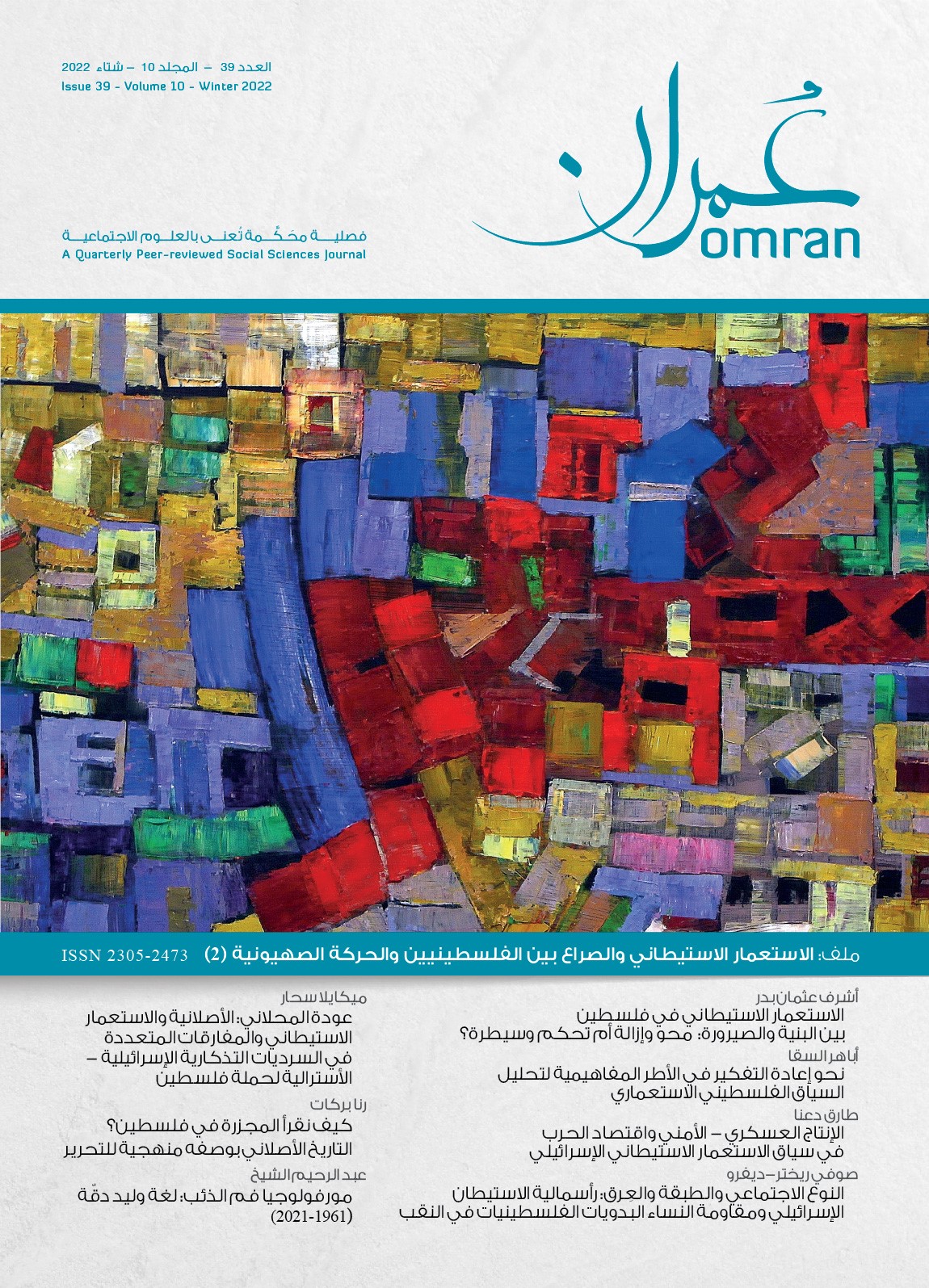
This article deconstructs the conceptual tools employed by the Palestinian national movement to diagnose the Palestinian condition. It traces the transformations of contemporary political and academic discourses, from labeling the Palestinian condition as ‘colonialism’ in the 1950s and then re-packaging it as ‘occupation’ in post-Oslo era. Consequently, the article explains the impact of the absence of academic-epistemic frameworks in the field of colonial studies on the political field. To achieve this goal, the article is divided into three parts: Part I reads through theoretical frameworks to qualify colonial structure/ the structure of colonialism; Part II analyzes the concept of ‘Total Violence,’ that has been used to analyze communal violence but never to analyze colonial state violence; while Part III examines the impact of merging academia into the political realm.
References
- "تعريف ومعنى استعمر"، معجم المعاني، شوهد في 2021/12/21، في: https://bit.ly/3552ubw
- Elia Zureik, The Palestinians in Israel: A Study in Internal Colonialism (London: Routledge & Kegan Paul, 1979); Edward Said, The Question of Palestine (New York: Times Books, 1979); Abdul–Wahhab Kayyali (ed.), Zionism, Imperialism, and Racism (London: Croom Helm, 1979); Fayez Sayegh, Zionist Colonialism in Palestine (Beirut: The Palestine Liberation Organization Research Center, 1965); Ibrahim Abu–Lughod & Baha Abu–Laban (eds.), Settler Regimes in Africa and the Arab World: The Illusion of Endurance (Wilmette, IL: Medina University Press International, عبد الوهاب المسيري، اليهودية والصهيونية وإسرائيل: دراسة في انتشار وانحسار الرؤية الصهيونية للواقع (بيروت: المؤسسة العربية للدراسات والنشر،.)1975
- Said, pp. 56–114.
- Hilal Jamil, "Imperialism and Settler–Colonialism in West Asia: Israel and the Arab Palestinian Struggle," Utafiti , vol. 1, no. 1 (1976), pp. 51–69.
- Nur Masalha, The Palestine Nakba: Decolonising History, Narrating the Subaltern, Reclaiming Memory (London/ New York: Zed Books, 2012), pp. 88–204; Nur Masalha, The Zionist Bible: Biblical Precedent, Colonialism and the Erasure of Memory (Durham: Acumen, 2013).
- مثل: Arie Bober (ed.), The Other Israel: The Radical Case Against Zionism (Garden City, NY: Anchor Books, 1972); Uri Davis, Israel, Utopia Incorporated: A Study of Class, State, and Corporate Kin Control (London: Zed Press, 1977).
- Maxime Rodinson, "Israël, fait colonial?" Les Temps modernes , vol. 22, no. 253 (1967), pp. 17–88.
- Maxime Rodinson, Peuple juif ou problème juif? (Paris: François Maspero, 1981).
- Shlomo Sand, Comment le peuple juif fut inventé: De la Bible au sionisme (Paris: Fayard, 2008); Anthony D. Smith, Chosen Peoples: Sacred Sources of National Identity (Oxford: Oxford University Press, 2003).
- Amnon Raz–Krakotzkin, Exil et souveraineté: Judaïsme, sionisme et pensée binationale (Paris: La Fabrique, 2007), pp. 20–21.
- Gilles Deleuze, Les Indiens de Palestine Paru dans le recueil Deux régimes de fous (Paris: Minuit, 1983), pp. 222–
- Julian Go, "The 'New' Sociology of Empire and Colonialism," Sociology Compass , vol. 3, no. 5 (2009), pp. 775– 788; Julian Go, "For a Postcolonial Sociology," Theory and Society , vol. 42, no. 1 (2013), pp. 25–55; Patrick Wolfe, Settler Colonialism and the Transformation of Anthropology: The Politics and Poetics of an Ethnograph Event (London: Cassell, 1999); Patrick Wolfe, "Settler Colonialism and the Elimination of the Native," Journal of Genocide Research , vol. 8, no. 4 (2006), pp. 387–409; Lorenzo Veracini, Settler Colonialism: A Theoretical Overview (New York: Palgrave Macmillan, 2010).
- Rashid Khalidi, The Hundred Years’ War on Palestine: A History of Settler Colonialism and Resistance, 1917–2017 (New York: Metropolitan Books, 2020); Maya Mikdashi, "What is Settler Colonialism? (For Leo Delano Ames Jr.)," American Indian Culture & Research Journal , vol. 37, no. 2 (2013), pp. 23–34.
- Ahmed Sa’di, "Colonialism and Surveillance," in: Kirstie Ball, Kevin Haggerty & David Lyon (eds.), Routledge Handbook of Surveillance Studies (London: Routledge, 2012), pp. 151–158; Magid Shihade, "Settler Colonialism and Conflict: The Israeli State and Its Palestinian Subjects," Settler Colonial Studies , vol. 2, no. 1 (2012), pp. 108–123; Nadera Shalhoub–Kevorkian, "Human Suffering in Colonial Contexts: Reflections from Palestine," Settler Colonial Studies , no. 4, no. 3 (2014), pp. 277–290; Raef Zreik, "When Does a Settler Become a Native? (With Apologies to Mamdani)," Constellations , vol. 23, no. 3 (2016), pp. 351–364; الفلسطينيون في إسرائيل: قراءات في التاريخ والسياسة والمجتمع، نديم روحانا وأريج صباغ – خوري (محرران) (حيفا: مدى الكرمل،.)2015
- Areej Sabbagh–Khoury, "Tracing Settler Colonialism: A Genealogy of a Paradigm in the Sociology of Knowledge Production in Israel," Politics & Society (2021), p. 15.
- Ibid., pp. 14–17.
- Sari Hanafi & Linda Taber, "Spatio–cide, réfugiés, crise de l’État–nation," Multitudes , vol. 4, no. 18 (2004), pp. 187–196.
- Saleh Abdeljawad, "La politique israélienne envers le peuple palestinien," Inprecor , no. 517 (Mai 2006), accessed on 10/1/2022, at: https://bit.ly/3JUy4sx
- Baruch Kimmerling, Politicide: Les guerres d’Ariel Sharon contre les Palestiniens (Paris: Éditions Agnès Viénot, 2003), p. 10.
- Elia Zureik, Israel’s Colonial Project in Palestine: Brutal Pursuit , Routledge Studies on the Arab–Israeli Conflict (Abingdon: Routledge, 2015).
- Elikia M’Bokolo, "Les pratiques de l’apartheid," in: Marc Ferro (dir.), Le livre noir du colonialisme (Paris: Robert Laffont, 2003), p. 469.
- Uri Davis, Apartheid Israel, Possibilities for the Struggle Within (London/ New York: Zed Books, 2003), p. 88.
- Rana Barakat, "Writing/ Righting Palestine Studies: Settler Colonialism, Indigenous Sovereignty and Resisting the Ghost(s) of History," Settler Colonial Studies , vol. 8, no. 3 (2017), pp. 349–363.
- أحمد أمارة ويارا هواري، "توظيف الأص نااية في النضال التحرّري الفلسطيني"، شبكة السياسات الفلسطينية، 2019/8/8، شوهد في 2021/8/20، في: https://bit.ly/34E4ffN
- Jean–Clément Martin, "Révolution française et ‘violence totale’," Inflexions , vol. 31, no. 1 (2016), pp. 73–79.
- Jean–Yves Guiomar, L’Invention de la guerre totale (Paris: Le Félin, 2004); Gabriella Gribaudi, Guerra Totale: Tra bombe alleate e violenze naziste: Napoli e il fronte meridionale, 1940–44 (Torino: Bollati Boringhieri, 2005); David Bell, The First Total War: Napoleon’s Europe and the Birth of Warfare as We Know it (New York/ Boston: Houghton Miflin Company, 2010).
- Jean–François Kervégan, Que faire de Carl Schmitt? (Paris: Gallimard, 2011); Giorgio Agamben, État d’exception: Homo Sacer II (Paris: Seuil, 2003).
- Martin, pp. 73–79.
- Isabelle Sommier, "Du ‘terrorisme’ comme violence totale?" Revue internationale des sciences sociales , vol. 4, no. 174 (2002), pp. 525–533.
- Georges Balandier, "La situation coloniale: Approche théorique," Cahiers internationaux de sociologie , vol. 11 (1951), pp. 44–79.
- Georges Labica, Théorie de la violence (Paris: Vrin; Napoli: La Citta del Sol, 2008).
- Walter Benjamin, "Critique de la violence," in: Rainer Rochlitz (dir.), Walter Benjamin: Critique philosophique de l’art (Paris: Gallimard, 2000 [1921]), p. 242.
- Étienne Balibar, "Lénine et Gandhi, Une rencontre manquée?" Alternative Roma , no. 6 (2005).
- Immanuel Wallerstein, L’universalisme européen: De la colonisation au droit d’ingérence (Paris: Demopolis, 2008), pp. 15–16.
- Hannah Arendt, Du mensonge à la violence: Essai de politique contemporaine , Guy Durand (trad.) (Paris: Calmann–Lévy, 1972), pp. 150–157.
- Israel Shanker & Shanker Mary (eds.), As Good as Golda: The Warmth and Wisdom of Israel’s Prime Minister (New York: McCall, 1970).
- Sylvie Mansour, "La génération de l’Intifada," Cultures & Conflits , vol. 2, no. 18 (1995), pp. 63–76.
- Nadera Shalhoub–Kevorkian, Militarization and Violence against Women in Conflict Zones: A Palestinian Case– study (Cambridge: Cambridge University Press, 2009).
- Abaher El–Sakka, "Representations of Violence and Non–violence in Palestinian Society," in: Chandra Sudhir (ed.), Violence–Nonviolence across Time: History, Religion and Cultures (London: Routledge, 2018), pp. 204–221.
- Salman Abu Sitta, The Palestinian Nakba, 1948: The Register of Depopulated Localities in Palestine (London: Palestinian Return Centre, 2000).
- نقلً عن هيئة شؤون الأسرى والمحررين التابعة لمنظمة التحرير الفلسطينية، ينظر: عبير العدوى، "شؤون الأسرى: إسرائيل اعتقلت مليون فلسطيني منذ 1967 "،، 2021/6/5، شوهد في 2021/11/4، في: مبتدا https://bit.ly/3Gg6OCq
- Abaher El–Sakka & Mehl Sandra, "La cérémonie de l’humiliation, le monde diplomatique," Le monde diplomatique , 25/9/2015, accessed on 1/10/2021, at: https://bit.ly/3ffsOkZ
- Neve Gordon, "From Colonisation to Separation: Exploring the Structure of Israel’s Occupation," in: Adi Ophir, Michal Givoni & Sari Hanafi (eds.), The Power of Inclusive Exclusion: Anatomy of Israeli Rule in the Occupied Palestinian Territories (New York: Zone Books, 2009), pp. 239–267.
- "Domination," in: André Akoun & Pierre Ansart (dir.), Dictionnaire de sociologie , Collection Le Robert (Paris: Seuil, 1999).
- Frantz Fanon, Les damnés de la terre (Paris: Gallimard, 1991), p. 84.
- Albert Memmi, Portrait du colonisé (Paris: Payot, 1973), pp. 115–124.
- Olivier Le Cour Grandmaison, Coloniser, exterminer, sur la guerre et l’état colonial (Paris: Fayard, 2005).
- Pierre Bourdieu, Langage et pouvoir symbolique (Paris: Seuil, 2001).
- Einat Bar–On Cohen, "Globalization of the War on Violence: Israeli Close–combat, Krav Maga and Sudden Alterations in Intensity," Social Anthropology , vol. 18, no. 3 (2010), p. 269.
- Michel Foucault, Dits et écrits (1954–1988) , tome II: 1970–1975 , Daniel Defert, François Ewald & Jacques Lagrange (dir.) (Paris: Gallimard, 1978), p. 386.
- ينظر بيان صدر عن مجموعة من الكتاب والمثقفين والأكاديميين المدافعين عن إسرائيل في فرنسا، في: "Israël, éternel exutoire des passions primaires," Le Monde , 3/9/2021, accessed on 10/1/2022, at: https://bit.ly/3teAHQ3; وكذلك بيان آخر أصدره باحثون فرنسيون وآخرون ناطقون بالفرنسية ردًا عليه اعتمادًا على مجموعة من المحاجات التي تؤكد على الطابع الاستعماري وفاعلية مفهومَي الأبارتهايد والتمييز، في: "Le terme ‘apartheid’ permet de penser dans la durée l’asymétrie des relations israélo–palestiniennes," Le Monde , 28/9/2021, accessed on 10/1/2022, at: https://bit.ly/3HOWG47 مقتطفات من البيان الأخير: "إن البيان السابق هو مقاربة تبسيطية، ومخادعة وخطيرة، ومغايرة للواقع، ويعتبر محاولة لتجريم الباحثين والمثقفين. ويرى الموقعون أن استخدام مقاربات 'كصراع مركب ومعقد' ينفي وضوح المقاربة التي يُنظر بها إلى إسرائيل، وبمنزلة محاولةٍ بائسة لاستخدام ذرائع مثل معاداة السامية ومعاداة اليهود للتأثير في الرأي العام الفرنسي، وضربٍ من الاستخفاف بالقانون الدولي الكامل الضامن لحق العودة للاجئين والمنفيين بالعودة إلى أراضيهم، والذي يؤكد أن الممارسات في إسرائيل نفسها وفي المناطق المحتلة عام 1967 هي ممارسات تمييزية [...] كذلك يرى الموقعون أن البيان هو تزييف للحالة وتقديمها بوصفها تعبيرًا عن صراع جماعاتي داخل فرنسا، ومحاولة لتقديم رؤية متساوية في الصراع ولطرفيه. كذلك يذكّر البيان بالممارسات التمييزية المعتمدة على التمييز العرقي والإثني، وعمليات تهميش حقوق الفلسطينيين الإنسانية والوطنية واستمرار الممارسات الاستعمارية والاستيطانية، وينتهي البيان برفض كل هذه المحاولات لمنع المواقف المناهضة للسياسات الاستعمارية في الحيز الفرنسي العام والرأي العام وفي البحث حول فلسطين فيها".
- Nadim N. Rouhana & Areej Sabbagh–Khoury, "Settler–colonial Citizenship: Conceptualizing the Relationship between Israel and its Palestinian Citizens," S ettler Colonial Studies , vol. 5, no. 3 (2015), p. 206.
- Pierre Bourdieu, La misère du monde: Essais (Paris: Points, 2015 [1993]), p. 1391.
- Pierre Bourdieu, "Le champ scientifique," Actes de la recherche en sciences sociales , vol. 2, no. 2–3 (1976), p. 91;. Pierre Bourdieu, Homo Academicus (Paris: Minuit, 1984) ينظر أيضًا:
- Pierre Bourdieu & Luc Boltanski, "La production de l’idéologie dominante," Actes de la recherche en sciences sociales , vol. 2, no. 2–3 (1976), pp. 4–73.
- Pierre Bourdieu, La distinction: Critique sociale du jugement (Paris: Minuit, 1979).
- Max Weber, Le savant et le politique , Julien Freund (trad.) (Paris: Plon, 1959).
- Pierre Bourdieu, "Pour un savoir engagé," in: Interventions (1961–2001): Sciences sociales et action politique (Marseille: Agone; Montréal: Comeau & Nadeau, 2002).
- Michel Foucault, Surveiller et punir: Naissance de la prison (Paris: Gallimard, 1975); Michel Foucault, L’Archéologie du savoir (Paris: Gallimard, 1969).
- Marcel Mauss, Essai sur le don: Forme et raison de l’échange dans les sociétés archaïques (Paris: PUF, 2007).
- Pierre Bourdieu, Sur l’État: Cours au Collège de France (1989–1992) (Paris: Seuil; Raisons d’agir, 2012), p. 291.
- Pierre Bourdieu, Méditations pascaliennes (Paris: Seuil, 1997), p. 209.
- Pierre Bourdieu, "Les modes de domination," Actes de la recherche en sciences sociales , vol. 2, no. 2–3 (1976), pp. 122–132; ينظر أيضًا: Pierre Bourdieu, La distinction (Paris: Minuit, 1984); Pierre Bourdieu, "Quelques propriétés des champs," in: Questions de sociologie (Paris: Minuit, 1989), pp. 113–120; Pierre Bourdieu, La noblesse d’Etat: Grandes écoles et esprit de corps (Paris: Minuit, 1992); Pierre Bourdieu & Loïc Wacquant, "La logique des champs," in: Réponses (Paris: Seuil, 1992), pp. 71–90; Pierre Bourdieu, "Esprits d’État: Genèse et structure du champ bureaucratique," Actes de la recherche en sciences sociales , vol. 96–97 (Mars 1993), pp 49–62; Pierre Bourdieu, "‘L’État et la construction du marché’ et ‘Le champ des pouvoirs locaux’," in: Les structures sociales de l’économie (Paris: Seuil, 2000), pp. 113–180; Bourdieu & Boltanski, pp. 4–73.
- عبد الرحيم الشيخ، "الهوية الثقافية الفلسطينية: المثال والتمثيل والتماثل" في: التجمعات الفلسطينية وتمثاتها ومستقبل القضية الفلسطينية، سلسلة وقائع المؤتمر السنوي الثاني (رام الله: المركز الفلسطيني لأبحاث السياسات والدراسات الاستراتيجية – مسارات، 2013)، ص.76
- أحمد الشقيري، أربعون عامًا في الحياة العربية والدولية (بيروت: دار النهار للنشر، 2005)، ص 688–601؛ ينظر أيضًا: خيرية قاسمية، أحمد الشقيري: زعيمًا فلسطينيًا ورائدًا عربيًا (الكويت: لجنة تخليد ذكرى المجاهد أحمد الشقيري،.)1987
- Claude Lévi–Strauss, La Pensée sauvage (Paris: Pocket, 1990 [Paris: Plon, 1962]), p. 222.
- Luc Boltanski, La souffrance à distance (Paris: Métailié, 1993), p. 16.
- "بعد حديث ميركل عن إقامة دولة فلسطينية.. رئيس وزراء إسرائيل: ستكون دولة 'إرهاب'"، سي إن إن بالعربية، 2021/10/10، شوهد في 2022/1/23، في: https://cnn.it/3H1sRNW
- أباهر السقا، "ورقة مفاهيمية مرجعية لمشروع دراسة عن الهويات الشبابية الفلسطينية: تراتبات متغيرة من تجمعات مغايرة لكل متجانس"، في: الشباب الفلسطيني: دراسات عن الهوية والمكان والمشاركة المجتمعية، جميل ه لاا (محرر) (بيرزيت: جامعة بيرزيت – مركز دراسات التنمية، 2017)، ص.22
- مالك بن نبي، وجهة العالم الإسامي (دمشق: دار الفكر، 1980)، ص.150
Citing articles in ACRPS journals (1)
- (2024) نحو إعادة النظر في الثقافة السياسية من خلال نظرية بيير بورديو السوسيولوجية: حالة فسلطين بعد الانقسام عام 2007. https://doi.org/10.31430/VPUM3756
Sources: Crossref Cited-by, and the references (notes and reference lists) of the Center's own articles
Downloads
Published
Article dates
Usage statistics
Issue
Section
License
Copyright (c) 2022 Omran for Social Sciences and Humanities

This work is licensed under a Creative Commons Attribution-NonCommercial 4.0 International License.
