Cities as Frameworks of Affiliation: Some Considerations
DOI:
https://doi.org/10.31430/gykh6459Keywords:
Ulrike Freitag, Urbanism, Heritage, Identity, Futurism, Saudi Arabia, Download ArticleAbstract
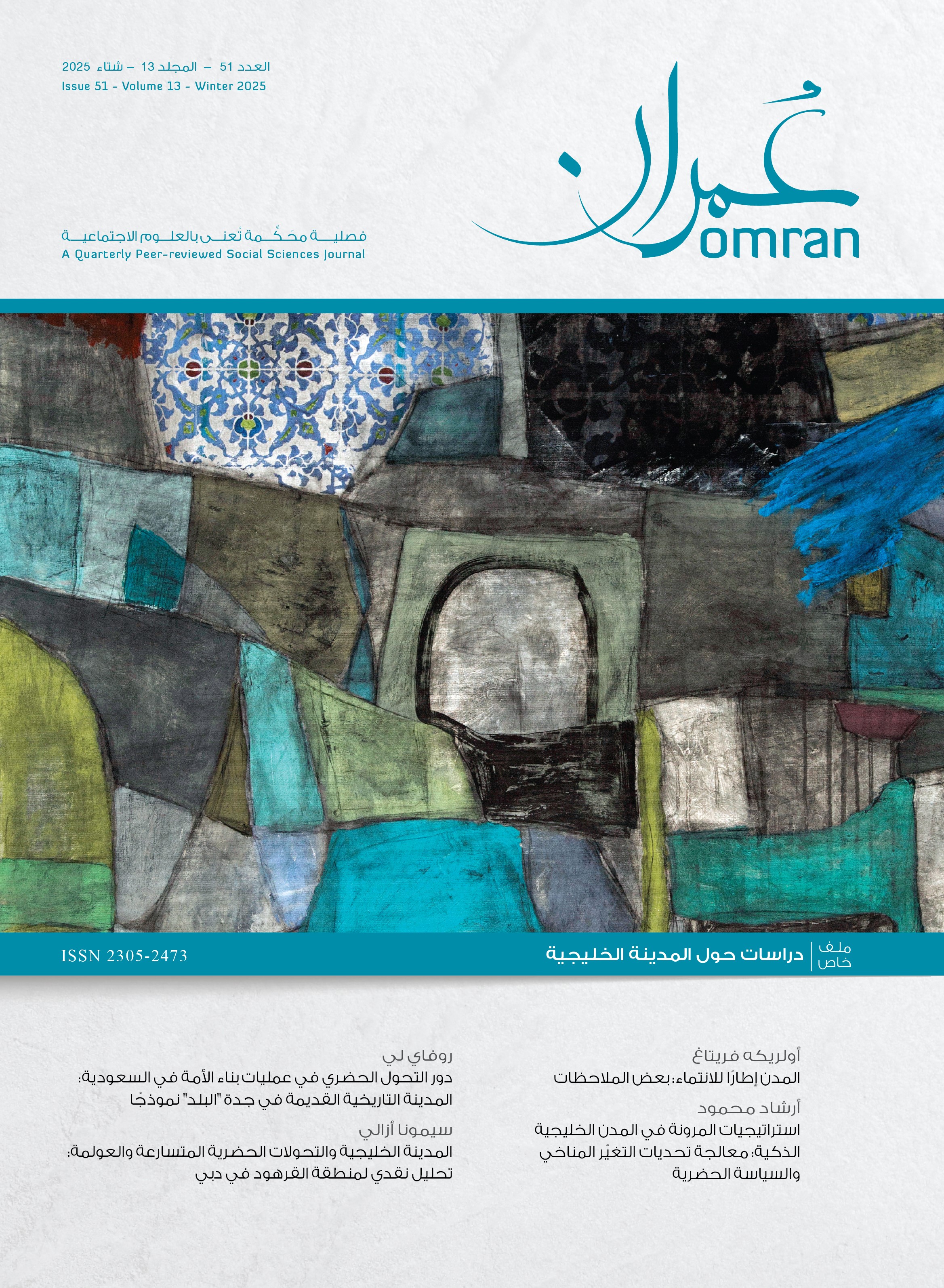
This article discusses the different ways in which people have created affective links with cities, what cities offer for people to create affective links and how they are being presented to them. Taking the old city of Jeddah, now bare of its original inhabitants, as its starting point, the paper argues that in spite of many transformations, references to the old city are still crucial for the urban identity of many people hailing from Jeddah. In contrast, many New urban developments appeal instead by their spectacular architecture, promises of a new lifestyle, or indeed of environmental benefits associated with different urban planning. In this, they follow and surpass the model of Dubai as a particular type of hypermodern capitalist development which serves as a model for cities in and far beyond the Peninsula.
References
- "The Remarkable Transformation of the Dammam–Dhahran–Al–Khobar Triangle," The Embassy of the Kingdom of Saudi Arabia Washington D.C., accessed on 27/12/2024, at: https://tinyurl.com/3nw9cx54; MEED editorial, "Jubail Industrial City," Middle East Economic Digest , 1/5/2017, accessed on 27/12/2024, at: https://tinyurl.com/5f54mwap ولتناول مفصل لمشروعات التطوير حتى منتصف ثمانينيات القرن العشرين، ينظر: Khalid M. Al–Ankary & El–Sayed El–Bushra, "Urban Growth and Urbanization in Saudi Arabia," in: Khalid Al–Ankary & El–Sayed El–Bushra (eds.), Urban and Rural Profiles in Saudi Arabia (Berlin/ Stuttgart: Borntraeger, 1989), pp. 3–13.
- Giga Projects , Public Investment Fund, accessed on 18/12/2024, at: (2) "NEOM: The New Future," https://tinyurl.com/yc85pktr; "New Murabba," Our Portfolio , Public Investment Fund, accessed on 18/12/2024, at: https://tinyurl.com/bdekb853
- John Irish, "SAGIA Opens Doors: The Kingdom is Hoping Its Six Economic Cities will Stimulate Growth and Encourage Social Change. But Much Work Remains to be Done," The Middle East , no. 378 (May 2007), pp. 38–39.
- يصح هذا الأمر خصوصًا في حالات جدة ومكة والمدينة؛ إذ كانت الأولى بوصفها ميناء ومنفذًا رئيسًا، والثانية والثالثة بوصفهما مقصدًا للحجاج المسلمين، مدنًا عالمية قديمة، إن لم تكن "كونية".
- من المستحيل تقريبًا الحصول على إحصائيات معدّلة موثوقة.
- ويرجع اقتراح التركيز على المجال الاجتماعي في مناقشة الأنماط المختلفة من المدن العالمية إلى: Ursula Rao, "Global Cities," in: Matthias Middell (ed.), The Routledge Handbook of Transregional Studies (London: Routledge, 2018), p. 189.
- ثمة مناقشة للبعد العابر للقارات الخاص بالتطوير الحضري المرتبط برأس المال القائم على النفط في الخليج، فاضلًا عن الأدبيات حول هذا الموضوع، في: Alex Boodrookas & Arang Keshavarzian, "The Forever Frontier of Urbanism: Historicizing Persian Gulf Cities," International Journal of Urban and regional Research , vol. 43, no. 1 (2019), pp. 14–29.
- استثناءً من هذه القاعدة، على الرغم من المعلومات القليلة حول الآراء الكلية لسكان هذه المدن، ينظر: Tarik M. Al–Soliman, "The Characteristics of Planned Communities and Their Impact on Urban Development and Residents Perceptions," in: Al–Ankary & El–Bushra (eds.), pp. 45–76; ولبعد الصراع الطبقي، ينظر، على سبيل المثال: Claudia Ghrawi, "Structural and Physical Violence in Saudi Arabian Oil Towns, 1953–56," in: Ulrike Freitag et al. (eds.), Urban Violence in the Middle East: Changing Cityscapes in the Transition from Empire to Nation State (New York/ Oxford: Berghahn, 2015), pp. 243–264.
- على سبيل المثال: Hend Aly, "Place Branding as a Political Act: Approaching Saudi Arabia’s NEOM beyond its Shiny Façade," in: Steffen Wippel (ed.), Branding the Middle East: Communication Strategies and Image Building from Qom to Casablanca (Berlin/ Boston: De Gruyter, 2023), pp. 543–559. ولمنظور نقدي لمرحلة أبكر بعض الشيء من التطوير الحضري النيوليبرالي في مكة، يُقدم في شكل تصوير فوتوغرافي، ينظر: Ahmed Mater, Desert of Pharan (Lars Müller Publishers 2016).
- عن جدة، ينظر، على سيبل المثال: عبد القدوس الأنصاري، موسوعة تاريخ مدينة جدة (جدة: مطابع الروضة، 1980)، ص 272–219؛ محمد يوسف حسن طرابلسي، جدة... حكاية مدينة، ط 2 (الرياض: كنوز المعرفة، 2008)، ص 509–309؛ عبد الرزاق سليمان أحمد أبو داود، جدة والجداويون في ذاكرة الإنسان، ط 2 (جدة: دار منصور الزامل، 2017)، ص 993–859؛ ولمزيد من المراجع ولمناقشة مفصلة عن هذه القضايا، ينظر: Ulrike Freitag, A History of Jeddah: The Gate to Mecca in the Nineteenth and Twentieth Centuries (Cambridge/ New York: Cambridge University Press, 2020), pp. 159–217. وتتشابه العديد من هذه العادات المحلية مع ما تطلق عليه مي يماني الهوية الحجازية، ينظر كتابها: Mai Yamani, Cradle of Islam: The Hijaz and the Quest for an Arabian Identity (London/ New York: I.B. Tauris, 2004).
- يبنى مفهوم الذاكرة الثقافية على الفهم الذي قدمه: Jan Assmann, Cultural Memory and Early Civilization: Writing, Remembrance, and Political Imagination (Cambridge/ New York: Cambridge University Press, 2011); Pierre Nora, "Between Memory and History: Les Lieux de Mémoire ," Representations , vol. 26, no. 7 (1989), pp. 7–24.
- بالنسبة إلى العلا، ينظر: عبد الله بن آدم صالح نصيف، العلا: دراسة في التراث الحضاري والاجتماعي (الرياض: [د. ن].، 1995)؛ وعن إيران، ينظر مثل: Reza Masoudi Nejad, "Urban Violence, the Muharram Processions and the Transformation of Iranian Urban Society: The Case of Dezful," in: Freitag et al. (eds.), pp. 91–110.
- يناقش هذا الأمر: Stefan Maneval, New Islamic Urbanism. The Architecture of Public and Private Space in Jeddah, Saudi Arabia (London: UCL Press, 2019), pp. 45–54.
- للمناقشة حول كيفية عمل هذا الأمر في مجال النساء (من النخبة)، ينظر: Soraya Altorki, Women in Saudi Arabia: Ideology and Behavior Among the Elite (New York: Columbia University Press, 1986), pp. 99–147.
- لمثال دال على نحو خاص، ينظر: Philippe Pétriat, Le négoce des Lieux Saints: Négociants hadramis de Djedda, 1850–1950 (Paris: Èditions de la Sorbonne, 2016), pp. 269–275.
- عن تطور الرياض، ينظر: Yasser Elsheshtawy, Riyadh: Transforming a Desert City (London/ New York: Routledge, 2022), pp. 118–136.
- Faisal Almubarak, "Urbanization, Urban Policy and City Form: Urban Development in Saudi Arabia," PhD Dissertation, University of Washington, Washington, 1992, p. 100.
- ثمة مناقشة لمشاريع التطوير المشابهة في مدينة العنيزة الأصغر حجمًا في: Soraya Altorki & Donald P. Cole, Arabian Oasis City (Austin: University of Texas Press, 1989), p. 236.
- زرت بنفسي مجمعات ثلاثة على الأقل.
- عبد الله بن ناصر السدحان، ماذا فعلت المدينة بسكانها؟ (بيروت: مؤسسة الانتشار العربي، 2012)، ص.126–115
- وعن رد الفعل على العمارات ذات الشقق السكنية، ينظر: Maneval, pp. 182–184.
- Mashary A. Al Naim, "Urban Transformation in the City of Riyadh: A study of Plural Urban Identity," Open House International , vol. 38, no. 4 (December 2013), p. 75.
- عن قضية الفقر الحساسة إلى حد ما، ينظر: Nora Derbal, Charity in Saudi Arabia (Cambridge: Cambridge University Press, 2022), pp. 152–162; كما يشار إليها عرضًا في: Altorki & Cole, p. 244.
- Pascal Menoret, Joyriding in Riyadh (Cambridge: Cambridge University Press, 2014), p. 207; Al Naim, p. 78.
- إضافة إلى الأدبيات المشار إليها سابقًا، ينظر على سبيل المثال: محمد بن عبد الله بن هاشم النمر، حارة البحر: موطن الآباء والأجداد (جدة: دار منصور الزامل، 2017)؛ ياسين بن ساعد بن عمرو الجحدلي، الرويس: ضاحية جدة، تاريخ وأحداث (جدة: أطوار، 2020)، ص 256–220،.366–335
- في ضوء السياسات الثقافية عمومًا في السعودية، ثمة توجه لدى أهل الحضر لادعاء أصول قبلية، وهو ما يزيد غالبًا في الواحات الصغيرة عنه في المدن الكبيرة. عن هذا الأمر، ينظر: Nadav Samin, Of Sand or Soil: Genealogy & Tribal Belonging in Saudi Arabia (Princeton/ Oxford: Princeton University Press, 2015), pp. 136-164.
- Faisal A. Al–Mubarak, "Oil, Urban Development and Planning in the Eastern Province of Saudi Arabia: The Case of the Arab American Oil Company in the 1930’s–1970’s," Journal of King Saud University: Architecture & Planning , vol. 11 (1999), pp. 31–51.
- Nelida Fuccaro, "Introduction. Histories of Oil and Urban Modernity in the Middle East," Comparative Studies of South Asia, Africa and the Middle East , vol. 33, no. 1 (2013), pp. 1–6.
- Almubarak, table 9.1, p. 336.
- James Gelvin, The Modern Middle East. A History (New York/ Oxford: Oxford University Press 2005), pp. 223–227.
- Atef Alshehri & Lulu Almana, "Khobar City Plan and the New Public Space in Saudi Arabia," The Journal of Public Space , vol. 6, no. 1 (2021), pp. 222–224.
- Nushin Atmaca, "Saudische Lebensgeschichten: Die, Generation des Aufbaus‘ im Spiegel zeitgenössischer Autobiographien," Master Thesis, Freie Universität Berlin, Berlin, 2012; تناقش أتماكا في أطروحتها: عبد الله بن عبد الكريم السعدون، عشت سعيدًا (بيروت: المركز الثقافي العربي، 2011)؛ وعبد الجليل السيف، مشوار في دروب الوطن (الرياض، [د. ن].، 2008)؛ وعبد الله حسين با سلامة، مواقف وذكرى عاشها الأستاذ الدكتور عبد الله حسين با سلامة (جدة: [د. ن].، 2002)؛ وعبد الرحمن طه بخش، أيام العمر (جدة: دار المرسى للنشر والتوزيع،.)2006
- معلومات شفوية، جدة، حي المحمدية. ليست لديّ معلومات عن مدى انتشار هذه اللجان، أو تفاصيل أكبر عن برامجها، وهو ما يمثل موضوع مشروع بحثي مثير للاهتمام.
- لمناقشة عن هذا الأمر مع التركيز على القرن الحادي والعشرين، ينظر: Derbal.
- NEOM, "THE LINE – New Wonders of the World," NEOM, YouTube, 25/7/2022, accessed on 18/12/2024, at: https://tinyurl.com/23skeuyj
- Dominik Hochwarth, "'The Line' Saudi Arabien: Das Märchen aus 1001 bleibt in den Schlagzeilen," Ingenieur , 23/9/2024, accessed on 18/12/2024, at: https://tinyurl.com/ycy6h94v
- Programs , Vision 2030, accessed on 18/12/2024, at: (39) "Public Investment Fund Program," https://tinyurl.com/23m44nvp; "Vision 2030 Projects," Projects , Vision 2030, accessed on 18/12/2024, at: https://tinyurl.com/3rts5rpa
- Crispin Thorold, "New Cities Rise from Saudi Desert," BBC News , 11/6/2008, accessed on 18/12/2024, at: https://tinyurl.com/3c6mkbkm; Lucy Sarret, "The Incredible 'New' City that will House Two Billion People and Cost £ 67bn to Build," Express , 15/6/2024, accessed on 7/11/2024, at: https://tinyurl.com/5n7893r6; سعيد عبد الله الفرحة الغامدي، "المدن الاقتصادية"، في: سعيد عبد الله الفرحة الغامدي، السعودية على أعتاب مرحلة جديدة (جدة: [د. ن].، 2017)، ص.88–86
- مقتبس من: Gökçe Günel, Spaceship in the Desert (Durham: Duke University Press, 2019), p. 35.
- إذا لم يذكر أي مصدر آخر، فما يأتي يعتمد على: Andrew Gardner, The Fragmentary City (Ithaca/ London: Cornell University Press, 2024), pp. 94–108.
- "Saudi Crown Prince on The Line," Al Arabiya English , YouTube, 27/6/2023, accessed on 18/12/2024, at: https://tinyurl.com/2p9c32um
- على سبيل المثال، ينظر: الغامدي، "ضرورة تطوير إدارة المدن الكبرى"، في: الغامدي، ص 78–76. وقد نشر المقال أولًا في الصحيفة اليومية المدينة في 21 أيلول/ سبتمبر 2010. ينظر أيضًا: المرجع نفسه، ص 124–122، 157–153، ومواضع أخرى.
- Saudi Crown Prince on the Line." 4(مقتبس من:وبينما يشير غاردنر إلى حداثيين مثل لو كوربيسييه Le Corbusier، أجادل بأننا يمكننا العودة أكثر إلى الوراء، من المفاهيم اليونانية القديمة (أفلاطون)، والمسيحية (أوغسطين)، والإسلامية (الفارابي) عن المدن المثالية لمحاولة بناء تلك المدن في مناطق مختلفة من العالم، بما في ذلك مدينة عنجر الأموية ومدينة السلام، وما يشبهها من جهود أوروبية بدءًا من القرن السادس عشر الميلادي.
- يأتي الاقتباس الأول من: "Communities," Roshn Group , accessed on 7/12/2024, at: https://tinyurl.com/yc3ehx4v أمّا الاقتباس الثاني، فمن: "Giga–Projects", Our Investments , Public Investment Fund, accessed on 10/12/2024, at: https://tinyurl.com/ycy32dwd
- من ضمن الأدبيات المتزايدة عن العلامة (الحضرية) في الخليج، أذكر فقط (وعلى نحو عشوائي تمامًا تقريبًا:) Steffen Wippel et al., Under Construction: Logics of Urbanism in the Gulf Region (Farnham/ Burlington: Routledge, 2014); Miriam Cooke, Tribal Modern (Berkeley/ Los Angeles: University of California Press, 2013), pp. 77–98; Wippel (ed.); خاصةً فصل: Hend Aly, "Place Branding as a Political Act: Approaching Saudi Arabia’s NEOM beyond its Shiny Façade," in: Wippel (ed.), pp. 543–559.
- Davide Ponzini, "Large Scale Development Projects and Star Architecture in the Absence of Democratic Politics: The Case of Abu Dhabi, UAE," Cities , vol. 28 (2011), p. 258.
- أستعير عبارة "قوة الصورة الحدسية" من: Khaled Adham, "The Power of the Speculative Image: In Branding Desert Developments and Selling Cairo’s Urban Future," in: Wippel, pp. 479–496.
- Muhammed Bin Salman City, accessed on 8/10/2024, at: https://tinyurl.com/37th7nkj; Qiddiya , accessed on 8/10/2024, at: https://tinyurl.com/2k45vewp
- على سبيل المثال: Andrew Hammond, "Saudi Youth Bored in Model Islamic State: Blogger," Reuters , 9/8/2007, accessed on 8/10/2024, at: https://tinyurl.com/2zrjfjcv
- Ponzini, p. 258.
- Neha Vora, Impossible Citizens: Dubai’s Indian Diaspora (New York: Duke University Press, 2020).
- Elsheshtawy, pp. 7–8.
- Ibid., pp. 56–60.
- Herman Pienaar, "Jeddah. City Profile" Ministry of Municipal and Rural Affairs, UNHabitat (Riyadh: 2019), p. 102, accessed on 5/1/2025, at: https://tinyurl.com/534nsvah
- Elsheshtawy, p. 270.
Downloads
Published
Article dates
Usage statistics
Issue
Section
License
Copyright (c) 2025 Omran for Social Sciences and Humanities

This work is licensed under a Creative Commons Attribution-NonCommercial 4.0 International License.
