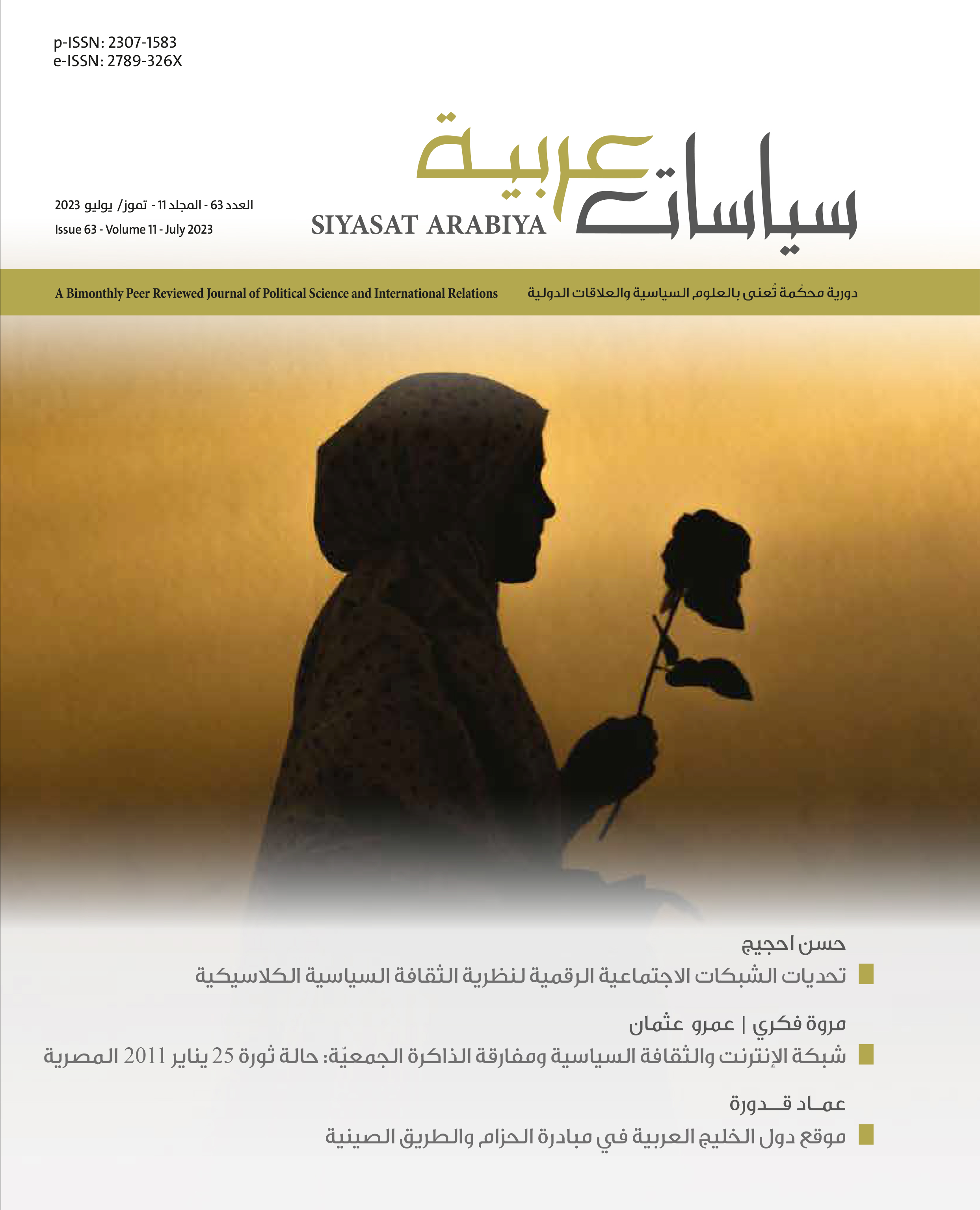
تحديات الشبكات الاجتماعية الرقمية لنظرية الثقافة السياسية الكلاسيكية
DOI:
https://doi.org/10.31430/xnvh9747الكلمات المفتاحية:
الثقافة السياسية، وسائط التواصل الاجتماعي، الحزب الرقمي، خوارزمية التفضيل السياسي، الفجوة الرقميةالملخص
تؤدي تكنولوجيا الاتصال الرقمية دورًًا مركزيًًا في توسيع نطاق المشاركة السياسية، من خلال السماح لمعظم الفئات الاجتماعية بالتعبير عن آرائه ومواقفه من القضايا، ومن ثم المساهمة في تشكيل الثقافة السياسية المحلية أو الوطنية. ويبدو أن العناصر السياسية كلها ذات الصلة بالثقافة السياسية (التمثيل، والوساطة، والإعلام، والأحزاب، وغيرها)، تأثرت كثيرًًا بانبثاق الشبكات الاجتماعية الرقمية وعرفت تغييرات عميقة أضحت تمثل تحديات حقيقية لنظرية الثقافة السياسية الكلاسيكية. تهدف هذه الدراسة إلى استكشاف خصائص الثقافة السياسية في العصر الرقمي ومناقشة تحديات الشبكات الاجتماعية الرقمية لنظرية الثقافة السياسية الكلاسيكية.المراجع
- نستخدم في هذه الدراسة مصطلحات الشبكات الاجتماعية الرقمية وشبكات التواصل الاجتماعية ووسائط التواصل الاجتماعي على نحو مترادف.
- R. Reiffel, Révolution numérique, révolution culturelle (Paris: Gallimard, 2014), p. 11; Esteban Ortiz-Ospina, "The Rise of Social Media: Social Media Sites are Used by more than Two-Thirds of Internet Users. How has Social Media Grown Over Time?" Our World in Data , 18/9/2019, accessed on 9/5/2023, at: https://bit.ly/4bgn7Pw
- R. Bond & S. Messing, "Quantifying Social Media's Political Space: Estimating Ideology from Publicly Revealed Preferences on Facebook," American Political Science Review , vol. 109, no. 1 (2015), pp. 62-78; J.E. Carlisle & R.C. Patton, "Is Social Media Changing How We Understand Political Engagement? An Analysis of Facebook and the 2008 Presidential Election," Political Research Quarterly , vol. 66, no. 4 (2013), pp. 883 - 895.
- K. Daesik, J.C. Chung& E. Kihong, "Measuring Online Public Opinion for Decision Making: Application of Deep Learning on Political Context," Sustainability , vol. 14, no. 7 (2022).
- G.A. Almond & S. Verba, The Civic Culture: Political Attitudes and Democracy in Fire Nations (Princeton, N.J.: Princeton University Press, 1963), p. 4.
- N. Lechner, "Por qué la política ya no es lo que fue?" Leviatán: Revista de hechos e ideas , no. 63 (May 1996), pp. 63 - 74. نقلًا عن: X. Barandiarán, A. Unceta & S. Peña, "Political Communication in Times of a New Political Culture," Icono14 , vol. 18, no. 1 (June 2019), pp. 256 - 281.
- V.O. Key, Jr., Public Opinion and American Democracy (New York: Knopf, 1961), p. 14.
- D.J. Elkins & R.E.B. Simeon, "A Cause in Search of its Effects, or What Does Political Culture Explain?" Comparative Politics , vol. 11, no. 2 (1979), p. 127.
- M.A. Seligson, "The Renaissance of Political Culture or the Renaissance of the Ecological Fallacy?" Comparative Politics , vol. 34, no. 3 (2002), pp. 273 - 292.
- C.F. Voinea & M. Neumann, "Political Culture: A Theory in Search for Methodology: An Editorial," Quality & Quantity , vol. 54 (2020), pp. 335 - 360.
- S. Verba, "Comparative Political Culture," in: L. Pye & S.Verba (eds.), Political Culture and Political Development (Princeton N.J.: Princeton, 1965), p. 513.
- Elkins & Simeon.
- A. Cohen, The Symbolic Construction of Community (New York: Ellis Horwood Limited, 1985), p. 18.
- Elkins & Simeon, p. 124.
- B. Swedlow, "Political Culture," in: G. Claeys (ed.), Encyclopedia of Modern Political Thought , (Thousand Oaks, CA: Sage, 2013), p. 624.
- J. Murphy, C.A. Hill & E. Dean, "Social Media, Sociality and Survey Research," in: C.A. Hill, E. Dean & J. Murphy (eds.), Social Media: Sociality and Survey Research (Hoboken, New Jersey: Wiley, 2013), p. 3.
- A.M. Kaplan M. & Haenlein, "Users of the World, Unite! The Challenges and Opportunities of Social Media," Business Horizons , vol. 53, no. 1 (2010), p. 61.
- Murphy , Hill & Dean.
- Michael Hauben, "What the Net Means to Me," CAN , vol. 6, no. 1 (Spring 1994).
- Jurgen Habermas, "Political Communication in Media Society: Does Democracy Still Enjoy an Epistemic Dimension? The Impact of Normative Theory on Empirical Research," Communication Theory , no. 16 (2006), pp.
- M. Castells, Networks of Outrage and Hope: Social Movements in the Internet Age (Cambridge, UK: Polity Press, 2012).
- W.L. Bennett& A. Segerberg, The Logic of Connective Action: Digital Media and the Personalization of Contentious Politics (New York: Cambridge University Press, 2013).
- J. Katz, "Birth of a Digital Nation," Wired , 1/4/1997, p. 49.
- في البايولوجيا، تشير "الكائنات الحية النموذجية" إلى الأنواع (مثل الفئران المنزلية، وذبابة الفاكهة سوداء البطن، وبكتيريا الإشريكية القولونية) التي يجري عليها العلماء دراساتهم التجريبية من أجل تسليط الضوء على العمليات البيولوجية الرئيسة، مثل الخصائص الأساسية للخلايا الحية.
- Z. Tufekci, "Big Questions for Social Media Big Data: Representativeness, Validity and other Methodological Pitfalls," ICWSM , no. 14, (2014), pp. 505 - 514.
- H. Margetts, "Cyber Parties," in: R.S. Katz & W.J. Crotty (eds.), Handbook of Party Politics (Thousand Oaks, CA: Sage, 2006), pp. 531 - 532.
- نعني ب "الديمقراطية الرقمية " Digital Democracy ممارسة العمليات الديمقراطية والمشاركة الناشطة في تدبير الشأن العام على الصعيدين المحليي والوطني باستخدام تكنولوجيا المعلومات والاتصالات الرقمية، ولا سيما الشبكات الاجتماعية الرقمية.
- C. Burdeau, "Digital Parties' Disrupt Europe's Traditional Politics," Courtehouse News Service , 20/2/2019, accessed on 5/10/2022, at: https://bit.ly/3OoJokF
- P. Norris, Digital Divide: Civic Engagement, Information Poverty, and the Internet Worldwide (New York: Cambridge University Press, 2001), p. 10.
- M. Vergeer, L. Hermans & S. Sams, "Online Social Networks and Micro-Blogging in political Campaigning: The exploration of a New Campaign Tool and a New Campaign Style," Party Politics , vol. 19, no. 3 (2011), pp. 477 - 501.
- N.A. Jackson & D.G. Lilleker, "Building an Architecture of Participation? Political Parties and Web 2.0 in Britain," Journal of Information Technology and Politics , vol. 6, no. 3 - 4 (2009), p. 223.
- Y. Benkler, The Wealth of Networks: How Social Production Transforms Markets and Freedom (New Haven, CT: Yale University Press, 2006).
- D. Owen, "The Campaign and the Media," in: M.J. Box-Steffensmeier & S.E. Schier (eds.), The American Elections of 2008 (Lanham: Rowman and Littlefield Publishers, 2009), p. 9.
- V. Polonski, "Impact of Social Media on the Outcome of the EU Referendum," EU Referendum Analysis (2016), accessed on 9/5/2023, at: https://bit.ly/3SDbwTt
- D.L. Altheide& R.P. Snow, Media logic (Beverly Hills, CA: Sage, 1979).
- U. Klinger & J. Svensson, "The Emergence of Network Media Logic in Political Communication: A Theoretical Approach," New Media & Society , vol. 17, no. 8 (2015), pp. 1241 - 1257.
- M.E. McCombs & D.L. Shaw, "The Agenda-Setting Function of Mass Media," Public Opinion Quarterly , vol. 36, no. 2 (1972), pp. 176 - 187.
- R.M. Entman, "Framing: Toward Clarification of a Fractured Paradigm," Journal of Communication , vol. 43, no. 4 (1993), pp. 51 - 58.
- D.C. Hallin & P. Mancini, Comparing Media Systems: Three Models of Media and Politics (Cambridge, UK: Cambridge University Press, 2004).
- G. Tuchman, Making News: A Study of Construction of Reality (New York: Free Press, 1978).
- J. Strömbäck, "Four Phases of Mediatization: An Analysis of the Mediatization of Politics," The International Journal of Press/ Politics , vol. 13, no. 3 (2008), pp. 228 - 246.
- D. Gillmor, We the Media: Grassroots Journalism by the People, for the People (Sebastopol, CA: O'Reilly Media, 2004).
- R. Williams, Television: Technology and Cultural Form , 3 rd ed. (London/ New York: Routledge, 2003), p. 5.
- A. Feenberg, "Looking Backward, Looking Forward: Reflections on the 20th Century," Presented at the The 20th Century-Dreams and Realities, Hitotsubashi University Conference (December 2000).
- في عام 1995، تنبأ بذلك عالم التكنولوجيا في معهد ماساتشوستس للتكنولوجيا نيكولاس نيغروبونتي: N. Negroponte, Being Digital (New York: Vintage Books, 1995), p. 153.
- T.R. Dillahunt, C.A. Brooks& S. Gulati, "Detecting and Visualizing Filter Bubbles in Google and Bing," Proceedings of the Thirty-Third Annual ACM Conference: Extended Abstracts on Human Factors in Computing Systems (1851-1856) (New York: Association for Computing Machinery, 2015).
- N.E. Friedkin, A Structural Theory of Social Influence (New York: Cambridge University Press, 1998).
- E. Rogers, Diffusion of Innovations (New York: Free Press 1995).
- M. McPherson, L. Smith-Lovin & J. Cook, "Birds of A Feather: Homophily in Social Networks," Annual Review of Sociology , vol. 27 (2001), pp. 415 - 444.
- W.P. Davison, "The Public Opinion Process," Public Opinion Quarterly , vol. 22, no. 2 (1958), pp. 91-106.
- E. Noelle-Newmann, "The Spiral of Silence: A Theory of Public Opinion," Journal of Communication , vol. 24, no. 2 (1974), pp. 43-51; Elisabeth Noelle-Neumann, The Spiral of Silence: Public Opinion, Our Social Skin , 2 nd ed. (Chicago: University of Chicago Press, 1993).
- Elisabeth Noelle-Neumann, "Return to the Concept of Powerful Mass Media," Studies of Broadcasting , no. 9 (1973), pp. 67 - 112.
- C.R. Sunstein, #Republic: Divided Democracy in the Age of Social Media (New Jersey: Princeton University Press, 2017), p. 1.
- 61.5 60 في المئة من مستخدمي الفيسبوك هم شباب، تراوح أعمارهم بين 18 و 35 عامًا. كما أن 62 في المئة في المستوى الجامعي، و 30 في المئة لهم مستوى ثانوي. ينظر: " Empowering People with Data: Insights and Facts Across 170 Industries and 150+ Countries," Statista , accessed on 9/5/2023, at: https://bit.ly/47ThK6g
- N. Zillien & E. Haggattai, "Digital Distinctions: Status-Specific Types of Internet Usage," Social Science Quarterly , no. 90 (2009), pp. 270 - 291.
24إجمالي الاستشهادات
1من دوريات المركز
23من مصادر خارجية
مقالات مُستشهِدة من دوريات المركز العربي (1)
مقالات مُستشهِدة من مصادر خارجية (23)
- Haneen A. Al-khawaja, Abdul Razzak Alshehadeh, Iqbal Jebril, Faisal Asad Aburub, Mohannad Mohammad Ebbini (2026) Generative Artificial Intelligence-Driven Innovation: Strategies and Ethical Frameworks for Responsible AI. https://doi.org/10.1007/978-3-032-13149-2_30
- Manaf Al-Okaily (2026) Implementation of generative AI tools in accounting education context. https://doi.org/10.1108/JARHE-08-2024-0422
- Fatma Saif Al-Busaidi, Wisal Al Balushi, Zahran Al-Salti, Aqdas Malik, Fadi Shehab Shiyyab, Manaf Al-Okaily (2026) RETRACTED: Evaluating the students’ academic performance in the higher education sector through using social media platforms. https://doi.org/10.1108/GKMC-04-2024-0205
- Mohammad M. Taamneh, Manaf Al-Okaily, Belal Barhem, Abdallah M. Taamneh, Ziyad Saleh Alomari (2026) RETRACTED: Examining the influence of gender equality in HRMP on job performance: the mediating role of job satisfaction. https://doi.org/10.1108/GKMC-11-2023-0457
- Manaf Al-Okaily, Ali Tarhini, Ahmad Albloush, Malek Alharafsheh (2026) RETRACTED: Impact of organizational politics on organizational performance: the mediating role of individual performance. https://doi.org/10.1108/GKMC-10-2023-0392
- Manaf Al-Okaily (2025) Artificial intelligence and its applications in the context of accounting and disclosure. https://doi.org/10.1108/JFRA-04-2024-0209
- Manaf Al-Okaily (2025) Attitudes toward the adoption of accounting analytics technology in the digital transformation landscape. https://doi.org/10.1108/JAOC-04-2024-0127
- Manaf Al-Okaily (2025) ChatGPT as an educational resource for accounting students: expanding the classical TAM model. https://doi.org/10.1007/s10639-025-13391-1
- Ashraf Bany Mohammed, Manaf Al-Okaily, Dhia Qasim, Shafique Ur Rehman, Latifa Abdalla (2025) Digital activism and public opinion: understanding the role of social media during the Gaza Conflict. https://doi.org/10.1108/JIMA-03-2024-0101
- Manaf Al-Okaily, Anas Ali Al-Qudah, Abeer F. Alkhwaldi, Ayman Wael Alkhatib, Aws Al-Okaily, Bilal Abu-Salih (2025) Exploring FinTech trends in Jordan: insights from the post-COVID-19 era. https://doi.org/10.1108/FS-09-2022-0097
- Nour Qatawneh, Aws Al-Okaily, Manaf Al-Okaily, Shafique Ur Rehman (2025) Exploring the antecedent factors of continuous intention to use mobile money: insights from emerging markets. https://doi.org/10.1108/DPRG-04-2024-0080
- Manaf Al-Okaily, Leena Al-Quran, Suaad Jassem, Faisal AlReshaid (2025) FinTech innovation in the digitalization era: a bibliometric literature review. https://doi.org/10.1108/GKMC-06-2024-0321
- Haneen A. Al-khawaja, Abdul Razzak Alshehadeh, Asad Aburub Faisal, Ali Matar, Osaid Hasan Althnaibat (2025) Solutions for Insider Trading and Regulatory Challenges in Financial Governance. https://doi.org/10.56294/dm2025680
- Manaf Al-Okaily (2025) The antecedents and outcomes of accounting information systems usage: the indirect effect of IT knowledge. https://doi.org/10.1007/s10115-024-02306-0
- Anas Ali Al-Qudah, Manaf Al-Okaily, Miklesh Prasad Prasad Yadav (2025) The growth of FinTech and blockchain technology in developing countries: UAE’s evidence. https://doi.org/10.1108/IJAIM-02-2024-0065
- Manaf Al-Okaily (2025) The influence of digital disclosure language adoption on decrease financial information asymmetry and increase its quality. https://doi.org/10.1108/IDD-03-2024-0045
- Ziyad Saleh Alomari, Manaf Al-Okaily, Yousef Alsafadi, Alaa Mansour Odaibat (2025) The nexus between green human resource management practices and sustainable performance: the moderating role of green supply chain management. https://doi.org/10.1007/s43621-025-01273-y
- Manaf Al-Okaily, Fadi Shehab Shiyyab, Nesreen A. Salim, Amer Al-Rahayfeh (2025) The role of AI-enabled health systems in the Jordanian context: the case of digital contact tracing apps. https://doi.org/10.1108/JHOM-06-2024-0252
- Aws Al-Okaily, Manaf Al-Okaily, Ai Ping Teoh (2025) What determines data analytics systems performance in financial engineering? A user perspective. https://doi.org/10.1108/VJIKMS-02-2023-0051
- Hanan Al-Ghazo, Manaf Al-Okaily, Aws Al-Okaily, Arwa Al-Anber, Hadeel B. Heilat, Mohammad A. Alissa, Ali A. Alomar, Iman A. Basheti (2024) RETRACTED: Factors affecting telemedicine services adoption in the healthcare sector. https://doi.org/10.1108/GKMC-03-2024-0184
- Nour Qatawneh, Manaf Al-Okaily, Raghed Alkhasawneh, Abraham Althonayan, Abeer Tarawneh (2024) RETRACTED: The mediating role of e-trust and e-satisfaction in the relationship between e-service quality and e-loyalty toward e-government services. https://doi.org/10.1108/GKMC-07-2023-0263
- Shafique Ur Rehman, Nour Qatawneh, Aws Al-Okaily, Manaf Al-Okaily, Fadi Shehab Shiyyab, Malek Alsharairi, Ra’ed Masa’deh, Ashraf Bani Mohmmad (2024) RETRACTED: The utility of smart government services apps solutions in the post-pandemic era. https://doi.org/10.1108/GKMC-03-2024-0185
- Yousef Alsafadi, Manaf Al-Okaily, Aws Al-Okaily, Fadi Shehab Shiyyab (2024) The effects of high-performance work systems on the creativity of a faculty member: a moderated mediated analysis. https://doi.org/10.1108/GKMC-03-2024-0158
المصادر: Crossref Cited-by، ومراجع مقالات دوريات المركز (الهوامش وقوائم المراجع)
التنزيلات
منشور
2023-07-01
تواريخ المقالة
الاستلام: فبراير 1, 2023 التعديل: أبريل 10, 2023 القبول: يوليو 1, 2023
إحصاءات الاستخدام
51 مشاهدة 61 تنزيل
إصدار
القسم
دراسات
الرخصة
الحقوق الفكرية (c) 2023 Hassane Hjij (Author)

هذا العمل مرخص بموجب Creative Commons Attribution-NonCommercial 4.0 International License.
