Writing the Televised Revolution Facts: Visibility but no Insight in Reading the Arab Revolutions Facts
DOI:
https://doi.org/10.12816/0025453Keywords:
Arab Revolutions, Revolution FactsAbstract
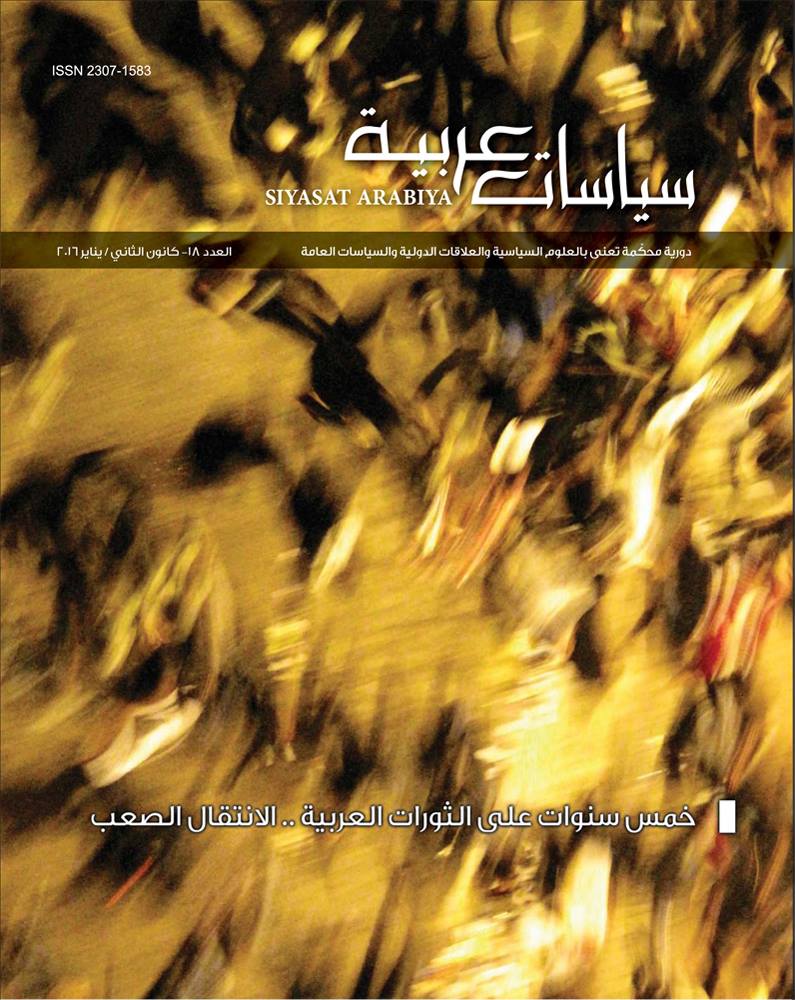
Five years prior, the Arab Center for Research and Policy Studies brought together a group of young activists whose dedication and courage gave ris eto what would become the Arab Spring. The group of activists, gathered again in Doha on January 15-16, 2016, appeared to have been completely changed by the intervening months. With the initial ecstasy of the fall of tyrants across the region now faded, the young revolutionary activists had matured ideologically and politically. It was a maturity born of suffering and setbacks, and revealed a realism towards the coming battle for freedom. One unchanging fact was their continued hope for freedom, and their belief in its possibility.References
- Council on Foreign Relations, The New Arab Revolt: What Happened, What It Means, and What Comes Next (New York: Council on Foreign Relations/Foreign Affairs, 2011).
- Marc Lynch & Susan Glasser & Blake Hounshell (eds), Revolution in the Arab World: Tunisia, Egypt, And the Unmaking of an Era (Washington, DC: Foreign Policy eBook, 2011).
- People Power , MERIP 258, Vol 41, (spring 2011).
- Wael Ghonim, Revolution 2.0: The power of the people is greater than the people in power (New York: Hougthon Milfflin Harcourt, 2012).
- Mehran Kamrava (ed.,), Beyond the Arab Spring: The evolving ruling bargain in the Middle East (Oxford: Oxford University Press, 2014).
- Rex Brynen (ed.,), Beyond the Arab Spring: Authoritarianism and Democratization in the Arab World (Boulder, CO: Lynne Rienner, 2012).
- Marc Lynch, The Arab Uprising: The Unfinished Revolutions of the New Middle East (New York: Public Affairs, 2012).
- لمناقشة أوسع لكتاب لينش، انظر: عبد الوهاب الأفندي، "تفاصيل 'مؤامرة أوباما' على الربيع العربي (بحسب مارك لينش")، 10 شباط/فبراير 2014، في: http://www.alquds.co.uk/?p=132361.
- Jason Brownlee, et. al. , The Arab Spring: Pathways of Repression and Reform (Oxford: Oxford University Press, 2015).
- انظر: غريغوري غوس، "ملوكٌ لجميع الفصول: كيف اجتازت الأنظمة الملكية في الشرق الأوسط عاصفة الربيع العربي"، مركز بروكنجز، 24 أيلول/سبتمبر 2013، في: http://www.brookings.edu/ar/research/papers/2013/09/24-resilience-arab- monarchies-gause. انظر أيضًا: مارينا أوتاوي ومروان المعشر، "الأنظمة الملكية: فرصة للإصلاح لمّا تتحقق بعد"، مؤسسة كارنيغي للسلام الدولي، كانون الأول/ديسمبر 2011، في: http://carnegieendowment.org/files/monarchiesAR.full_and_ final17-12-2011.pdf وانظر أيضًا: Zoltan Barany, “The Arab Spring in the Kingdoms”, Arab Centre for Research and Policy Studies , (Sept 2012).
- Eva Bellin, “The Robustness of Authoritarianism in the Middle East: Exceptionalism in Comparative Perspective”, Comparative Politics , Vol. 36, No. 2 (Jan., 2004), pp. 139 - 157.
- Eva Bellin, "The Robustness of Authoritarianism Reconsidered: Lessons of the Arab Spring", Comparative Politics 44. 2 (2012), pp. 127 - 149.
- Bahgat Korany & Rabab El-Mahdi (eds.), Arab Spring in Egypt. Revolution and Beyond (Cairo/ New York: The American University in Cairo Press, 2012).
- انظر الفصل السابع من كتاب دان تشيرغي وزملائه: Dan Tschirgi et. al. (eds.) , Egypt's Tahrir Revolution (Boulder, CO: Lynne Rienner, 2013).
- Olivier Roy, “The Transformation of the Arab World”, Journal of Democracy, 23: 3, (July 2012), pp. 5-18; Asef Bayat, “The Arab Spring and its Surprises”, Development and Change , 44 (3), pp. 587–601; Asef Bayat, (ed.), Post-Islamism: The Many Faces of Political Islam (Oxford: Oxford University Press, 2013).
- John R. Bradley, After the Arab Spring: How Islamists Hijacked The Middle East Revolts (London: Palgrave Macmillan, 2012).
- Shadi Hamid, Temptations of Power: Islamists and Illiberal Democracy in a New Middle East (Oxfrod: Oxford University Press, 2014).
- John L. Esposito & Tamara Sonn & John O. Voll, Islam and Democracy after the Arab Spring (Oxford: Oxford University Press, 2015).
- مجموعة من المؤلفين، الإسلاميون ونظام الحكم الديمقراطي: اتجاهات وتجارب (الدوحة/ بيروت: المركز العربي للأبحاث ودراسة السياسات،.)2013
- Abdelwahab El-Affendi, “A Trans-Islamic Revolution?” Critical Muslim, 1: 1 (2012), pp. 61 - 84.
- Sectarian Gulf: Bahrain, Saudi Arabia, and the Arab Spring That Wasn't (Stanford: Stanford University Press, 2013).
- Robert Mason, The International Politics of the Arab Spring: Popular Unrest and Foreign Policy (London: Palgrave Macmillan, 2014).
- Graham E. Fuller, Turkey and the Arab Spring: Leadership in the Middle East (Lexington, KY: Bozorg Press, 2014).
- Paul Danahar, The New Middle East: The World After the Arab Spring (New York: Bloomsbury, 2013).
- Jason Brownlee et. al. , The Arab Spring: Pathways of Repression and Reform (Oxford: Oxford University Press, 2015).
- Donatella della Porta, Mobilizing for Democracy: Comparing 1989 and 2011 (Oxford: Oxford University Press, 2015); انظر كذلك: Abdelwahab El-Affendi, “Constituting Liberty, Healing the Nation: revolutionary identity creation in the Arab world's delayed 1989”, Third World Quarterly, Vol 32, Issue 7, (August 2011), pp. 1255 - 1271.
- Democratization , Vol. 22: No. 2 (2015): 1131 - 1153.
- “ Arab Uprisings: New Opportunities for Political Science”, Middle East Political Science , (June 12, 2012), at: http://pomeps.org/2012/06/12/arab-uprisings-new-opportunities-for- political-science/
- Amel Ahmed & Giovanni Capoccia, “The Study of Democratization and the Arab Spring”, Middle East Law and Governance , 6, (2014), pp. 1 - 31.
- Magid Shihade, “On the Difficulty in Predicting and Understanding the Arab Spring: Orientalism, Euro-Centrism, and Modernity”, International Journal of Peace Studies , 17: 2, (Winter 2012), pp. 57 - 69.
Downloads
Published
2016-01-01
Usage statistics
34 views 40 downloads
Issue
Section
Book Reviews
License
Copyright (c) 2015 Abdelwahab El Affendi (Author)

This work is licensed under a Creative Commons Attribution-NonCommercial 4.0 International License.
