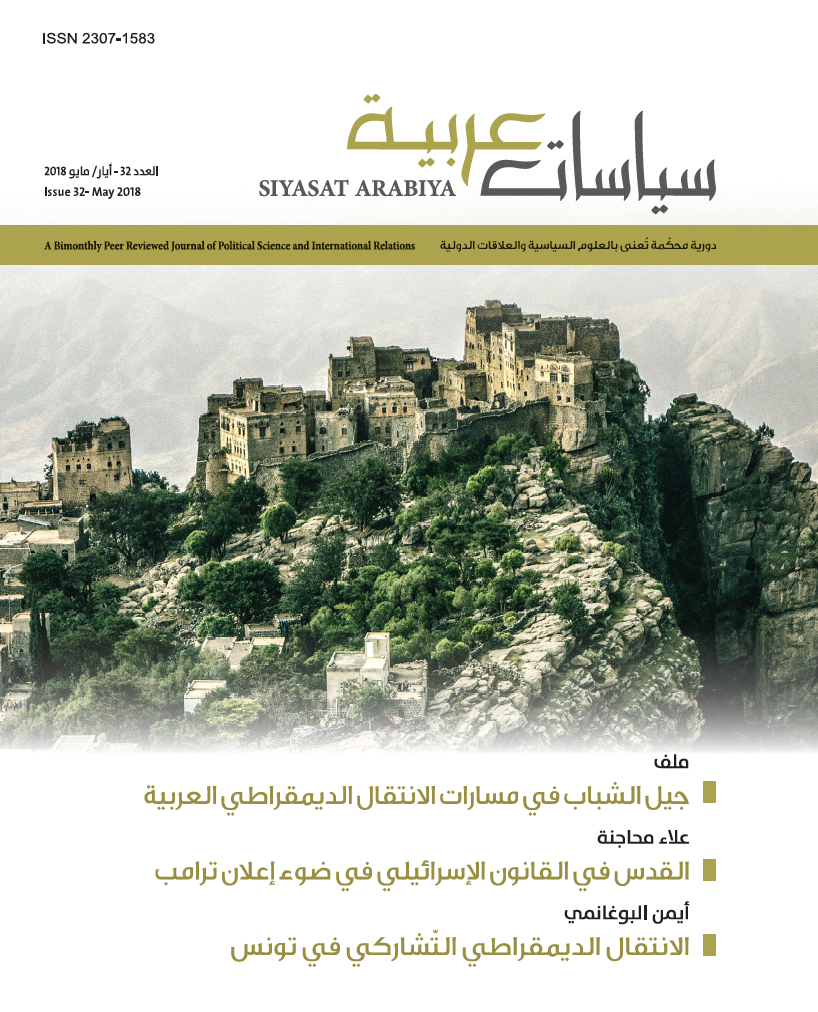
Participatory Democratic Transition in Tunisia: Elitist Answers in a Revolutionary Context
DOI:
https://doi.org/10.12816/0049552Keywords:
Tunisian Revolution, Democratic Transition, Participatory Democracy, Tunisian ElitesAbstract
This study addresses the extent to which the "participatory" framework is compatible with the networks of Tunisian elites since the Revolution of 2011. The author seeks to understand, analyze and interpret the theoretical approaches which allowed Tunisian politicians to reduce the level of political divisions within the country. The author further illustrates how Tunisia's formal political parties adapted and developed in the post-revolutionary setting, despite the revolution unraveling the vast extent of a societal rift in Tunisia which has dominated the country's political debates since that time. Finally, the study explores in depth the role and influence of Tunisian political elites as it relates to the praxis of participatory democracy, something which could not have been possible without the consciousness and awareness of these elites and their duty to fulfill their roles.References
- Anver Versi, "The Sweet Scent of Flowers," African Business , no. 372 (February 2011), p. 54.
- يعرّف التوافق في هذا الكتاب على أساس الاستنتاجات المستخلصة من التجارب الديمقراطية في النمسا وبلجيكا وهولندا وسويسرا، انظر: Arend Lijphart, Democracy in Plural Societies: A Comparative Exploration (New Haven: Yale University Press, 1977).
- يعتبر فرانسيس فوكوياما المسألة الثقافية من أعمق مستويات الدمقرطة، انظر: Francis Fukuyama, "The Primacy of Culture," Journal of Democracy , vol. 6, no. 1 (1995), p. 9.
- للاطلاع على تجربة مقارنة، انظر: Shiva Falsafi, "Civil Society and Democracy in Japan, Iran, Iraq and Beyond," Vanderbilt Journal of Transnational Law , vol. 43, no. 2 (2010), pp. 357-412.
- للرجوع إلى عمل يُعدّ من أهم الأعمال التي روجت مفهوم رأس المال الاجتماعي، انظر: James S. Coleman, "Social Capital in the Creation of Human Capital," American Journal of Sociology , vol. 94 (1988), pp. 95-120.
- Friedrich A. Hayek, Law, Legislation and Liberty , vol. 3, The Political Order of a Free People (Chicago: The University of Chicago Press, 1979), pp. 107-108
- Omar G. Encarnación, "Beyond Civil Society: Promoting Democracy after September 11," Orbis , vol. 47, no. 4 (2003), pp. 705-720.
- للاطلاع على أهمية المجتمع المدني في الفترات التاريخية العصيبة، انظر: Larry Diamond, Developing Democracy: Toward Consolidation (Baltimore: Johns Hopkins University Press, 1999), pp. 233-238.
- يعتقد هوبز أن الوزراء يملكون سلطة تعليم الناس وتمكين بقية الناس من معرفة واجبهم نحو السلطة ومعرفة العدل والظلم، وبذلك يَسمون بأرواحهم ويتعايشون في سلام ويقاومون العدو، انظر: Thomas Hobbes, Leviathan , C. B. MacPherson (ed.), (London: Penguin, 1968), p. 291.
- يعتقد هوبز أن الملك هو مصدر القانون المدني، انظر: Ibid., chapter 26.
- Domingo F. Sarmiento, Facundo, or Civilisation and Barbarism (London: Penguin, 1998).
- Paul Taggart, Populism (Philadelphia: Open University Press, 2000), pp. 10-22.
- Norman Barry, An Introduction to Modern Political Theory (London: Macmillan, 2000), pp. 284-287.
- للاطلاع على دور النخبة المحتمل في عملية الدمقرطة، انظر: Zheng Yongnian, Will China Become Democratic? Elite, Class and Regime Transition (Singapore: Eastern Universities Press, 2004), pp. 13, 311.
- يقول كارل بوبر: إنه على الرغم من ممارسة الناس ضغوطًا على الحكام بالتهديد بعزلهم، فإنهم لا يحكمون بطريقة فعلية، انظر: Karl Popper, The Open Society and its Enemies , vol. 1, The Spell of Plato (New York: Harper and Row, 1963), p. 125; Robert Dahl, Democracy and its Critics (New Haven: Yale University Press, 1989).
- Alain Badiou, The Rebirth of History: Times of Riots and Uprisings (London: Verso Books, 2012), p. 5.
- Samuel Huntington, "Social and Institutional Dynamics of One- Party Systems," in: Samuel P. Huntington & Clement H. Moore (eds.), Authoritarian Politics and Modern Society (New York: Basic Books, 1970), pp. 11-12.
- يرى ماكس فيبر أن السلطة تتمثل بقدرة بعض الناس على فرض إرادتهم على بقية الناس على الرغم من مقاومته، انظر: Max Weber, "The Sociology of Charismatic Authority," in: Hans Gerth & C. Wright Mills (eds.), From Max Weber: Essays in Sociology (New York: Oxford University Press, 1946), pp. 245-252. إن انخرام موازين القوى يضعف قدرة التحكم ويشجع على تحدي السلطة، وتكون النتيجة انسياق الطرفين إلى استعمال العنف، انظر: Alex Dennis & Peter J. Martin, "Symbolic Interactionism and the Concept of Power," British Journal of Sociology , vol. 56, no. 2 (2005), pp. 191-213.
- للوقوف على حدود تطهير ألمانيا من النازيين، انظر: Norbert Frei, Adenauer's Germany and the Nazi Past: The Politics of Amnesty and Integration , Joel Golb (trans.), (New York: Columbia University Press, 2002).
- Laurence Whitehead, Democratization: Theory and Experience (New York: Oxford University Press, 2002), pp. 76-83.
- للاطلاع على تاريخ العدالة الانتقالية، انظر: Neff J. Kritz (ed.), Transitional Justice: How Emerging Democracies Reckon with Former Regimes (Washington, D.C.: Institute of Peace Press, 1995).
- Anuradha Kataria, Democracy on Trial, All Rise! (New York: Algora, 2010), pp. 3-9.
- Carlos M. Vilas, "Prospects for Democracy in a Post-Revolutionary Setting: Central America," Journal of Latin American Studies , vol. 28, no. 2 (1996), pp. 461-504.
- Steffen Erdle, Ben Ali's 'New Tunisia' (1987-2009): A Case Study of Authoritarian Modernization in the Arab World (Berlin: Klaus Schwarz Verlag, 2010), pp. 176-185.
- Volker Perthes (ed.), Arab Elites: Negotiating the Politics of Change (Boulder: Lynne Rienner Publishers, 2004).
- أصبحت النخب السياسية التونسية واعية بأهمية المجتمع المدني للحصول على السلطة، وهذا لا ينطبق فقط على الحالات الثورية، انظر: Floyd Hunter, Community Power Structure (New York: Anchor Books, 1953).
- ينبغي أن نأخذ في الاعتبار أنّ المعسكرين تربطهما علاقة على أعلى مستوى، ومن المفيد أن نفهم أن الفصل بينهما ليس مبنيًا على أساس الثنائية الصارمة، وأن تقسيم المعسكرين إلى ثقافتين فرعيتين يعود أساسًا إلى الإصرار المفترض على الاختلاف، وقد كرّس ذلك في الإعلام ومنظمات المجتمع المدني بواسطة خطاب رسمي مزدوج في كل القضايا؛ بدءًا بالعلاقات الخارجية، ووصولً إلى المسائل المحلية.
- من ال وررري الإشارة إلى أنّ الحالة التونسية لا تمثل نموذجًا للتوافق في غياب ترتيبات رسمية لاقتسام السلطة، ولكن رواج فكرة التوافق في أوساط النخب على أنه حل ناجع للخلافات السياسية في تونس، لا تظهر تطابقًا كبيرًا مع التأويلات التشاركية، ويتقيد هذا البحث في التحليل بنموذج ليجبهارت، وخصوصًا أنه يميز بين الديمقراطية التشاركية والديمقراطية التوافقية، انظر: Arend Lijphart, Democracies: Patterns of Majoritarian and Consensus Government in Twenty-one Countries (New Haven: Yale University Press, 1984).
- Kenneth D. McRae (ed.), Consociational Democracy: Political Accommodation in Segmented Societies (Toronto: McClelland and Stewart, 1974), pp. 5-13.
- يعتقد الكتّاب الماركسيون أن التشاركية هي وسيلة تستعملها النخب لتحريك الشعب بالتوازي مع انقسام حول الهوية، وبذلك يصبح الصراع الطبقي ثانويًا. لدرس المثال الهولندي، انظر: Ronald A. Kieve, "Pillars of Sand: A Marxist Critique of Consociational Democracy in the Netherlands," Comparative Politics , vol. 13, no. 3 (1981), pp. 313-337.
- إن خسارة السلطة لا يعني بالضرورة خسارة مصادرها ومواضعها وشبكاتها، وللتمييز بين السلطة والعناصر المذكورة في الولايات المتحدة الأميركية، انظر: William Domhoff, Who Rules America? (Boston: McGraw Hill, 2002).
- إن التسوية على النحو المذكور، أو على نحو غيره، تُعد ضرورية لإنجاح المسار الانتقالي، وللاطلاع على نمط تسوية مختلف بين مراقبة الدولة وتحرير السوق في بلدان أوروبا الوسطى، انظر: Pasquale Tridico, Institutions, Human Development, and Economic Growth in Transition Economies (London: Palgrave Macmillan, 2011), pp. 255-257.
- للاطلاع على نتائج الانتخابات وردّات الفعل تجاهها، انظر: Erika Atzori, "Tunisia Leads the Way," The Middle East , no. 428 (December 2011), p. 18.
- لا يسير الانتقال السياسي، عادةً، في شكل مسار خطيٍّ من الدكتاتورية نحو الديمقراطية. ولمعرفة "المنطقة الرمادية" بينهما، انظر: Thomas Carothers, "The End of the Transition Paradigm," Journal of Democracy , vol. 13, no. 1 (2002), pp. 5-21.
- تمثل هذه الإجراءات وضعية تستحق الدراسة لفهم المسار التشاركي الديمقراطي الذي يرتكز على ضوابط قانونية لتفادي تطبيق نظام الأغلبية، ولبناء حكم ديمقراطي قادر على الاستمرار، انظر: Ruti Teitel, "Transitional Jurisprudence: The Role of Law in Political Transformation," Yale Law Journal , no. 106 (1997).
- بما أن الدستور التونسي الجديد يتضمن بنودًا عديدة لا يمكن تنقيحها، فإن مفعول سلطة النقض سيكون طويل الأمد، وتحدد البنود غير القابلة للتنقيح ما يمكن أن تمرره الأغلبية المنتخبة ديمقراطيًا، إضافة إلى النظام الانتخابي النسبي. للاطلاع على دور الدسترة في المجتمعات المنقسمة، انظر: Samuel Issacharoff, "Constitutionalizing Democracy in Fractured Societies," Journal of International Affairs , vol. 58, no. 1 (2004), pp. 73-89.
- للاطلاع على ملخص الأحداث المذكورة، انظر: Arend Lijphart, "The Puzzle of Indian Democracy: A Consociational Interpretation," American Political Science Review , vol. 90, no. 2 (1996), p. 258.
- للاطلاع على الاتحاد الاحتكاري للديمقراطية، انظر: Arend Lijphart, The Politics of Accommodation: Pluralism and Democracy in the Netherlands (Berkley: University of California Press, 1975), pp. 201-203.
- من مظاهر الديمقراطية التشاركية توزيع السلطة بين القوى المتنافسة بطريقة لا تمتّ بصلة إلى العملية الانتخابية، انظر: Arend Lijphart, "Consociational Democracy," World Politics , vol. 21, no. 2 (1969), p. 216.
- Lijphart, Democracy in Plural Societies , pp. 24-44.
- يعتبر الاختيار ضروريًا بالنسبة إلى المتخصصين على الرغم من قصوره، ولكنه يحد من فرضية العودة إلى الدكتاتورية، انظر: Henry Hale, "Formal Constitutions in Informal Politics: Institutions and Democratization in Post-Soviet Eurasia," World Politics , vol. 63, no. 4 (2011), pp. 581-617.
- على الرغم من تنافس القوى السائد في الحملة الانتخابية، فإنها لم تتطرق إلى القضايا الاقتصادية والاجتماعية المهمة، للاطلاع على الإطار النظري، انظر: Andreas Schedler, "The Nested Game of Democratization by Elections," International Political Science Review , vol. 23, no. 1 (2002), pp. 109-111.
- تعتبر حركة نداء تونس حزبًا تشاركيًا إذا أخذنا في الاعتبار انقسام الثقافة الفرعية العلمانية في تونس. للتحليل النظري للتكيف داخل الحزب وبين الأحزاب، انظر: Matthijs Bogaards, Democracy and Social Peace in Divided Societies: Exploring Consociational Parties (London: Palgrave Macmillan, 2014), pp. 1-19.
- تتوافق النتيجة مع مقاربة بوغارت التشاؤمية المتعلقة بالأحزاب التشاركية التي تثبت أنها ضعيفة هيكليًا على الرغم من قوتها في الظاهر، كما أن الأحزاب التشاركية عادة ما تكون منهكة بوظائف ثنائية تتعلق بالتمثيل والتكيف، انظر: Ibid., pp. 123-139.
- يتعرض النظام السياسي الجديد لمخاطر كثيرة ما لم يتحقق نمو اقتصادي مستدام، انظر: Michael O'Sullivan, Markus Siterli & Antonios Koutsoukis, From Spring to Revival: Regime Change and Economic Transformation (Zurich: Credit Suisse Research Institute, 2011), pp. 5-6.
- يعتبر ذلك متغيرًا من جملة المتغيرات التي تسهل التمييز بين الديمقراطية التشاركية والديمقراطية التوافقية، لمزيد من الاطلاع، انظر: Paul Pennings, "The Utility of Party and Institutional Indicators of Change in Consociational Democracies," in: Kurt Richard Luther & Kris Deschouwer (eds.), Party Elites in Divided Societies: Political Parties in Consociational Democracy (London: Routledge, 1999), p. 23.
Downloads
Published
2018-05-01
Usage statistics
43 views 53 downloads
Issue
Section
Studies
License
Copyright (c) 2018 Ayman Bouganmi (Author)

This work is licensed under a Creative Commons Attribution-NonCommercial 4.0 International License.
