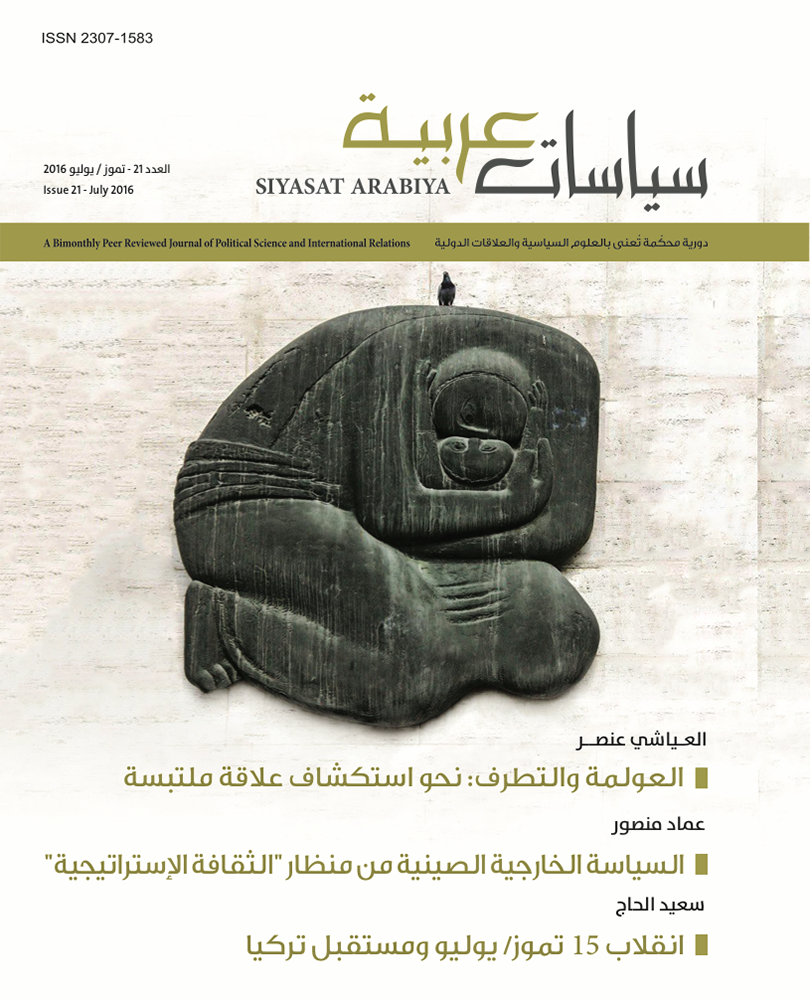
العولمة والتطـرف نحو استكشاف علاقة ملتبسة
DOI:
https://doi.org/10.12816/0029958الكلمات المفتاحية:
العولمة، التطرف، الراديكالية، الإمبرالية، الهجرة، الإندماجالملخص
تستقطب ظاهرتا "العولمة" و"التطرف" اهتمامًا غير مسبوق، إذ تحتل كل منهما مساحات متزايدة في وسائل الإعلام التقليدية والحديثة لم تبلغها موضوعات أخرى من قبل. وقد صار إلى الربط بينهما بصفة مباشرة أو غير مباشرة، كونهما موضوعًا رئيسًا في البحوث والدراسات الأكاديمية والمؤتمرات والندوات الفكرية والتقارير المتخصصة لمراكز التفكير وصناعة السياسات. تنطلق هذه الدراسة من السؤال التالي: هل توجد صلة بين العولمة والتطرف في عالمنا اليوم؟ وإن وجدت بينهما صلة، وذلك ما تزعمه الورقة، فما طبيعتها؟ وما هي المجالات التي تتجسد فيها؟ تحاول الورقة شرح مفاهيم العولمة وصيرورة ظهورها، والتطرف ومصادره، وتداعياته، فضل ا عن العلاقة الملتبسة بين التطرف والراديكالية، ثمّ تقوم باستكشاف مجالات العلاقة بين العولمة والتطرف، وتوضيح كيف يمكن أن تساهم العولمة في بروز الجماعات المتطرفة، باستعراض مجموعة من المجالات التي تتجسد فيها هذه العلاقة الملتبسة.المراجع
- Anthony Giddens, The Consequences of Modernity. (Stanford: Stanford University Press, 1990), p. 21.
- Robert Gilpin, Global Political Economy: Understanding the International Economic Order (Princeton: Princeton University Press, 2001), p. 364.
- Jan Aart Scholte, Globalization: A Critical Introduction (Basingstoke: MacMillan, 2000), p. 46.
- Harvey David, The Condition of Postmodernity: An Enquiry into the Origins of Cultural Change (Cambridge: Blackwell, 1989), pp. 265 - 266.
- Andrés Musacchio, “The Concept of Globalisation”, in Alfredo Canavero & Silvia Pizzetti & Lucio Valent (eds.), Globalisation, Regionalisation and the History of International Relations (Milan, 2000), pp. 223 - 224.
- Anthony Giddens, Runaway World: How Globalization is Reshaping Our Lives (London: Profile Books, 2002), p. 8.
- Giddens, The consequences , p. 8.
- Jake Gordon, “Is Globalisation a Myth or a Fact?”, 2001, pp. 1-2, accessed on 15/6/2016, at: http://jakeg.co.uk/essays/globalisation
- Giddens, Runaway World.
- عدنان عويد، "قراءة منهجية في التطرف"، موقع حراك، 2014/4/25، شوهد في 2015/6/11، في: http://bit.ly/28Vbnlv.
- معنى لفظ "التطرف"، موقع معجم المعاني الجامع، شوهد في 2015/04/21، في: http://bit.ly/29eNh73 موقع؛ السكينة، شوهد في 2015/04/21 في،:.http://www.assakina.com/book/27192.html
- موقف الكنسية من مفكري عصر النهضة وعصر التنوير مثل محاكمة غاليلي غاليلو، وفولتير وجان جاك روسو...إلخ. ومحاكم التفتيش والاضطهاد والتصفية التي طالت الفلاسفة العقلانيين المسلمين مثل ابن سينا، وابن طفيل، وابن الهيثم، والحلاج، وابن عربي، وابن المقفع، وابن رشد، وحديثًا ومحمد عبده، وطه حسين، وحسين مروة، وفرج فودة، ونصر حامد أبوزيد، ومحمد أركون... والقائمة طويلة من المفكرين والمبدعين والفنانين. يكفينا مثل هنا التذكير بالتصفيات الجسدية التي طالت المثقفين في الجزائر، على اختلاف تخصصاتهم، خلال العشرية السوداء (2000-1990)، إذ قامت الجماعات الإرهابية المنتمية إلى الحركة الإسلامية بإزهاق أرواح المئات منهم.
- محمد ياسر الخواجة، "التطرف الديني ومظاهره الفكرية والسلوكية"، موقع مؤسسة مؤمنون بلا حدود للدراسات والأبحاث، ص 3، شوهد في 2016/6/28، في: http://ow.ly/HR41w
- انظر التفاصيل والتحليل المستفيض حول هذه القضايا في مقال عزمي بشارة، "في ما يسمى التطرف"، مجلة سياسات عربية، العدد 14 (أيار/ مايو 2015)، ص 5 -.18
- انظر: Peter Thomas Coleman & Andrea Bartoli, Addressing Extremism (New York: The International Center for Cooperation and Conflict Resolution, Teachers College, Colombia University, n.d), pp. 3 - 4.
- هذه النسبية في الحكم الأخلاقي هي ما يمنع لفظ التطرف، بحسب عزمي بشارة، من أن يرقى إلى مرتبة المفهوم، بل وحتى مرتبة المصطلح. لذلك يرى أنه من الضروري توفير قاعدة أخلاقية تضمن الحد الأدنى من الاتفاق حول ما يُعدّ وما لا يُعدّ "تطرفًا"، حتى يمكن رفع اللفظ إلى مرتبة المفهوم. انظر: بشارة، ص 5 –.18
- Coleman & Bartoli, pp. 3 - 4..انظر كذلك: بشارة
- من أمثلة العنف الهيكلي أو المؤسساتي الحروب التي تشنها دول قوية ضد دول ضعيفة، أو ضد حركات تحررية، أو جماعات انفصالية أو مناوئة، لكن هذا عادة ما لا يصنف تحت مسمى التطرف، ومع ذلك يستخدم ضحايا هذا العنف المؤسساتي لفظ إرهاب الدولة أو الإرهاب المنظم للإشارة إلى هذه الحالات مثل حروب إسرائيل ضد الفلسطينيين في غزة، أو حرب أميركا على أفغانستان والعراق... إلخ. انظر: بشارة، ص 7 -.8
- Coleman & Bartoli, pp. 3-4;.وانظر أيضًا: بشارة، ص 13 - 15
- “ radicalism”, Merriam- Webster , accessed on 27/6/2016, at: http://www. merriam-webster.com/dictionary/radicalism; “radicalism”, vocabulary.com , accessed on 27/6/2016, at: www.vocabulary.com/dictionary/radicalism
- ولا يزال هذا النظام، الذي كان سائدًا في عهد الإقطاع، قائمًا إلى اليوم إذ توزع ملكة بريطانيا إليزابيث الثانية في مناسبات وطنية معيّنة الألقاب وتعلق النياشين من قبيل "اللورد" و"الفارس" و"السير" و"الدوق" وغيرها من الألقاب؛ بعضها مخصص للأسرة المالكة، وبعضها لنخبة المجتمع من السياسيين والفنانين والمفكرين وحتى الرياضيين...إلخ الذين حققوا إنجازات، أو قاموا بأعمال مهمّة تستحق التنويه والتقدير.
- Jerome Himmelstein, To the Right: The Transformation of American Conservatism (Berkeley: University of California Press, 1990), p. 7.
- John George & Laird Wilcox, Nazis, Communists, Klansmen, and Others on the Fringe: Political Extremism in America (Buffalo: Prometheus Books, 1992), p. 61.
- Charles A. H. Thomson, “The Vital Center by Arthur M. Schlesinger, Jr.; the Twilight of World Capitalism, William Z. Foster,” Indiana Law Journal , Vol. 26, Issue. 1, accessed on 27/6/2016, at: http://www.repository. law.indiana.edu/cgi/viewcontent.cgi?article=3603&context=ilj
- Seymour Martin Lipset, The Political Man: the Social Bases of Politics (Garden City, New York: Anchor Books, 1960), p. 134; Gáspár Miklós Tamás, “On Post-Fascism”, Boston Review , 1/6/2000, accessed on 27/6/2016, at: http://bostonreview.net/world/g-m-tam%C3%A1s-post-fascism
- Naumana Amjad & Alex M. Wood , “Identifying and Changing the Normative Beliefs about Aggression Which Lead Young Muslim Adults to Join Extremist Anti-Semitic Groups in Pakistan,” Aggressive Behavior , vol. 35, no. 6 (Nov-Dec 2009), pp. 514 - 519.
- Ronald Wintrobe, Rational Extremism: The Political Economy of Radicalism (Cambridge: Cambridge University Press, 2006), pp. 6 - 7.
- Bernd Simon & Bert Klandermans, “Politicized Collective Identity,” American Psychologist , vol. 56, no. 4 (2001), pp. 319 - 331.
- Clark McCauley, “The Psychology of Group Identification and the Power of Ethnic Nationalism”, In Daniel Chirot & Martin E. P. Seligman (Eds.) Ethno-political Warfare: Causes, Consequences, and Possible Solutions (Washington, DC: American Psychological Association, 2001), p. 350.
- Michael Wessells, “Terrorism, Apocalyptic Ideology, and Young Martyrs: Why Peacebuilding Matters”, Paper Presented at The American Psychological Association Conference, Chicago, August 2002.
- Arno Gruen, “An Unrecognized Pathology: The Mask of Humaneness,” Journal of Psychohistory , vol. 30, no.3 (Win 2003), pp. 266 - 272.
- Janet Gross Stein, “Image, Identity, and Conflict Resolution”, In Daniel J. Christie & Richard V. Wagner & Deborah Du Nann Winter (Eds.), Peace, Conflict and Violence: Peace Psychology for the 21st Century (Upper Saddle River, NJ: Prentice Hall, 2001), pp. 93 - 111.
- هناك عدة أمثلة أشهرها ملاحقة مسؤولين في صربيا، ورواندا والسودان ومحاكمة محكمة العدل الدولية بعضهم.
- Ibid., p. 94; Stanley Schneider, “Fundamentalism and Paranoia in Groups and Society”, Group , vol. 26, no. 1 (Mar 2002), pp. 17 - 27.
- David Rapoport, “Four Waves of Terrorism”, In Dipak K. Gupta (ed.) Terrorism and Homeland Security (Belmont, CA: Wadsworth, 2005), p. 10.
- Dipak K. Gupta “Spread of Radicalism: A Theoretical Perspective on the Process by which Ideas Flood the World,” International Journal of Security and Terrorism , vol. 1, no.1 (2010), p. 3.
- Gupta, “Spread of Radicalism…”, pp. 1 - 15.
- Samuel P. Huntington, The Clash of Civilizations and the Remaking of World Order)New York: Simon & Shuster, 1996), pp. 19 - 20.
- Samuel Huntington, “The Clash of Civilizations?,” Foreign Affairs , vol. 72, no. 3 (Summer 1993), pp. 22 - 49.
- Edward Said, “The Clash of Ignorance,” The Nation (October 2001), accessed on 18/3/2015, at: http://www.thenation.com/article/clash- ignorance/ انظر أيضًا: Fouad Ajami, “The Clash”, The New York Times , 6/1/2008, accessed on 19/3/2015, at: http://www.nytimes.com/2008/01/06/books/review/Ajami-t.html; Liu Binyan, “Civilization Grafting: No Culture is an Island,” Foreign Affairs (September/October 1993), accessed on 20/3/2015, at: http:// www.foreignaffairs.com/articles/49194/liu-binyan/civilization-grafting- no-culture-is-an-island; Marc Cogen, “The West, Europe and the Islam”, The Centre for the Study of European Politics and Society / Ben Gurion University, 2005, accessed on 20/3/2015, at: http://docslide.us/documents/ clash-of-civilizations-review.html; Muhammad Tahir Ashraf Mian, “The Clash of Civilizations? A Critique,” Pakistan Journal of Social Sciences (PJSS), vol. 32, no. 2 (2012), pp. 521 - 527.
- UNHCR, “Global Trends; Forced Displacement in 2014”, accessed on 9/06/2015 at: http://www.unhcr.org/556725e69.html
- Pierre Bourdieu & Abdelmalek Sayad, Le déracinement. La crise de agriculture traditionelle en Algérie (Paris: Eds. Minuit, 1964).
- يتوافر كم هائل من الأدبيات حول الموضوع، ويمكن الاكتفاء بذكر عيّنة منها فقط: Roy Olivier, La sainte ignorance: le temps de la religion sans culture (Paris: Ed Seuil, 2008); Roy Olivier, Le croissant et le chaos , (Paris: éd. Hachette, 2007); Gilles Kepel, Fitna. Guerre au cœur de l’islam)Paris: éd. Gallimard, 2004);Francois Burgat, L'Islamisme à l'heure d'Al Qaida (Paris: Ed. La Découverte, 2005); Ahmed Rouadjia, Les frères et la Mosquée: Enquête sur le movement islamiste en Algérie (Paris: Ed. Karthala, 1990); Eli Berman, Hamas, Taliban and the Jewish Underground: An Economist's View of Radical Religious Militias , UC San Diego National Bureau of Economic Research (August 2003); Martin E. Marty & R. Scott Appleby (eds.), Fundamentalisms and Society (Chicago: University of Chicago Press,1993); Graham E. Fuller, The Future of Political Islam , (London: Palgrave MacMillan, 2003).
- يكفي الاطلاع هذه الأيام على ما تحمله الأخبار يوميًا من الاعتداءات المتزايدة والجرائم العنصرية ضد الأميركيين السود في الولايات المتحدة، أو الفرنسيين، أو الألمان من أصول غير أوروبية (عرب، وأتراك، وأفارقة، وآسيويين.)
- Francis Fukuyama, “The End of History?,” The National Interest (Summer1989), pp. 3 - 18.
- يمكن ذكر أمثلة عديدة هنا من أعمال المؤسسين لعلم الاجتماع وعلم النفس، وعلم النفس الاجتماعي، أعمال دوركايم حول الأشكال البدائية للحياة الدينية، Les formes التي يبرز Le Suicide, 1897 ودراسة الانتحار élémentaires de la vie religieuse 1912 فيها كيف أنّ الانتحار ظاهرة اجتماعية بالأساس، وأنّ أنواع الانتحار المختلفة مرتبطة مباشرة بسيادة المعايير الاجتماعية أو ضعفها وبشدة الانتماء الاجتماعي أو ضعفه. كما يمكن الإشارة إلى أعمال غوستاف لوبون في دراساته حول تأثير الجماعة عن طريق التقليد والمحاكاة الاجتماعية. سيكولوجية الجماهير، (New The Crowd, a study of the popular mind)York: the Macmillan,1895 كما يمكن ذكر أعمال عالم النفس ماسلو وهرمه المشهور للحاجات حيث تأتي الحاجة للانتماء في المرتبة الثانية مباشرة بعد الحاجة للطعام. وقد طور هذا الهرم بعد ذلك في كتابه المشهور: Motivation and Personality (New York: Harper, 1954)
- انظر تفاصيل عن نماذج من الدراسات الحديثة حول مدى تأثير الجماعة في الفرد، ودورها في صوغ شخصيته وصقلها من خلال فكرة الانتماء واستبطان المعايير والقواعد التي تعطي حياة الأفراد معنى وغاية، في: 3 “Spread of Radicalism…”, p..Gupta,
- Dipak K. Gupta, “Accounting For the Waves of International Terrorism,” Perspectives on Terrorism, Vol. II, Issue. 11 (August 2008), p. 4.
- Ibid., pp. 4 - 5.
التنزيلات
منشور
2016-07-01
إحصاءات الاستخدام
69 مشاهدة 62 تنزيل
إصدار
القسم
دراسات
الرخصة
الحقوق الفكرية (c) 2016 Layachi Anser (Author)

هذا العمل مرخص بموجب Creative Commons Attribution-NonCommercial 4.0 International License.
