The Welfare State in Egypt 1995-2005: A Comparative Study
DOI:
https://doi.org/10.12816/0008192Keywords:
Welfare State, Egypt, Esping, AndersenAbstract
This paper applies the categorization of welfare state systems set out by Esping-Andersen in 1990 to the welfare state in Egypt. It analyzes the relationships between state, market, and society over the 10 years from 1995 to 2005, which were marked by a shift to a market economy and a confrontation with the historical legacy of the state’s social role. The best description for the current welfare state in Egypt is “conservative/unorganized” in that social security entitlements are limited to work in the formal sector, which makes the family, religious institutions, and patronage networks take on important roles in meeting the social needs of the large informal sector. Additionally, the study proposes some modifications to the Esping-Andersen categorization with the aim of understanding welfare programs in developing countries. When analyzing welfare systems in general, particularly in the developing countries, it is necessary to take into account methodologically aspects of mismanagement, considerations of quality, the gap between stated aims and their implementation, the disparity resulting from differences between countryside and city and between the sexes, and the role of the informal sector.References
- Esping-Andersen, The Three Worlds of Welfare Capitalism.
- Gough and Wood, Insecurity and Welfare Regimes in Asia, Africa and Latin America ; Kwon, “Beyond European Welfare Regimes: Comparative Perspectives on East Asian Welfare Systems”; Barrientos, “Latin America: Towards a Liberal-Informal Welfare Regime”; Fenger, “Welfare Regimes in Central and Eastern Europe; Choi, Y.-J., “Coming to a Standstill?”; Barrientos, “Labor Markets and the Hyphenated Welfare Regime in Latin America.”
- Esping-Andersen, The Three Worlds of Welfare Capitalism , p. 37.
- Lelkes, “A Great Leap towards Liberalism? The Hungarian Welfare State,” p. 93.
- Esping-Andersen, Social Foundations of Post-Industrial Economies.
- Esping-Andersen, The Three Worlds of Welfare Capitalism , p. 47.
- مصطلح actuarialism يعني في علم الجريمة خصوصًا: مقاربة في مجال السيطرة على الجرائم وفي إدارتها (أي في قانون العقوبات)، وهي لا تُعنى بمعنى الانتهاكات أو دوافعها، ولكنها تُعنى بالتركيز على تكنولوجيات التخفيف من المخاطر والقضاء على المخاطر المحتملة التي تهدّد النظام الاجتماعي.
- Esping-Andersen, The Three Worlds of Welfare Capitalism , p. 48.
- Esping-Andersen, The Three Worlds of Welfare Capitalism , p. 77.
- Esping-Andersen, The Three Worlds of Welfare Capitalism , p. 27.
- Esping-Andersen, The Three Worlds of Welfare Capitalism , p. 28.
- Leibfried, “Towards a European Welfare State?”; Ferrera, “The ‘Southern’ Model of Welfare in Social Europe”; Bonoli, “Classifying Welfare States”; Trifiletti, “Southern European Welfare Regimes.”
- Castles, Comparative Public Policy.
- Lewis, “Gender and the Development of Welfare Regimes”; O’Connor, “Gender, Class and Citizenship”; Or loff, “Gender and the Social Rights of Citizenship”; Sainsbury, Gender, Equality and Welfare States ; O’Connor, Orloff, and Shaver, States, Markets, Families.
- Orloff, “Gender and the Social Rights of Citizenship.”
- Daly and Lewis, “The Concept of Social Care,” p. 289.
- Leibfried, “Towards a European Welfare State?”; Castles and Mitchell, “Worlds of Welfare”; Siaroff, “Work, Welfare and Gender Equality”; Ferrera, “The ‘Southern’ Model of Welfare”; Korpi and Palme, “The Paradox of Redistribution”; Bonoli, “Classifying Welfare States.”
- Bonoli, “Classifying Welfare States.”
- Kasza, “The Illusion of Welfare Regimes,” pp. 277-280.
- Kwon, “Beyond European Welfare Regimes”; Jones, “The Pacific Challenge.”
- Barrientos, “Latin America: Towards a Liberal-Informal Welfare Regime.”
- Barrientos, “Latin America: Towards a Liberal-Informal Welfare Regime.”
- Barrientos, “Labor Markets and the Hyphenated Welfare Regime in Latin America.”
- Bugra and Candas, “Change and continuity”; Grutjen, “The Turkish Welfare Regime.”
- Ringen and Ngok, “What Kind of Welfare State is Emerging in China?”
- Arts and Gelissen, “Three Worlds of Welfare Capitalism or More?” p. 140.
- Esping-Andersen, “Welfare States and the Economy,” p. 712.
- Kassem, Egyptian Politics.
- Bebber, The Policies of the State and Targeting the Poor in Egypt , p. 51.
- Amin, Whatever Happened to the Egyptians? p. 14.
- Kassem, Egyptian Politics , p. 24.
- Abdel-Khalek, “Looking Outside, or Turning Northwest?” 397.
- Farah, Egypt's Political Economy , p. 77.
- World Bank, Egypt: Towards a More Effective Social Policy.
- World Bank and Ministry of Economic Development, Arab Republic of Egypt: A Poverty Assessment Update , p. 61.
- World Bank, Egypt: Towards a More Effective Social Policy.
- Bebber, The Policies of the State and Targeting the Poor in Egypt , p. 85.
- Adams, “Self-Targeted Subsidies.”
- Adams, “Self-targeted Subsidies,” pp. 16-18
- World Bank, Egypt: Towards a More Effective Social Policy.
- World Bank, Egypt: Towards a More Effective Social Policy.
- Abouleinein, El Laithy, and Kheir-El-Dein, “The Impact of Phasing Out Subsidies,” pp. 13-19.
- World Bank, Egypt: Towards a More Effective Social Policy.
- Helmy, “Egypt’s New Pension System,” pp. 3-10.
- Galal, “Social Expenditure and the Poor in Egypt,” p. 3.
- Galal, “Social Expenditure and the Poor in Egypt,” p. 8.
- Ministry of Health, Egypt, and Health Systems 20/20 , p. 13.
- Galal, “Social Expenditure and the Poor in Egypt,” p. 8.
- Abou-Habib, “The Right to Have Rights.”
- Abou-Habib, “The Right to Have Rights,” p. 445.
- Galal, “Social Expenditure and the Poor in Egypt,” pp. 5-9.
- Galal, “Social Expenditure and the Poor in Egypt,” p. 3.
- United Nations Development Program, Egypt Human Development Report 2005.
- Bebber, The Policies of the State and Targeting the Poor in Egypt , pp. 102-104.
- Assaad, R., “The Effects of Public Sector Hiring and Compensation Policies on the Egyptian Labor Market.”
- El Ghamrawy and Amer, “The Public Wage Premium in Egypt,” p. 23.
- El Ghamrawy and Amer, “The Public Wage Premium in Egypt,” pp. 6-7.
- Okasha, El Kholy, and El Ghamry, “Overview of the Family Structure in Egypt,” p. 163.
- Singerman, Avenues of Participation.
- Pioppi, “From Religious Charity to the Welfare State and Back,” p. 4-6.
- Anheier and Salamon, The Non-Profit Sector in the Developing World , pp. 145-146.
- Mohamed and Mohamed, “The Effect of Wasta,” p. 412.
- Lust, “Democratization by Elections?” p. 125.
- Dobie, Grant, and Knudstrup, “Attitudes and Perceptions of the Role of Wasta”; Whiteoak, Crawford, and Mapstone, “Impact of Gender and Generational Differences.”
- Mohamed and Mohamed, “The Effect of Wasta,” p. 421.
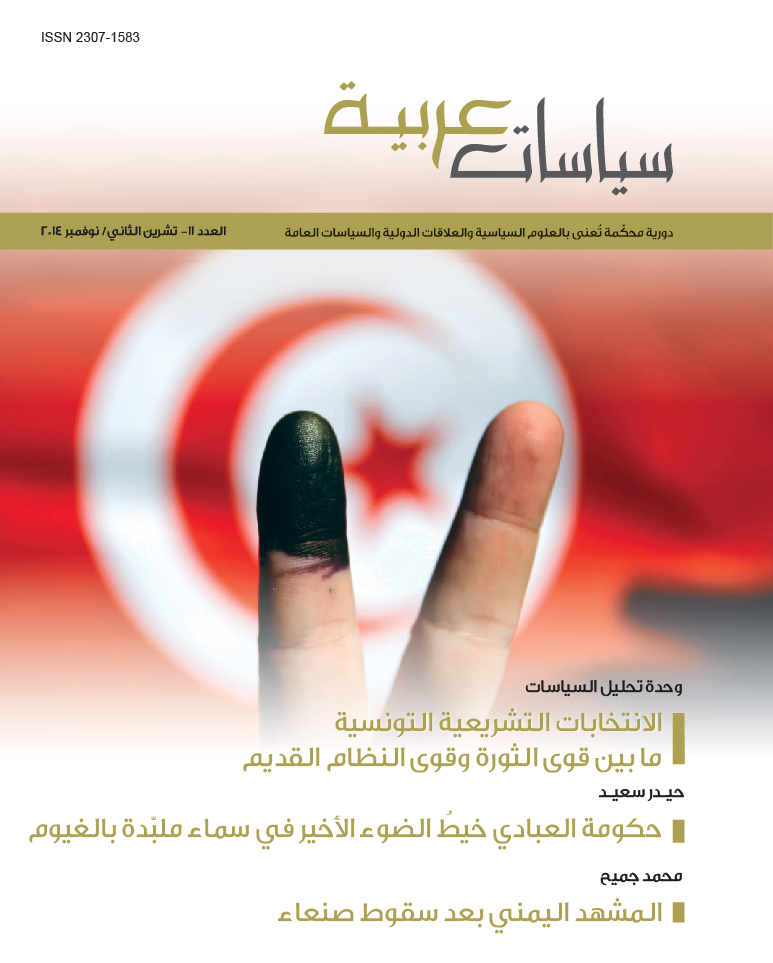
Downloads
Published
2014-11-01
Usage statistics
37 views 58 downloads
Issue
Section
Studies and Analytical Papers
License
Copyright (c) 2014 Ahmad Ezzedine Mohammed (Author)

This work is licensed under a Creative Commons Attribution-NonCommercial 4.0 International License.
