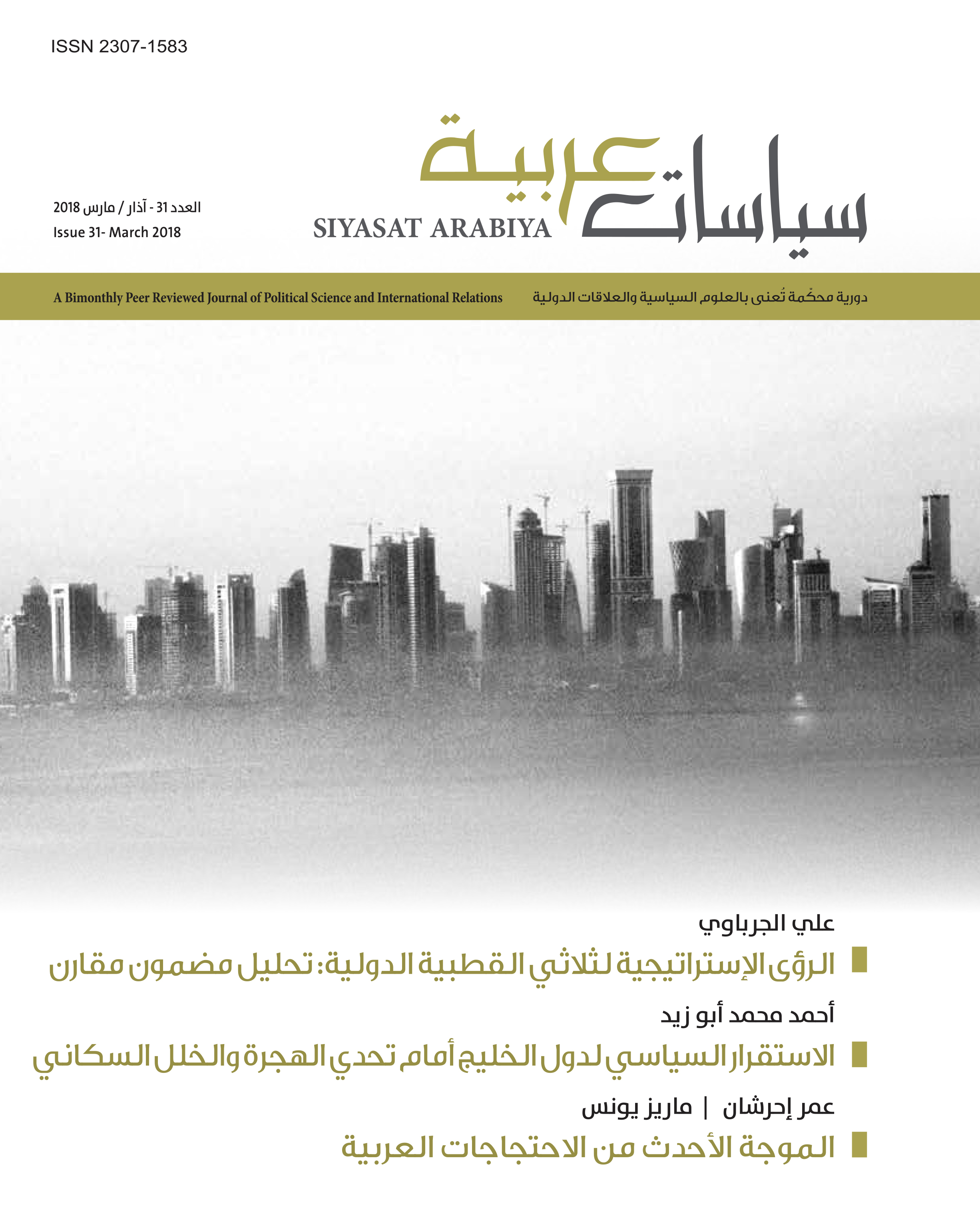
China, Russia and the United States: Understanding the Emergence of a Tri-polar World Order
DOI:
https://doi.org/10.12816/0049171Keywords:
China, Russia, USA, Strategy, World OrderAbstract
This article is a contribution to the ongoing debate regarding the changing dynamics of global power relations, which seem to be heading toward an inevitable end of the unipolar world order dominated by the United States since the collapse of the Soviet Union in 1990. It demonstrates that through highlighting the rising global power of China and Russia, which is currently causing a substantial threat to the US hegemony. As such, the continuation of this trajectory in the upcoming decades will likely lead to the emergence of a tri-polar world order, whereby the international system will be shared among the US, China and Russia. Methodologically, this article primarily relies on content analysis and thorough scrutinization of recent official foreign policy and national security documents issued by these actors in order to provide an in-depth understanding of the respective strategic vision underpinning.References
- See: Stephen Walt, "Keeping the World 'Off-Balance': Self-Restraint and U.S. Foreign Policy," in: John Ikenberry (ed.), America Unrivaled: The Future of the Balance of Power (Ithaca, NY: Cornell University Press, 2002), pp. 121-154; Charles Krauthammer, "The Unipolar Moment," Foreign Affairs , vol. 70, no. 1 (Winter 1990-1991), pp. 21-33; Charles Krauthammer, "The Unipolar Moment Revisited," The National Interest , no. 57 (Winter 2002-2003), pp. 5-17; G. John Ikenberry, Michael Mastanduno & William C. Wohlforth (eds.), International Relations Theory and the Consequences of Unipolarity (Cambridge, MA: Cambridge University Press, 2011).
- See: Paul Kennedy, "The Relative Decline of America," The Atlantic Monthly (August 1987), p. 33; Sam Perlo-Freeman et al., "Trends in World Military Expenditure 2015," Stockholm International Peace Research Institute (April 2016), accessed on 12/2/2018, at: https://goo.gl/Ux94aT; Michael Beckley, The Unipolar Era: Why American Power Persists and China's Rise Is Limited? (New York: Columbia University, 2012), p. 29.
- See: Paul Kennedy, The Rise and Fall of the Great Powers: Economic Change and Military Conflict from 1500 to 2000 (London: Fontana Press, 1989), pp. 488-495; Anna Mulrine, "Obama to Confront Limits of America's Overstretched Military," U.S. News and World Report (January 16, 2009), accessed on 12/2/2018, at: https://goo.gl/mm54F3; Barry Posen, "The Security Dilemma and Ethnic Conflict," Survival , vol. 35, no. 1 (Spring 1993), pp. 27-47; Marks O. Yeisley, "Bipolarity, Proxy Wars, and the Rise of China," Strategic Studies Quarterly , vol. 5, no. 4 (Winter 2011), pp. 75-91. تحليل مضمون مقارن
- See: Kenneth N. Waltz, "The Stability of a Bipolar World," Daedalus , vol. 93, no. 3 (Summer 1964), pp. 881-909; Yan Xuetong & Koichi Furuya, "Conflict Control is Key to U.S.-China Relations in a Bipolar World," Carnegie-Tsinghua Center, May 14, 2014, accessed on 12/2/2018, at: http://goo.gl/RyvPno; Fareed Zakaria, "The Future of American Power: How America Can Survive the Rise of the Rest," Foreign Affairs , vol. 87, no. 3 (May-June 2008), pp. 18-43; Joshua Kurlantzick, "The Decline of American Soft Power," Current History , vol. 104, no. 686 (December 2005), pp. 419- 423; Stephen Walt, "Beyond Bin Laden: Reshaping U.S. Foreign Policy," International Security , vol. 26, no. 3 (Winter 2001-2002), pp. 65-80; Richard Haass, "The Age of Nonpolarity: What will Follow U.S. Dominance," Foreign Affairs , vol. 87, no. 3 (May-June 2008), accessed on 12/3/2018, at: https://goo.gl/StxNzG
- See: Waltz; Michael Hass, "International Subsystems, Stability and Polarity," American Political Science Review , vol. 64, no. 1 (March 1970), pp. 98-123; John Lewis Gaddis, "The Long Peace, Elements of Stability in the Post War International System," International Security , vol. 10, no. 4 (Spring
- Waltz, pp. 881-909.
- See: Francis Fukuyama, The End of History and the Last Man Ideology (New York: Free Press, 1992).
- See: Samuel P. Huntington, The Clash of Civilizations and the Remaking of World Order (New York: Touchstone, 1996).
- See: Martin Griffiths & Terry O'Callaghan, International Relations: The Key Concepts (London: Routledge, 2002), pp. 124-126; Matthew D. Stephen, "Rising Powers, Global Capitalism and Liberal Global Governance: A Historical Materialist Account of the BRICs Challenge," European Journal of International Relations , vol. 20, no. 4 (May 2014), p. 916; Ulrich Steger, Corporate Diplomacy: The Strategy for a Volatile, Fragmented Business Environment (London: John Wiley & Sons Ltd., 2003(.
- See: Haass, "The Age of Nonpolarity"; Xiaoxiong Yi, "American Leadership in a Non-Polar World," Marietta College website, December 27, 2009, accessed on 12/3/2018, at: https://goo.gl/rTzoDA
- جوزيف ناي، مستقبل القوة الأمريكية، سلسلة دراسات عالمية 105 (أبوظبي: مركز الإمارات للدراسات والبحوث الاستراتيجية، 2012)، ص.8
- See: Krauthammer, "The Unipolar Moment," pp. 21-33; Krauthammer, "The Unipolar Moment Revisited," pp. 5-17; Ikenberry, Mastanduno & Wohlforth (eds.); William C. Wohlforth, "The Stability of a Unipolar World," International Security , vol. 24, no. 1 (1999), pp. 5-41.
- See: Yan Xuetong, "How China Can Defeat America," The New York Times , 20/11/2011, accessed on 12/2/2018, at: http://goo.gl/5lTz6Q; Liu Qianqian, "China's Rise and Regional Strategy, Power, Interdependence and Identity," Journal of Cambridge Studies , vol. 5, no. 4 (2010), pp. 76-92; John Ikenberry, "The Rise of China and the Future of the West," Foreign Affairs, vol. 87, no. 1 (2008), pp. 23-37; Stefan Halper, The Beijing Consensus: How China's Authoritarian Model Will Dominate the Twenty-First Century (New York: Basic Books, 2010); Randall Schweller & Xiaoyu Pu, "After Unipolarity: China's Visions of International Order in an Era of U.S. Decline," International Security , vol. 36, no. 1 (2011), pp. 41-72.
- See: Thomas Ambrosio, "Russia's Quest for Multipolarity: A Response to U.S. Foreign Policy in the Post‐Cold War Era," European Security , vol. 10, no. 1 (2001), pp. 45-67; Glenn Diesen & Steve Wood, "Russia's Proposal for a New Security System, Confirming Diverse Perspectives," Australian Journal of International Affairs , vol. 66, no. 4 (2012), pp. 463-464.
- Brantly Womack, "Asymmetry Theory and China's Concept of Multipolarity," Journal of Contemporary China , vol. 13, no. 39 (2004), p. 355.
- Trine Flockhart, "The Coming Multi-Order World," Contemporary Security Policy , vol. 37, no. 1 (2016), p. 3; علي الجرباوي، "أوقات مثيرة: نظام دولي جديد في طور التشكيل"، جريدة الفلسطينية الأيام، تحليل مضمون مقارن
- استند هذا الجزء إلى معالجة سابقة للموضوع، انظر: علي الجرباوي، "استراتيجية الأمن القومي لإدارة الرئيس ترامب: تحليل المضمون"، جريدة الفلسطينية الأيام،.2018/1/3
- Mark Landler & David E. Sanger, "Trump Delivers a Mixed Message on His National Security Approach," The New York Times , December 18, 2017, accessed on 12/2/2018, at: https://goo.gl /UK4uxu
- The White House, National Security Strategy of the United States of America (Washington, DC: December 2017), accessed on 12/2/2018, at: https://goo.gl/CQFtzV
- ترامب يعلن الاستراتيجية الجديدة للأمن القومي الأميركي: السلام بالقوة"، روسيا اليوم، 2017/12/18، شوهد في 2018/2/12، في: https://goo.gl/o7zG8n
- The White House, p. 2.
- Thomas Wright, "The National Security Strategy Paper Over a Crisis," The Atlantic , 19/12/2017, accessed on 12/2/2018, at: https://goo.gl/Zsg3xj
- The White House, p. 26.
- Ibid., pp. 2-3, 37.
- Ibid., p. 2. تحليل مضمون مقارن
- Ibid., pp. 28-33.
- Ibid., pp. 45-47, 50-51.
- Ibid., pp. 48-50.
- انظر: "النص الكامل لتقرير شي جين بينغ في المؤتمر الوطني التاسع عشر للحزب الشيوعي الصيني"، صحيفة الشعب اليومية أونلاين، 2017/11/4، شوهد في 2018/2/12، ف:ي https://goo.gl/BtUEBu
- المرجع نفسه، ص.26
- المرجع نفسه، ص.1
- المرجع نفسه. يتكرر التعبير مرارًا داخل النص.
- المرجع نفسه، ص.9
- المرجع نفسه، ص.1
- المرجع نفسه، ص 7. يتكرر التعبير مرارًا داخل النص.
- المرجع نفسه، ص.6
- المرجع نفسه، ص.7
- المرجع نفسه، ص.32
- المرجع نفسه، ص.4
- المرجع نفسه، ص.1
- المرجع نفسه، ص.4
- المرجع نفسه، ص.10
- المرجع نفسه، ص.6 تحليل مضمون مقارن
- المرجع نفسه، ص.10
- المرجع نفسه، ص.5
- الاقتباسات في هذه الفقرة من: المرجع نفسه، ص.13
- المرجع نفسه، ص 1. يتكرر التعبير مرارًا داخل النص.
- الاقتباسات في هذه الفقرة من: المرجع نفسه، ص.9
- الاقتباسات في هذه الفقرة من: المرجع نفسه، ص.8
- المرجع نفسه، ص.15
- المرجع نفسه، ص.10
- الاقتباسات في هذه الفقرة من: المرجع نفسه، ص.26
- الاقتباسات في هذه الفقرة من: المرجع نفسه، ص.27
- المرجع نفسه، ص.6
- المرجع نفسه، ص.27
- المرجع نفسه، ص.9
- المرجع نفسه، ص.27
- الاقتباسات في هذه الفقرة من: المرجع نفسه، ص.27-26
- يمكن الاستفادة من: أحمد عبد الجبار عبد لله، الصين والتوازن الاستراتيجي العالمي بعد عام 2001 وآفاق المستقبل (بيروت: الدار العربية للعلوم ناشرون، 2015)، ص.389-376 تحليل مضمون مقارن
- للاطلاع على خلفية عن السياسة الخارجية الروسية، راجع: أولجا أوليكر وآخرون، "السياسة الخارجية الروسية في السياقين التاريخي والحالي: إعادة تقييم"، مؤسسة RAND، منظور تحليلي (2015)، شوهد في 2018/3/12، في: https://goo.gl/SYdcit؛ محمد مجدان، "سياسة روسيا الخارجية اليوم: البحث عن دور عالمي مؤثر،" المجلة العربية للعلوم السياسية، العددان 48-47 -(صيفخريف 2015)، شوهد في 2018/3/12، في: https://goo.gl/FSUgpj
- The Ministry of Foreign Affairs of the Russian Federation, "Foreign Policy Concept of the Russian Federation Approved by President of the Russian Federation Vladimir Putin on November 30, 2016," December 1, 2016, accessed on 12/2/2018, at: https://goo.gl/GVDXQ7
- Ibid., p. 11. تحليل مضمون مقارن
- Ibid., pp. 14-15.
- راجع في هذا الصدد: علاء عبد الحفيظ محمد، "تأثيرات الصعود الروسي والصيني في هيكل النظام الدولي في إطار نظرية تحول القوة"، المجلة العربية للعلوم السياسية، العددان 48-47 (صيف-خريف 2015)، شوهد في 2018/2/12، في: https://goo.gl/sNXwaQ
- Fred Kaplan, "Strategic Confusion: Donald Trump's new National Security Strategy will buffle allies and delight foes," Slate , 18/12/2017, accessed on 12/3/2018, at: https://goo.gl/bHBxGQ تحليل مضمون مقارن
- ريتشارد جواد حيدريان، "التنافس الأميركي الصيني في آسيا"، مترجم عن آسيا تايمز، الفلسطينية جريدة الأيام،.2018/1/10
3Total citations
2From ACRPS journals
1External sources
Citing articles in ACRPS journals (2)
- (2021) الهيمنة في العلاقات الدولية: مراجعة للمفهوم في ضوء الحالة الأميركية.
- (2019) النظرية الواقعية في مواجهة أحادية القطبية الدولية.
Citing articles from external sources (1)
- Ajad Jibril Hassan (2026) الشرق الأوسط بعد حرب إيران. https://doi.org/10.36360/1560-015-002-003
Sources: Crossref Cited-by, and the references (notes and reference lists) of the Center's own articles
Downloads
Published
2018-03-01
Usage statistics
41 views 114 downloads
Issue
Section
Studies
License
Copyright (c) 2018 Ali Jarbawi (Author)

This work is licensed under a Creative Commons Attribution-NonCommercial 4.0 International License.
