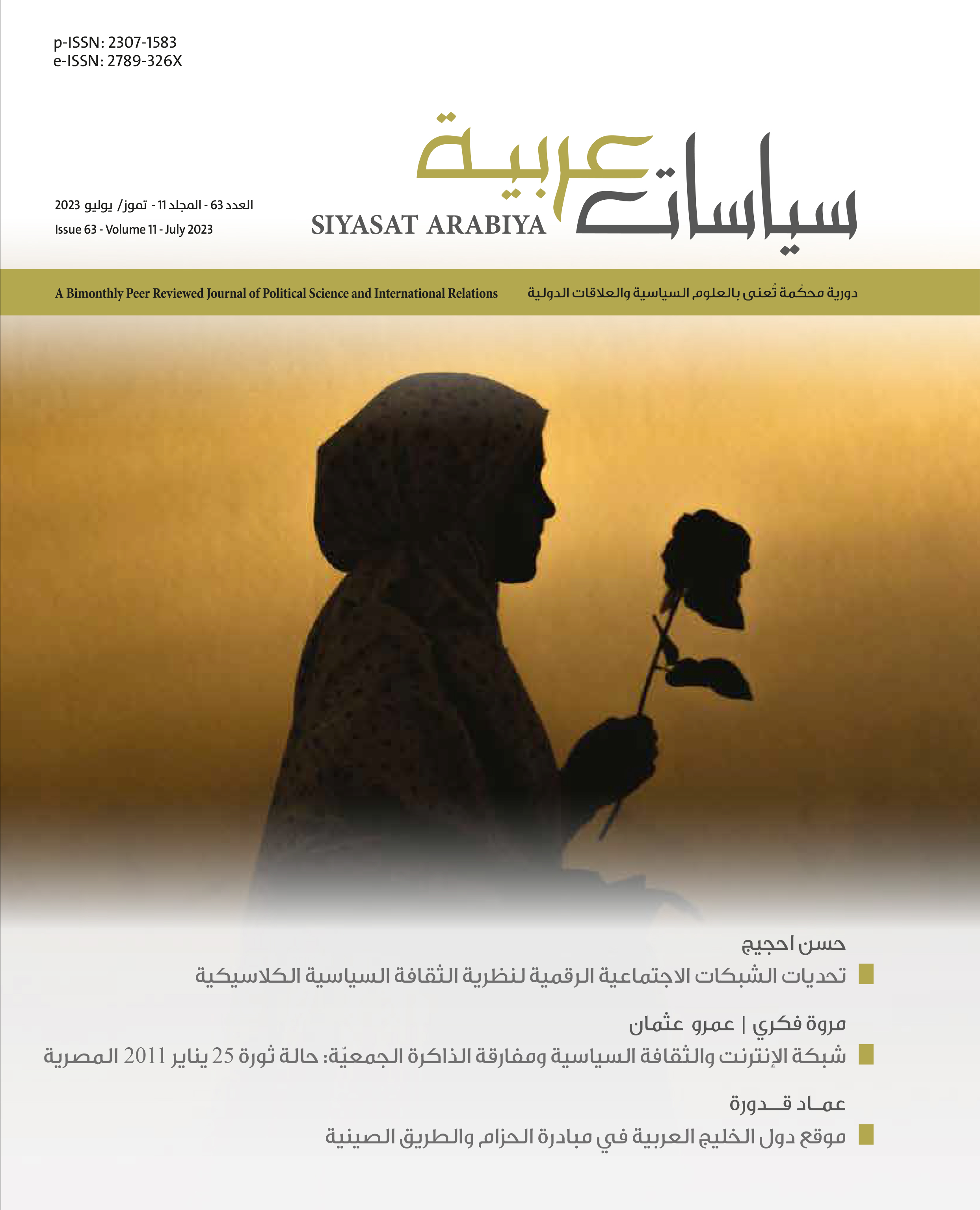
The Internet, Political Culture, and the Paradox of Collective Memory: The Case of the Egyptian January 25, 2011 Revolution
DOI:
https://doi.org/10.31430/msue5739Keywords:
Political Culture, Collective Memory, the Internet, Social Media, The Culture of Reconciliation, Democratic Transition, The Egyptian Revolution of January 25Abstract
This paper proposes an approach to studying the impact of the Internet on political culture through the concept of collective memory. Departing from the traditional approaches that confine political culture to knowledge, orientations, and behavior, to constructive and interpretive frameworks that define it through the process of "meaning-making," collective memory emerges as an essential component of political culture with its meanings, symbols, and narratives about political life. The paper concludes – from examining the case of the Egyptian Revolution of January 25, 2011 – that the development of the Internet may limit the role of the state and the elite in shaping political culture and collective memory, but it may also increase the severity of political and social polarization and weaken the culture of tolerance towards the other, and the chances of achieving social reconciliation, which is what we call the "paradox of collective memory".References
- Andreas Langenohl, "Memory in Post-Authoritarian Societies," in: Herausgegeben von Astrid Erll & Ansgar Nünning (eds.), Media and Cultural Memory (Berlin: Walter de Gruyter GmbH & Co., 2008), p. 163.
- James Young, Texture of Memory: Holocaust Memorials and Meaning (New Haven: Yale University Press, 1993), p. ix.
- Eric Langenbacher, "Collective Memory as a Factor in Political Culture and International Relations," in: Eric Langenbacher & Yossi Shain (eds.), Power and the Past: Collective Memory and International Relation (Washington, DC: George Town University Press, 2010), p. 33.
- زهير سوكاح، "مقدمة المحرر الضيف للعدد: عدد خاص، من 'الذاكرة' إلى 'دراسات الذاكرة'"، تبين، مج 9، العدد 33 (2020)، ص 7 -.9
- Giovanni Dazzo, "Exploring the Role of Collective Memory for Reconciliation: A Comparative Case of Guatemala and Cambodia," Beyond Intractability (May 2020), accessed on 20/1/2023, at: https://bit.ly/3SyG5d1
- Ruth García-Gavilanes et al., "The Memory Remains: Understanding Collective Memory in the Digital Age," Science Advances , vol. 3, no. 4 (2017), p. 1.
- Langenbacher, pp. 26 - 27.
- عزمي بشارة، الانتقال الديمقراطي وإشكالياته: دراسة نظرية وتطبيقية مقارنة (الدوحة/ بيروت: المركز العربي للأبحاث ودراسة السياسات، 2020)، ص.418
- Jil A. Edy, Troubled Pasts: News and the Collective Memory of Social Unrest (Philadelphia: Temple University Press, 2006), p. 10.
- Margaret R. Somers, "What's Political or Cultural about Political Culture and the Public Sphere? Toward an Historical Sociology of Concept Formation," Sociological Theory , vol. 13, no. 2 (1995), p. 116.
- Gabriel Almond & Sidney Verba, The Civic Culture: Political Attitudes and Democracy in Five Nations (Princeton: Princeton University Press, 1963), p. 13.
- محمد سعيد عبد المجيد وممدوح عبد الواحد محمد الحيطي، "الشبكات الاجتماعية الإلكترونية والثقافة السياسية للشباب الجامعي: دراسة ميدانية"، حوليات آداب عين شمس، مج 43 (2015)، ص.249
- Almond & Verba, pp. vii & viii.
- يتأثر جزء من هذا النقد بأفكار تالكوت بارسونز Talcott Parsons التي رسمت علاقة أحادية الاتجاه بين المجتمع والسياسة. وقد ميّز بارسونز بين أنظمة ثلاثة أساسية، هي: الاجتماعية والثقافية والنفسية، وأكّد أن جميع التفاعلات الاجتماعية تتضمّن أبعادًا لكلٍ من الأنظمة الثلاثة المذكورة: جذور النظام الاجتماعي، والرموز ذات المغزى في النظام الثقافي، والتأثير السببي الناتج من الدوافع النفسية. وانطلاقًا من هذا الاتجاه، قدّم علماء الاجتماع السياسي وعلماء السياسة في فترة ما بعد الحرب العالمية الثانية مفهوم الثقافة السياسية بوصفه متغرّيًا حاسمًا في شرح النتائج السياسية المتباينة في الديمقراطيات. وعرّف هؤلاء العلماء الثقافة السياسية بأنها "المشاعر الذاتية والمواقف والسلوكيات المترتبة عليها" التي يُعتقد أنها تميّز "التوجّهات السياسية" الفردية والجماعية - أي القيم - عبر النظام السياسي. ينظر: Walter Rosenbaum, Political Culture (New York: Prager, 1975), p. 4.
- Somers, pp. 114 - 115.
- يناقش رولاند فورميسانو مجموعة من الآراء الناقدة لبرنامج الثقافة السياسية على اعتبار أنه غير واضح وغير قادر على التوصّل إلى استنتاجات ثابتة. للمزيد، ينظر: Roland Formisano, "The Concept of Political Culture," The Journal of Interdisciplinary History , vol. 31, no. 3 (2001), p. 404.
- Harry Eckstein, "A Culturalist Theory of Political Change," The American Political Science Review , vol. 82, no. 3 (1988), pp. 789 - 804.
- Ronald Inglehart, "The Renaissance of Political Culture," The American Political Science Review , vol. 82, no. 4 (1988), pp. 1203 - 1230.
- المرجع نفسه. يؤكد بشارة على ضرورة توافر حد أدنى من الثقافة السياسية الديمقراطية لدى النخب السياسية – لا سّيمّا في مرحلة الانتقال – يشمل القابلية للحوار والمساومة وتسوية الصراعات سلميًا؛ وعدّ الإجراءات والمؤسسات الديمقراطية الإطارَ الأفضل لتسوية الصراعات، ينظر: المرجع نفسه، ص 418 -.436
- William Adams, "Politics and the Archeology of Meaning: A Review Essay," Western Political Quarterly , vol. 39, no. 3 (1986), pp. 549, 562.
- Formisano, p. 408.
- Somers, pp. 131 - 132.
- David D. Laitin & Aaron Wildavsky, "Political Culture and Political Preferences," The American Political Science Review , vol. 82, no. 2 (1988), pp. 589 - 597.
- عبد المجيد والحيطي، ص.249
- Narisong Huhe, Min Tang & Jie Chen, "Creating Democratic Citizens: Political Effects of the Internet in China," Political Research Quarterly , vol. 71, no. 4 (2018), pp. 757 - 771.
- Marija Andreeva, "(Re)shaping Political Culture and Participation through Social Networks," Journal of Liberty and International Affairs , vol. 5, no. 2 (2019), p. 47.
- Dong Zhou, Weiguang Deng & Xiaoyu Wu, "Impacts of Internet Use on Political Trust: New Evidence from China," Emerging Markets Finance and Trade , vol. 56, no. 14 (2020), p. 3236.
- Andreeva, p. 50; Jordan Carpenter et al., "Political Polarization and Moral Outrage and Social Media," Connecticut Law Review , vol. 52, no. 3 (2021), p. 1109.
- Marc Lynch, "How the Media Trashed the Transitions," Journal of Democracy , vol. 26, no. 4 (2015), pp. 90 - 99.
- Mark Beissinger, "Conventional and 'Virtual' Civil Societies in Autocratic Regimes," Comparative Politics , vol. 49, no. 3 (2017), pp. 351 - 371.
- يتضمّن العداء هنا كراهية المعارضين السياسيين والاعتقاد أن الطرف الآخر خطير أو شرير، أو تصويره على أنه كذلك.
- نفي صفة الإنسانية Dehumanization هي عملية إنكار امتلاك شخصٍ ما أو مجموعة معينة للقدرات والتوجّهات التي يتّسم بها الشخص الطبيعي مثل القدرة على اتخاذ قرارات عقلانية، أو الإحساس بالمعاناة والشعور بالألم. ينظر: 1116.Carpenter et al., p.
- Ibid., pp. 1112, 1113.
- Andreeva, p. 50.
- Hunt Allcott & Matthew Gentzkow, "Social Media and Fake News in the 2016 Election," Journal of Economic Perspectives , vol. 31, no. 2 (2017), p. 211.
- Andreeva, p. 50.
- Huhe, Tang & Chen, p. 761.
- تميّز الدراسة بين الذاكرة الجمعية والذاكرة التاريخية، على اعتبار أن الأخيرة ثمرة تقليد معرفي وعلمي ونتاج للتحليل والنقد والعقلنة.
- Eric Langenbacher & Yossi Shain, "Introduction: Twenty-first-Century Memories," in: Langenbacher & Shain (eds.), p. 15.
- William Hirst & Allin Coman, "Building a Collective Memory: The Case for Collective Forgetting," Current Opinion in Phycology , vol. 23 (October 2018), p. 88.
- زهير سوكاح، "حقل 'دراسات الذاكرة' في العلوم الإنسانية والاجتماعية: حضور غربي وقصور عربي"، أسطور، مج 6، العدد 11 (2020)، ص.37
- Motti Neiger, Oren Meyers & Eyal Zandberg, "On Media Memory: Editor's Introduction," in: Motti Neiger, Oren Meyers & Eyal Zandberg (eds.), On Media Memory: Collective Memory in a New Media Age (Basingstoke, UK: Palgrave Macmillan, 2011), pp. 2 - 3.
- Maurice Halbwachs, On Collective Memory , Lewis A. Coser (trans.) (Chicago: The University of Chicago Press, 1992), p. 22.
- نقلًا عن: زهير سوكاح، "السياسة والذاكرة الجمعية: علاقة تنافر أم تجاذب؟"، مجلة الناقد للدراسات السياسية، العدد 1 (تشرين الأول/ أكتوبر 2017)، ص 39 -.40
- Jan Assmann & John Czaplicka, "Collective Memory and Cultural Identity," New German Critique , no. 56 (1995), pp. 126 - 129.
- بول ريكور، الذاكرة، التاريخ، النسيان، ترجمة جورج زيناتي (طرابلس: دار الكتاب الجديد المتحدة، 2009)، ص.136
- نقلًا عن: سوكاح، "السياسة والذاكرة؟"، ص.49
- Langenbacher, pp. 34 - 35.
- Mariska Kappmeier & Aurélie Mercy, "The Long Road from Cold War to Warm Peace: Building Shared Collective Memory Through Trust," Journal of Social and Political Psychology , vol.7, no. 1 (2019), pp. 527 - 528.
- Langenbacher, p. 37.
- Olli Hellmann, "The Dictator's Screenplay: Collective Memory Narratives and the Legitimacy of Communist Rule in East Asia," Democratization , vol. 28, no. 4 (2021), p. 661.
- Neiger, Meyers & Zandberg, p. 4.
- Jill A. Edy, Troubled Pasts: News and the Collective Memory of Social Unrest (Philadelphia: Temple University Press, 2006), p. 2.
- Sophie Perryer, "The Internet never Forgets, but People Do," The New Economy , 13/11/2018, accessed on 20/1/2023, at: https://bit.ly/3UAiNoB
- Neiger, Meyers & Zandberg, p. 2.
- García-Gavilanes et al., p. 1.
- Hui Zhao & Jun Liu, "Social Media and Collective Remembrance: The Debate over China's Great Famine on Weibo," China Perspectives (January 2015), p. 41, accessed on 20/1/2023, at: https://bit.ly/3OHgGvr
- Roberta Bartoletti, "Memory and Social Media: New Forms of Remembrance and Forgetting," in: Bianca Pirani (ed.), Learning from Memory: Body, Memory and Technology (New Castle: Cambridge Scholars Publishing, 2011), p. 88.
- James Warren, "The Internet and Memorialisation: A Case Study of 9 / 11 Internet Memorials," Folio , 21/1/2015, accessed on 20/1/2023, at: https://bit.ly/3u0byLX
- ولا تغّير قدرة الدولة على حجب بعض مواقع الإنترنت أو التواصل الاجتماعي من هذا الأمر، وذلك بسبب وفرة وسائل مراوغة ذلك الحجب، ينظر، على سبيل المثال: "رغم قطع الإنترنت وشبكة الجوال.. هذه التطبيقات تتيح لك التواصل"، الجزيرة نت، 2019/9/24، شوهد في 2023/1/20، في: https://bit.ly/42hodqm
- Langenbacher, p. 16.
- Jane L. Curry, "When an Authoritarian State Victimizes the Nation: Transitional Justice, Collective Memory, and Political Divides," International Journal of Sociology , vol. 37, no. 1 (2007), pp. 64, 65.
- Matthew V. Hibbing, Matthew Hayes & Raman Deol, "Nostalgia isn't what it Used to be: Partisan Polarization in Views on the Past," Social Science Quarterly , vol. 98, no. 1 (2017), p. 231.
- يقصد بتوثيق ثورة 25 يناير المصرية جمع كل المواد والمعلومات الخاصة بأحداث الثورة وتصنيفها وفرزها والتحقق منها.
- عصام شعبان، "توثيق الثورة المصرية.. الضرورة والأهمية والإشكالات"، العربي الجديد، 2022/5/11، شوهد في 2023/6/20، في: https://bit.ly/42LjhKL
- من الكلمات السياسية إلى المناهج الدراسية... تحولات خطاب 'الدولة' عن 25 يناير"، رصيف 22، 2022/1/25، شوهد في 2023/6/20، في: https://bit.ly/47MfWMl
- فريد دياب، "يناير المصرية في الخطاب الرسمي... 'ستار' يسدل بهدوء"، وكالة الأناضول، 2017/1/25، شوهد في 2023/6/20، في: https://bit.ly/49bFwey
- صرّح السيسي في مؤتمر الشباب 2019 بأن: "[أحداث] 2011 وكل المؤامرة التي حدثت [استهدفت] وزارة الداخلية ووزارة الدفاع لأنهما مراكز الثقل التي تستطيع أن تحمي الدولة"، ينظر: "كلمة الرئيس السيسي خلال الجلسة الأولى في مؤتمر الشباب الثامن"، تن تي في، يوتيوب، 2019/9/14، شوهد في 2023/6/20، في: https://bit.ly/3HyisLt
- صرّح السيسي في المؤتمر الثامن للشباب 2019: "سأقول لكم عن غلطة واحدة، أو ثمن واحد دفعناه وسندفعه، [أحداث] 2011 لم تكن أبدًا لتُبنى سدود على نهر النيل إلا بها [بسببها]".
- كلمة الرئيس السيسي خلال افتتاح التوسعات الجديدة والتطوير لمصنع كيما للأسمدة 2022، ينظر: "السيسي: عرفتوا ليه البلد كانت هتضيع في 2011؟ وما تنسوش يا مصريين الليي أنقذكم ربنا من الدمار والخراب"، إكسترا نيوز، يوتيوب، شوهد في 2023/6/20، في: https://bit.ly/3STyAxF
- نقلًا عن: تامر هنداوي، "السيسي: ثورة يناير كان هدفها تدمير الدولة وليس التغيير "، القدس العربي، 2020/10/11، شوهد في 2023/6/20، في: https://bit.ly/3wd0GuP
- ثورة يناير في خطابات السيسي من التمجيد إلى الاتهام بالتدمير"، الخليج الجديد، 2020/10/12، شوهد في 2023/6/20، في: https://bit.ly/42jN6Sb
- أحلام حسنين، "بالفيديو: 25 يناير في خطاب السيسي.. 30 دقيقة للشرطة و 6 للثورة"، مصر العربية، 2017/1/25، شوهد في 2023/6/20، في: https://bit.ly/3S9ZEHc
- تناولت المناهج الدراسية الثورة في السنوات الأولى بشيء من التفصيل، ثم صارت تُعرض بصورة سريعة من دون ذكر مسبباتها. الآن، عادت الأمور إلى ما كانت عليه قبل عام 2011 تقريبًا، وهي أن 25 يناير هو عيد الشرطة المصرية، مع إشارة إلى ثورة 25 يناير في جملة قصيرة وعلى استحياء. للمزيد، ينظر: ريم محمود، "ضمن صفحات تقلصت مع الزمن، المناهج المدرسية المصرية الحالية تذكر قشورًا من ثورة 25 يناير"، رصيف 22، 2021/1/25، شوهد في 2023/6/20، في: https://bit.ly/3Oler0u 98 المرجع نفسه.
- وهي عبارة تقليدية أصبحت الآن شعارًا مرتبطًا ارتباطًا أساسيًا بمشروعات نظام حكم السيسي في مصر.
1Total citations
0From ACRPS journals
1External sources
Citing articles from external sources (1)
- Haneen A. Al-khawaja, Abdul Razzak Alshehadeh, Asad Aburub Faisal, Ali Matar, Osaid Hasan Althnaibat (2025) Solutions for Insider Trading and Regulatory Challenges in Financial Governance. https://doi.org/10.56294/dm2025680
Sources: Crossref Cited-by, and the references (notes and reference lists) of the Center's own articles
Downloads
Published
2023-07-01
Article dates
Received: February 1, 2023 Revised: April 10, 2023 Accepted: June 15, 2023
Usage statistics
34 views 55 downloads
Issue
Section
Studies
License
Copyright (c) 2023 Marwa Fekry, Amr Osman (Author)

This work is licensed under a Creative Commons Attribution-NonCommercial 4.0 International License.