Vol. 2 No. 007 (2014): Issue 007
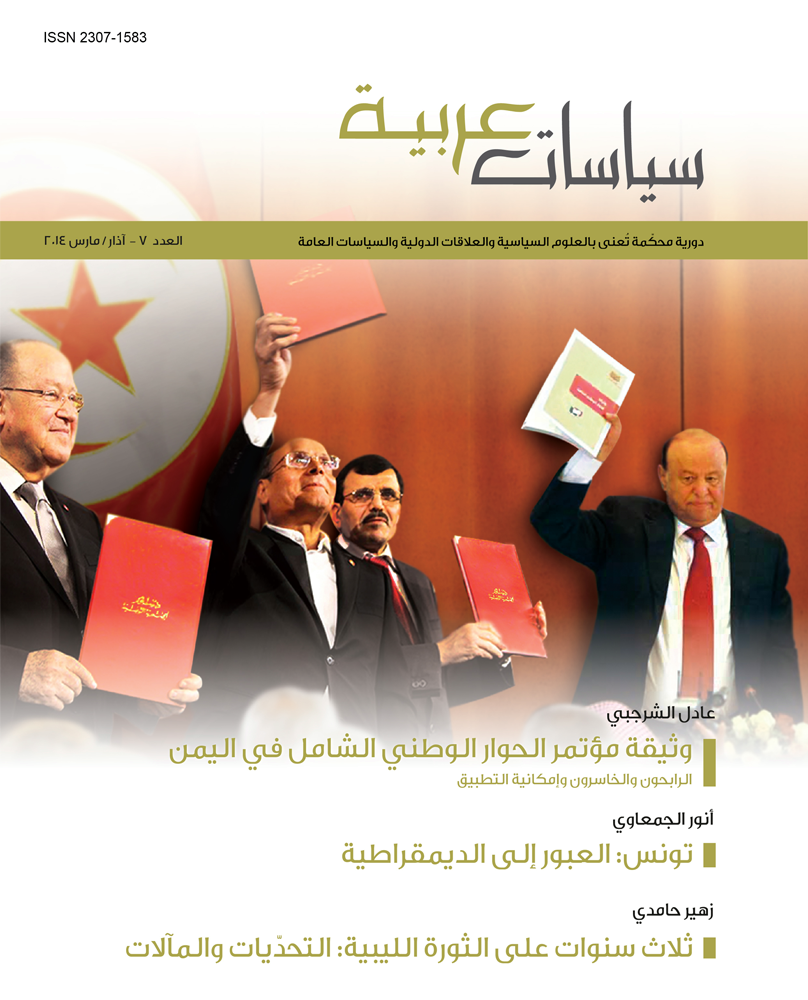
​ACRPS has published issue 7 of the bi-monthly peer-reviewed academic journal Siyasat Arabia, a journal devoted to political science and international relations. This issue includes the following articles: “The Charter of the Comprehensive Conference for National Reconciliation in Yemen” (Adel al-Shargabi); “The Other Bank: The Ethiopian Vision of the Conflict over the Nile’s Waters” (Ahmed Abu Zaid); “The War in Sinai: Fighting Terrorism or Strategic Shifts in Cooperation and Hostility?” (Ismail al-Iskandarani); “Hamas and Egypt: the Impasse and Outcomes of the Relationship” (Khalid Walid Mahmoud and Ayat Hamdan); “US policy in the Middle East: a Discussion of the Conceptions of the Washington Institute for Near East Policy” (Mohammed al-Masri); “Tunisia: the Passage to Democracy” (Anouar Jamaoui); “Paths and Outcomes of the Moroccan Spring: the February 20 movement and Moroccan specifics in dealing with political protest” (Zouheir Hamedi); “Banned Discrimination in International Law” (Mohammad Yusuf Alwan); “Geneva 2: A Negotiation Track without Results” (ACRPS Policy Analysis Unit); “The Confrontation with ISIL: Reasons and Possible Results” (Hamzeh al-Mustafa); “Moral Hazard and the US-Iran Talks” (Suhaim Al Thani); and “Public Opinion and Democracy” (ACRPS Public Opinion Unit).The issue includes the following book reviews: “Freedom – Equality – Social Assimilation: The Theory of Justice in the Sustainable Model of Liberalism” (Khalid Walid Mahmoud); “Global Justice or Global Revenge? International Criminal Justice at the Crossroads” (Mohamed Taifouri); “Encyclopedia of Egypt and the Palestinian issue 1917-1952” (Naiema Abou Mostafa); “Balance: The Economics of Great Powers from Ancient Rome to Modern America” (Suhaim Al Thani). A further five books were presented by Ziad Muna: “Corporate Europe: How Big Business Sets Policies on Food, Climate and War “; “The International Human Rights Movement: A History”; “Reporting Disasters - Famine, Aid, Politics and the Media”; “Light on the Impasse of the Palestinian Political Elite”; and “Wadie Haddad – Revolutionary or Terrorist?”.

Original Website (English) | Original Website (Arabic)

Published: 2014-03-01

Articles

  • Yemen’s Comprehensive National Dialogue Conference Document: Winners, Losers, and Applicability

    Author: Adel al-Shargabi
    5-12

    Yemen’s Comprehensive National Dialogue document presents a key moment in the nation’s contemporary political situation.

  • The Other Bank: Ethiopia’s View of the Fight over the Nile

    Author: Ahmed Abu-Zaid
    13-24

    This study limits its aim to a discussion of the water policy of Egypt and Ethiopia.

  • Sinai War: Combatting Terrorism or Strategic Shifts in Cooperation and Hostility?

    Author: Ismail al-Iskandarani
    26-40

    The phenomenon of armed groups operating in Egypt’s Sinai Peninsula is a growing one. This paper presents the history of this phenomenon as well as factors leading up to the violent encounters...

  • Hamas and Egypt: The Impasse and the Fate of the Relation

    Author: Khalid Walid Mahmoud, Ayat Hamdan
    41-55

    This paper examines the implications of Egypt’s military coup on Gaza and its ruling party Hamas.

  • The US Policies in the Middle East: Discussion of the Washington Institute for Near East Policy Perceptions

    Author: Mohammed al-Masri
    56-63

    Through a critical review, this paper examines the most important issues raised during the political forum for 'The Washington Institute,' a forum devoted to the discussion of US policies in the...

  • Tunisia: The Crossing into Democracy

    Author: Anouar Jamaoui
    64-70

    The Arab Spring caught its breath in Tunisia after political, syndicalist, and legal forces reached a series of agreements that shaped the features of a second republic.

  • Path of the Moroccan Spring and its Impacts: The ‘20 February’ Movement and Morocco’s Role in Managing the Political Protest

    Author: Mohammed Mesbah, El-hassan Mesbah
    72-87

    The 20 February movement was formed out of a defining moment in modern Moroccan political history, and forced the ruling regime to undertake a process to reform and give up some of its powers.

  • Three Years after the Libyan Revolution: Challenges and Impacts

    Author: Zouheir Hamedi
    88-95

    Examining the path of the Libyan revolution from its beginning in February 17, 2011 until today, this paper goes on to forecast the challenges that Libya will likely face in the future.

  • Prohibited Discrimination in the International Law

    Author: Mohamed Olwan
    96-111

    Rights to equality and non-discrimination in international law form the core of this paper. .