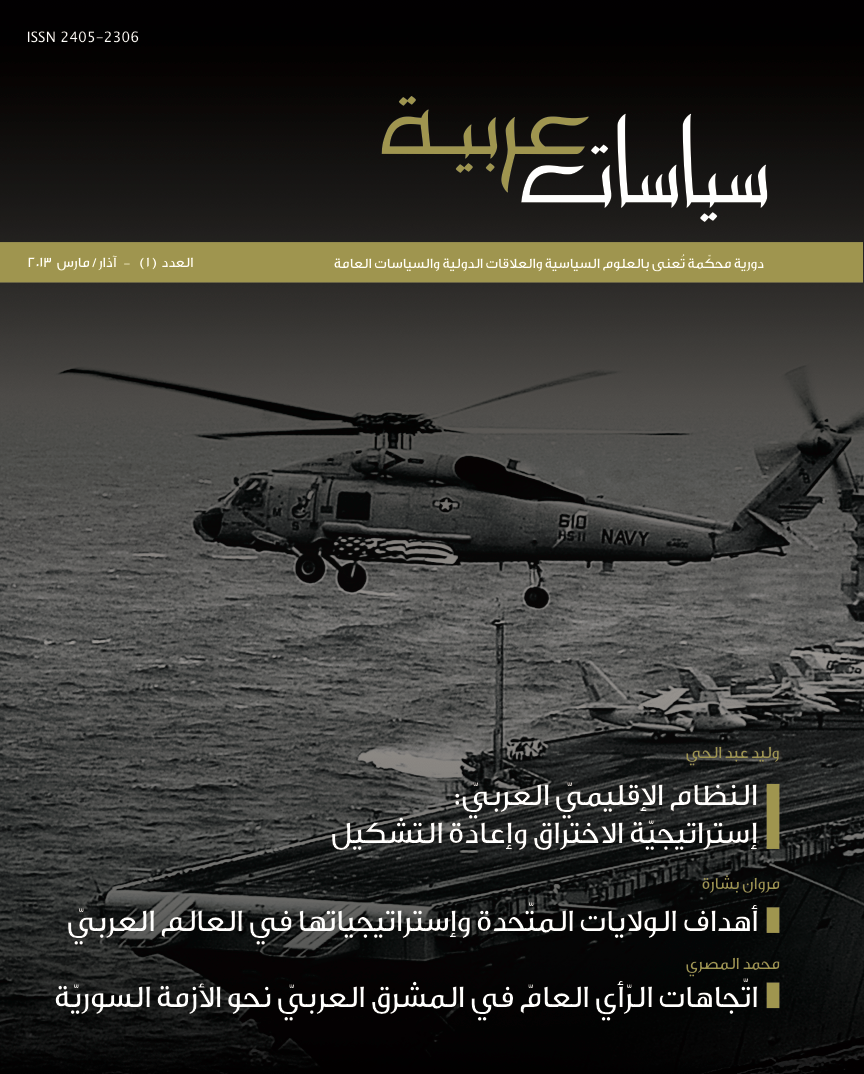
النظام الإقليمي العربي: إستراتيجية الاختراق وإعادة التشكيل
DOI:
https://doi.org/10.12816/0000416الكلمات المفتاحية:
الدول العربية، النظام الإقليمي، العلاقات الدوليةالملخص
تناقش هذه الدراسة الإطار النظري لتحليل ظاهرة الاختراق، مستعرضةً نظريات العلاقات الدولية التي يجري تعريف النُّظم المخترقة بناءً عليها. من صور الاختراق المختلفة التي عددتها الدراسة: التهديد العربي - العربي، والتنافس بين الدول العربية على احتلال موقع المركز، والإرث التاريخي، والشركات المتعددة الجنسية. ناقشت الدراسة أيضًا دور النخب العربية في عمليات الاختراق عن طريق ارتباطها بالقوى والمصالح الدولية. ولمست يعالج البحث موضوع الطائفيّة بوصفها نظامًا علائقيًّا خاصًا يقوم بين السلطة والمجتمع الدراسة الاختراق عن طريق اللغة، والتعليم، ووسائط الإعلام، ومنظمات المجتمع المدني. من جهة، والمجتمع والفرد من جهة أخرى، وهي انعكاس لخريطة توزيع القوة، وأثرُ من آثار كما تعرضت لما أسمته "الاختراق الخشن"، كاحتلال العراق ونشر القواعد الأجنبية. في جانبٍ تعريف الفرد وتحديد موقعه ومكانته في المجتمع، والحدود المسموح له بممارسة فعله آخر، ناقشت الدراسة اختراق دول الجوار الإقليمي للوطن العربي. وترى أن تباين مستويات عنها فشل الدولة في أداء مهماتها كدولة. تتعرض الدراسة لتعدد الإشكاليات الطائفيّة التطور في النظم السياسيّة والاجتماعيّة والاقتصاديّة بين الدول العربيّة يترتب عليه تباين في العالم العربيّ بتعدد طوائفها الكبرى: بين شيعيّة أخذت تتضخم خصوصيتها إلى في مستويات الاختراق الأجنبي للدولة، أو التغلغل فيها، أو النفوذ عليها. والنظر إلى درجة التقوقع خارج مجال الدولة، ومسيحيّة متوجسة من واقعها فأخذت تبحث لنفسها عن المنطقة العربيّة كمنظومة إقليمية واحدة، يكشف مستوىً عميقًا من الاختراق العسكري أمانٍ داخليّ أو خارجيّ يحميها، وسُنيَّة لا تزال فكرة الحكم السلطانيّ- الذي يغلّب ثقافةً والسياسيّ والاجتماعي والاقتصادي، فالخلافات البينيّة تسَهِّل على القوى الخارجيّة على أخرى مقابل التسليم بحكم مطلق- تداعب مخيلة الإسلاميّين. التسلل من خلال شقوق الخلاف لاختراق الدولة والتلاعب بها.المراجع
- James N.Rosenau, The Scientific Study of Foreign Policy (London: Frances Pinter, 1980), pp. 136-52.
- Leon. Carl Brown, International Politics and the Middle East: Old Rule, Dangerous Game , (Princeton: Princeton University Press,1984), pp. 3-5.
- Raymond Hinnebusch, The International Politics of the Middle East , (Manchester: Manchester University Press, 2003), p. 14.
- Michael J.Metrinko, The American Military Advisor: Dealing with Senior Foreign Officials in the Islamic World , Peacekeeping and Stability Operations Institute and Strategic Studies Institute, 2008, pp. 3, 5 , 52.
- R.Hinnebusch & Anoushiravan Ehteshami, (ed.), The Foreign Policies of Middle East States , (USA: Lynne Rienner, 2002), pp. 1-5.
- http://en.wikipedia.org/wiki/List_of_modern_conflicts_in_the_ Middle_East - http://www.historyguy.com/list_of_middle_east_wars.html
- محمد عبد السالم، "إدارة الصراعات الداخلية في المنطقة العربية"، مجلّة السياسة الدولية، العدد 918، (تمّوز/يوليو 0122)، الافتتاحية.
- R. Chuck Mason, Status of Forces Agreement (SOFA): What Is It, and How Has It Been Utilized? (Washington: Congressional Research Service, 2012), pp. 27-29.
- http://academic.evergreen.edu/g/grossmaz/interventions.html
- Marc Lynch , The Arab Uprising: The Unfinished Revolutions of the New Middle East (New York: Public Affairs, 2012), chapter 4.
- Everon Koksal, The Impact of Multinational corporations on International Relations , (Turkey: M.E.Technical University, 2006), pp112-113. - John Baylis and Steve Smith, The Globalization of World Politics , (Oxford: University Press, 1998), p. 292.
- Christos Pantzalis, “Corruption and Valuation of Multinational Corporations”, Journal of Empirical Fianance , vol.15.no. 3 (June, 2008), pp. 387-417.
- http://www.ft.com/cms/s/2/23fe9960-6712-11e1-9e53-00144feabdc0. html#axzz24lghxy4g
- انظر التفصيلات في: أ- صفية حمدي، "دور الشركات متعددة الجنسيات في عملية نقل السلطة في مصر"، جريدة الدستور المصرية، 2010/11/13 ب- محمد السيد سعيد، الشركات متعددة الجنسية وآثارها الاقتصادية والاجتماعية والسياسية، (القاهرة: الهيئة العامّة للكتاب، 97878)1، ص 2 وما بعدها.
- Giacomo Luciani- oil and Political Economy in the International relations of the Middle East. http://www.princeton.edu/~gluciani/pdfs/Chapter%20in%20Fawcett.pdf
- Alesina Alberto, and Dollar David, “Who Gives Foreign Aid to Whom and Why?”, Journal of Economic Growth , Vol. 5, No. 1, (2000), pp. 33-63.
- Dreher Axel, Nunnenkamp Peter, and Thiele, Rainer, “Does US Aid Buy U N General Assembly Votes? A Disaggregated Analysis,” in Public Choice , Vol. 136, (2008), pp. 139-164.
- Ilyana Kuziemko, and Eric Werker, “How Much is a Seat on the Security Council Worth? Foreign Aid and Bribery at the United Nations,” Journal of Political Economy , Vol. 114, No. 5, (2006), pp. 905-930.
- http://www.thepowerhour.com/news2/islamics_votes.htm - http://www.jewishvirtuallibrary.org/jsource/UN/Arab_freq10.html - http://www.fas.org/sgp/crs/mideast/RL32260.pdf
- Ward Warmerdam with Arjan de Haan, The Role of Aid in Politics , (The Hagne: International Institute of Social Studies, 2011), pp. 14-26.
- Barro Robert J. and Lee Jong Wha, “IMF Programs: Who is Chosen and What are the Effects?”, Journal of Monetary Economics , Vol. 52, (2005), pp. 1245-1269.
- أكاد خصاونة، "العلاقة بين العولمة وعمليات غسيل الأموال عالميًّا"، رسالة ماجستير، قسم العلوم السياسية، جامعة اليرموك، 012.108-86.2، ص
- كمال برش، "اللغة العربية بين العروبة والعولمة"، مقالة مقدّمة في مؤتمر مجمع اللغة في دورته الثامنة والستين يوم الاثنين 18 من محرم سنة 1423 ه الموافق 1 من نيسان/أبريل سنة 2002 www.arabicademy.org.eg.
- http://www.alriyadh.com/Contents/05-04-2004/Mainpage/ Thkafa_11132.php
- Robert Satloff , "Devising a Public Diplomacy Campaign toward the Middle East (Part II)", Policywatch.580, The Washington Institute for Near East Policy , October 31, 2001.
- http://www.almustaqbal.com/storiesv4.aspx?storyid=499129
- http://www.algeriatimes.net/algerianews17125.htm
- http://siadapp.dmdc.osd.mil/personnel/MILITARY/history/hst1112.pdf
- http://www.southasiaanalysis.org/%5Cpapers49%5Cpaper4895.html
- http://www.nytimes.com/2011/05/16/world/middleeast/16prince.html
- http://digital.ahram.org.eg/Policy.aspx?Serial=907290 العربيّة.
- Stephen Lendman, America's Secret Prisons, http:// dissidentvoice.org2010
- وليد عبد الحي، "أثر العولمة على حقوق الإنسان والحريات العامة"، مجلة الرسالة، المركز الوطني لحقوق الإنسان، السنة الثانية، العدد 5، (كانون الثاني، 006.18.)2، ص
- http://www.ft.com/cms/s/2/23fe9960-6712-11e1-9e53-00144feabdc0. html#axzz24lghxy4g - http://bpi.transparency.org/bpi2011/results/
- http://www.guardian.co.uk/commentisfree/2012/aug/16/serious-fraud- office-arms-trade
- http://bristolagainstarmstrade.wordpress.com/military-sales-to- middle-eastn-africa/
- Mahmoud Cherif Bassiouni, “Report of the Bahrain Independent Commission of Inquiry”,Bahrain,Dec, 2011, p.387,paragraph no.1584.
- Angel Rabasa, Building Moderate Muslim Network , Rand Center for Middle East Public Policy, 2007, pp. 63-70,113.
- http://www.nytimes.com/2011/04/15/world/15aid.html?_ r=1&pagewanted=all
- Philip Agee, Inside The Company: CIA Diary, (Penguin, 1975), pp. 69-79.
- أحمد نظيف، "أسرار الاختراق الأميركي لمنظمات المجتمع المدني في تونس"، المستقبل العربي، العدد 14.،.2012/4/14
- 44 حامد ربيع، "احتواء العقل المصري"، الأهرام الاقتصادي، العدد 31،33،.1983/1/7
- أحمد نظيف، المرجع نفسه.
- مثل: الجامعة الأميركيّة في القاهرة، ومؤسسة راند الأميركيّة، والمركز الثقافي الأميركي، ومركز البحوثالأميركيّة في القاهرة، ومؤسسة فورد فاونديشن، وهيئة المعونة الأميركيّة، ومعهد ماساشوستس وفرعه في القاهرة معهد “إم أي تي” في مبنى جامعة القاهرة، ومؤسسة روكفار للأبحاث، ومؤسسة كارنيغي، ومعهد التربية الدوليّة والمتخصص في منح السلام، ومعهد بروكسنجر، ومعهد دراسات الشرق الأوسط الأميركي، ومعهد المشروع الأميركي، والأكاديميّة الدوليّة لبحوثالسالم، ومشروع ترابط الجامعات المصرية والأميركيّة، ومقرهّ المجلس الأعلى للجامعات في القاهرة. انظر التفصيلات في: رفعت سيد أحمد، علماء وجواسيس، ص 43.،
- http://www.ahram.org.eg/Issues, Views/News/109102.aspx
- http://cosmos.ucc.ie/cs1064/jabowen/IPSC/articles/article0005345.html
- Ze'ev Schiff, Ha'artz,6-2-1982
- Saad Eddin Ibrahim, "Management and Mismanagement of Diversity", http://www.unesco.org/most/ibraeng.htm
- Joan Pere Plaza, Chaos Theory and its Application in political Science , (Spain: UAB, 2006).
- من نماذج هذه الدراسات الخاصة بإعادة تشكيل المنطقة العربية أو الشرق الأوسطية سياسيًّا واقتصاديًا واجتماعيًا، انظر: a.Carl Conetta, Charles Knight & Lutz Unterseher, Toward Defensive Restructuring in the Middle East Research Monograph 1,PDA.1991. b.Roger Owen-State , Power and Politics in the Making of the Modern Middle East, 3rd, (London: Routledge, 2003), pp. 113.219-229. c.Vicki Preibisch, The Political Logic of Economic Restructuring in The Middle East, (Grin, 2006), pp. 15-17.
- Ted C.Snyder, Turkey's Role in Greater Middle East , Joint Forces Quarterly, no.9, (Autumn,1995).
- Shimon Peres, The New Middle East , Holt and Co.N.Y,1993.
- Joint force Quarterly, pp. 31-64. 55 -Hans Binnendijk, Focus on the Middle East , Joint Force Quarterly, pp. 4-5 -J.H.Binford Peay, The Greater Middle East: The Five Pillars of Peace in The Central Region , Joint Force Quarterly, pp. 32-35.
- Geoffrey Kemp, Robert Harkevy, Strategic Geography and The Changing M.E., (Brookings Press.1997).
- Adam Garfinkle, The Greater Middle East in 2025 , The Foreign Policy Research Institute,1999.
- Nicholas Burns, The New Nato and the Greater Middle East. in Nato and The Greater Middle East , Conference Proceedings, Prague , Prague Security Studies Institute, 2004, p. 189.
- Cheryl Benard, Civil Democratic Islam: Partners, Resources, and Strategies , Rand Corporation,2004, pp. 25-48.
التنزيلات
منشور
2013-03-01
إحصاءات الاستخدام
49 مشاهدة 51 تنزيل
إصدار
القسم
دراسات وأوراق تحليلية
الرخصة
الحقوق الفكرية (c) 2013 Walid Abdulhay (Author)

هذا العمل مرخص بموجب Creative Commons Attribution-NonCommercial 4.0 International License.
