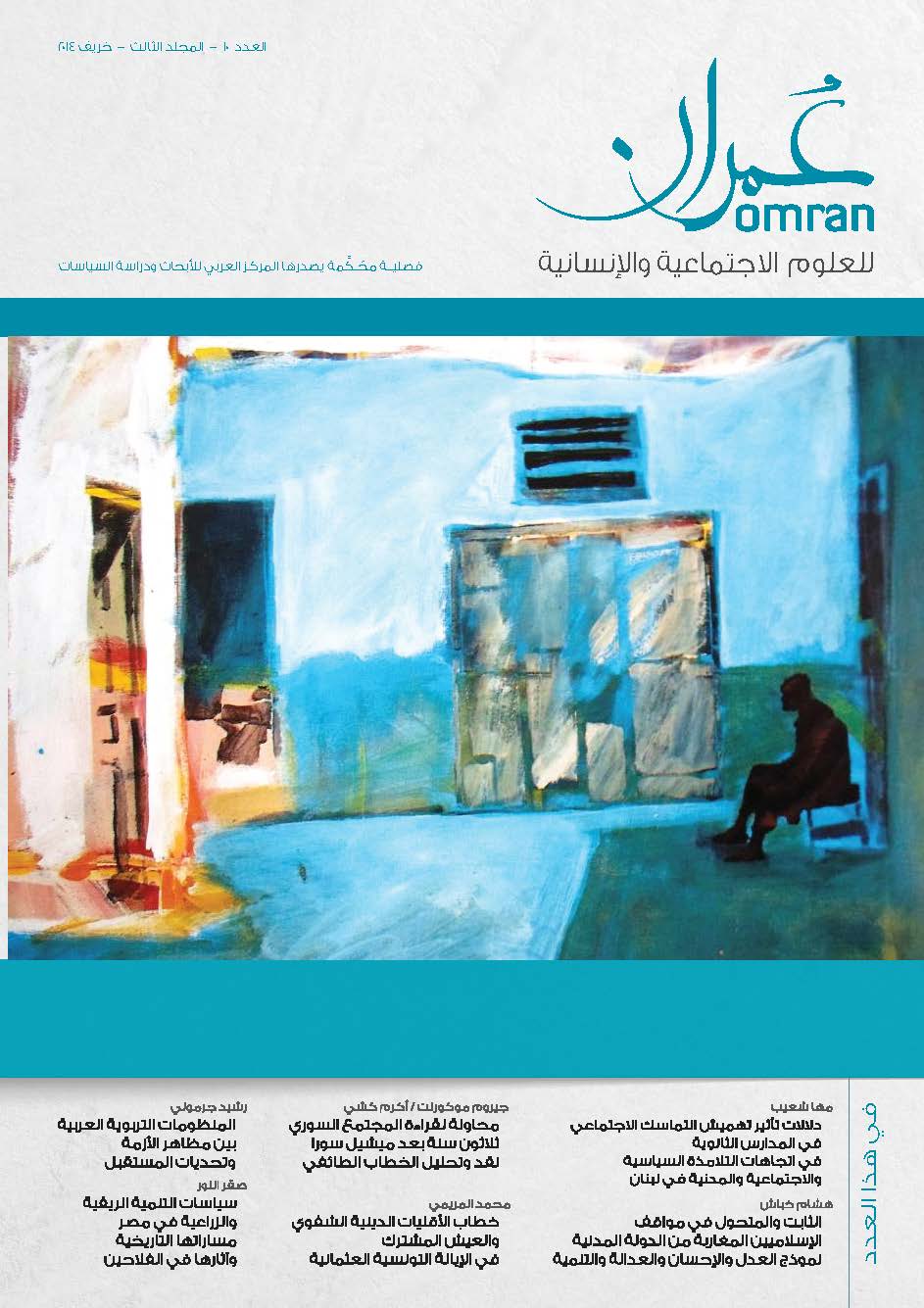
Moroccan Islamists on the Civilian State: Case of the Justice and Charity (Al Adl wal Ihsan) Movement and the Justice and De
DOI:
https://doi.org/10.12816/0007323Keywords:
Civil State, Justice and Charity Movement, Justice and Development PartyAbstract
Khabbashe’s study examines Morocco’s two main Islamist parties’ attitudes towards the modern civil state, and the extent to which members ofJustice and Charity Movement and the Justice and Development Party are willing to change their attitudes on the notion of a civilian state. Khabbashe’s findings reveal that both movements concur in their categorical rejection of a ruler being non-Muslim and in their affirmation of the importance of political participation in the context of an Islamic system of government, which is taken synonymous with shura (consultation). Notable differences are detected, however, with the Justice and Development Party deemed more receptive to partial secularism and to the election of government officials. The change in attitudes for the sample as a whole reveals a rise in the number of positive attitudes towards secularism and a drop in those concerned with its twin, democracy, and a marginal decline in the number of positive attitudes towards party pluralism and the election of government officials.
References
- Alain Gresh, "Sur les braises du "printemps arabe": Les Islamistes à l’épreuve du pouvoir," Le Monde diplomatique (Novembre 2012), pp. 1 et 20-21.
- Serge Moscovici, “Communication introductive à la première conférence internationale sur les représentations sociales,” Papier présentée à: La 1ère Conférence internationale sur les représentations sociales, Ravello, Italie, 1992.
- Joël Candau, Anthropologie de la mémoire , collection Cursus. Sociologie (Paris: A. Colin, 2005), p. 3.
- Jean-Claude Abric, “Central System, Peripheral System: Their Functions and Roles in the dynamics of Social Representations,” Papers on Social Representations = Textes sur les représentations sociales , vol. 2, no. 2 (1993), p. 75. الثابت والمتحول في مواقف الإسلاميين المغاربة من الدولة المدنية
- Gregory R. Maio and Geoffrey Haddock, The Psychology of Attitudes and Attitude Change (Los Angeles; London: SAGE, 2009), p. 91.
- R. J. Rydell and A. R. McConnell, “Consistency and Inconsistency in Implicit Social Cognition: The Case of Implicit and Explicit Measures of Attitudes,” in: Bertram Gawronski and B. Keith Payne, eds., Handbook of Implicit Social Cognition: Measurement, Theory, and Applications (New York: Guilford Press, 2010), p. 300.
- Martha Augoustinos, Iain Walker and Ngaire Donaghue, Social Cognition: An Integrated Introduction , 2nd ed. (London; Thousand Oaks: SAGE, 2006), p. 128.
- Geoffrey L. Cohen, “Party Over Policy: The Dominating Impact of Group Influence on Political Beliefs,” Journal of Personality and Social Psychology , vol. 85, no. 5 (2003), p. 809.
- Dana R. Carney [et al.], “The Secret Lives of Liberals and Conservatives: Personality Profiles, Interaction Styles, and the Things they Leave Behind,” Political Psychology , vol. 29, no. 6 (December 2008), p. 807.
- John T. Jost, Brian A. Nosek and Samuel D. Gosling, “Ideology: Its Resurgence in Social, Personality, and Political Psychology,” Perspectives on Psychological Science , vol. 3, no. 2 (March 2008), p. 126. خريف 2014
- B. A. Nosek, J. Graham and C. B. Hawkins, “Implicit Political Cognition,” in: Gawronski and Payne, eds., p. 551.
- John T. Jost [et al.], “Political Conservatism as Motivated Social Cognition,” Psychological Bulletin , vol. 129, no. 3 (2003), p. 339.
- Abdelhak Jebbar, “Etude Socio-cognitive des croyances politico-religieuses au Maroc,” (Thèse de doctorat en cours, Faculté SAIS Fès), et N. Mahmi, “Connaissance d’autrui et attitudes protocentriques dans les mouvements religieux au Maroc: Une Approche d’ethnographie cognitive,” (Thèse de doctorat en cours, Faculté SAIS Fès).
- Philip E. Tetlock, “Psychology and Politics: The Challenges of Integrating Levels of Analysis in Social Science,” in: Arie W. Kruglanski and E. Tory Higgins, eds., Social Psychology: Handbook of Basic Principles , 2nd ed. (New York: Guilford Press, 2007), p. 905.
- نتحدث في هذا الصدد عن أن الفرد لا يحاول بذل جهد ذهني كبير، لتحليل جملة من القضايا المحيطة به، وإنما يركن إلى نوع من التقتير المعرفي (Cognitive misers) القائم على استدعاء جملة من الإجابات الجاهزة التي اعتاد سماعها من الآخرين. انظر في هذا الصدد: Richard J. Crisp and Rhiannon N. Turner, Essential Social Psychology , 2 nd ed. (Los Angeles: SAGE, 2010), p. 65. الثابت والمتحول في مواقف الإسلاميين المغاربة من الدولة المدنية
- Mahmi, N, op. cit., p 17.
- Tetlock, “Psychology and Politics,” p. 905.
- Gregory R. Maio and G. Haddock, “Attitude Change,” in: Kruglanski and Higgins, eds., p. 571.
- وتجدر الإشارة إلى أن الفرد يلجأ إلى أسلوب إطلاقية رفض الموقف، عندما يمس تبنّي مواقف جديدة بهوية جماعة انتمائه. ويرغب بتشدّده هذا في أن يُظهر مدى ولائه لفضاء انتمائه. انظر:.Augoustinos, Walker and Donaghue, p. 133
- Jeff Greenberg and Eva Jonas, “Psychological Motives and Political Orientation—The Left, the Right, and the Rigid: Comment on Jost et al.,” Psychological Bulletin , vol. 129, no. 3 (2003), p. 376.
- Philip E. Tetlock, “Cognitive Style and Political Belief Systems in the British House of Commons,” Journal of Personality and Social Psychology , vol. 46, no. 2 (February 1984), p. 365.
- Philip E. Tetlock and Richard Boettger, “Cognitive and Rhetorical Styles of Traditionalist and Reformist Soviet Politicians: A Content Analysis Study,” Political Psychology , vol. 10, no. 2 (June 1989), p. 209.
- Nosek, Graham and Hawkins, p. 552. خريف 2014
- Hicham Khabbache, “Empowering Mindreading Skill via Online Social Networks,” in: Analele Universității Ovidius. Seria Filologie (Constanța, Romania: Ovidius University Press, 2012), p. 136.
- Crisp and Turner, p. 161.
- Melissa J. Ferguson, Travis J. Carter and Ran R. Hassin, “On the Automaticity of Nationalist Ideology: The Case of the USA,” in: John T. Jost, Aaron C. Kay, Hulda Thorisdottir, eds., Social and Psychological Bases of Ideology and System Justification (New York: Guilford Press, 2009), p. 53.
- Tetlock, “Psychology and Politics,” p. 905.
- George A. Bonanno and John T. Jost, “Conservative Shift Among High-Exposure Survivors of the September 11th Terrorist Attacks,” Basic and Applied Social Psychology , vol. 28, no. 4 (2006), p. 311.
- Hicham Khabbache, Joël Candau and Abdelhak Jebbar, “Dilemmes sociocognitifs d’Islamistes marocains confrontés au passage conceptuel de l’état religieux à l’état civil,” Societal and Political Psychology International Review , vol. 3, no. 1 (2012), p. 50.
- Nosek, Graham and Hawkins, p. 553. الثابت والمتحول في مواقف الإسلاميين المغاربة من الدولة المدنية
- Maio and Haddock, p. 566.
- Augoustinos, Walker and Donaghue, p. 141.
- Maio and Haddock, p. 566.
- Ian R. Newby-Clark, Ian McGregor and Mark P. Zanna, “Thinking and Caring about Cognitive Inconsistency: When and for Whom Does Attitudinal Ambivalence Feel Uncomfortable?,” Journal of Personality and Social Psychology , vol. 82, no. 2 (February 2002), p. 157. خريف 2014
- Leon Festinger, A Theory of Cognitive Dissonance , Mass Communication Series (Voice of America); 2 (Stanford, CA: Stanford University Press, 1957), p. 7.
- Stella Vosniadou and William F. Brewer, “Mental Models of the Earth: A Study of Conceptual Change in Childhood,” Cognitive Psychology , vol. 24 (1992), p. 535. الثابت والمتحول في مواقف الإسلاميين المغاربة من الدولة المدنية
- تظل فكرة الإمام المجدِّد، الحاضرة في موقع "العدل والاحسان"، صيغة أقل حدية من مبدأ ولاية الفقيه، ولكن يصعب معها الحديث عن ديمقراطية داخلية لدى الجماعة. انظر الموقع الإلكتروني:.>http://www.aljamaa.net<
- عبد السلام ياسين، حوار الماضي والمستقبل (الدار البيضاء: مطبوعات الأفق، 9971)، ص.27 الثابت والمتحول في مواقف الإسلاميين المغاربة من الدولة المدنية
- Nihel Chabrak and Russell Craig, “Student Imaginings, Cognitive Dissonance and Critical Thinking,” Critical Perspectives on Accounting , vol. 24, no. 2 (March 2013).
- Ministère d’éducation nationale et de formation des cadres, Manuel scolaire de la pensée islamique et de la philosophie, Baccalauréat (Rabat: Imprimerie Almaref, 1979), p. 537. الثابت والمتحول في مواقف الإسلاميين المغاربة من الدولة المدنية
- Chabrak and Craig, “Student Imaginings”.
- Clifton E. Brown, Mark E. Peecher and Ira Solomon, “Auditors’ Hypothesis Testing in Diagnostic Inference Tasks,” Journal of Accounting Research , vol. 37, no. 1 (Spring 1999), p. 11.
- Abdessalam Yassine, Islamiser la modernité (Rabat: Al Ofok impressions, 1998).
- Kathleen M. McGraw and Thomas M. Dolan, “Personifying the State: Consequences for Attitude Formation,” Political Psychology , vol. 28, no. 3 (June 2007), p. 299. خريف 2014
- Marilynn B. Brewer, "The Social Psychology of Intergroup Relations: Social Categorization, Ingroup Bias, and Outgroup Prejudice," in: Kruglanski and Higgins, eds., p. 695.
- Nosek, Graham and Hawkins, p. 550. الثابت والمتحول في مواقف الإسلاميين المغاربة من الدولة المدنية
- Abraham Sagie, Dov Elizur and Meni Koslowsky, “Effect of Participation in Strategic and Tactical Decisions on Acceptance of Planned Change,” Journal of Social Psychology , vol. 130, no. 4 (1990), p. 459.
- Hunt and Miller, Cités par: M-A. Martinie and V. Fointiat, “Enfreindre sans craindre: Tolérance à la dissonance dans le paradigme de l’hypocrisie induite,” Psychologie française , vol. 55, no. 1 (Mars 2010), p. 43. خريف 2014
- Robert S. Siegler, “Microgenetic Studies of Self-Explanation,” in: Nira Granott and Jim Parziale, eds., Microdevelopment: Transition Processes in Development and Learning , Cambridge Studies in Cognitive Perceptual Development (Cambridge; New York: Cambridge University Press, 2002), p. 31.
- Martinie and Fointiat, p. 41. الثابت والمتحول في مواقف الإسلاميين المغاربة من الدولة المدنية
- Fayeza S. Ahmed and L. Stephen Miller, “Executive Function Mechanisms of Theory of Mind,” Journal of Autism and Developmental Disorders , vol. 41, no. 5 (May 2011), p. 667.
- Allen R. McConnell and Christina M. Brown, “Dissonance Averted: Self-Concept Organization Moderates the Effect of Hypocrisy on Attitude Change,” Journal of Experimental Social Psychology , vol. 46, no. 2 (March 2010), p.
- Jonathon R. B. Halbesleben and M. Ronald Buckley, “Social Influences on Performance Evaluation: Implications for the Development of Performance Standards,” Journal of Applied Management and Entrepreneurship , vol. 14, no. 3 (2009), p. 74. خريف 2014
- E. Eser Telci, Ceyda Maden and Deniz Kantur, “The Theory of Cognitive Dissonance: A Marketing and Management Perspective,” Procedia - Social and Behavioral Sciences , vol. 24 (2011), pp. 378.
- Carl P. Maertz, Ahmad Hassan and Peter Magnusson, “When Learning Is not Enough: A Process Model of Expatriate Adjustment as Cultural Cognitive Dissonance Reduction,” Organizational Behavior and Human Decision Processes , vol. 108, no. 1 (January 2009), p. 66, and Halbesleben and Buckley, p. 74.
- Nosek, Graham and Hawkins, p. 549.
- N. Epley and A. Waytz, Mind Perception (In Press).
- James T. Tedeschi, ed., Impression Management Theory and Social Psychological Research (New York: Academic Press, 1981), p. 12. 6 حديث وزير الدولة، وزير الشؤون الخارجية والأوروبية آلان جوبيه إلى قناة "الجزيرة" التلفزيونية، نيويورك، تاريخ 22 أيلول/ سبتمبر.2011 الثابت والمتحول في مواقف الإسلاميين المغاربة من الدولة المدنية
- Rachel Karniol, “Egocentrism Versus Protocentrism: The Status of Self in Social Prediction,” Psychological Review , vol. 110, no. 3 (July 2003), p. 564. خريف 2014 Books Gawronski, Bertram and B. Keith Payne (eds.). Handbook of Implicit Social Cognition: Measurement, Theory, and Applications. New York: Guilford Press, 2010. Moscovici, Serge. La Psychanalyse, son image et son public. 2eme ed. Refondue. Paris: Presses universitaires de France, 1976. (Bibliothèque de Psychanalyse) Periodical Elcheroth, Guy, Willem Doise and Stephen Reicher. “On the Knowledge of Politics and the Politics of Knowledge: How a Social Representations Approach Helps Us Rethink the Subject of Political Psychology.” Political Psychology: vol. 32, no. 5, October 2011.
Downloads
Published
Usage statistics
Issue
Section
License
Copyright (c) 2014 Omran for Social Sciences and Humanities

This work is licensed under a Creative Commons Attribution-NonCommercial 4.0 International License.
