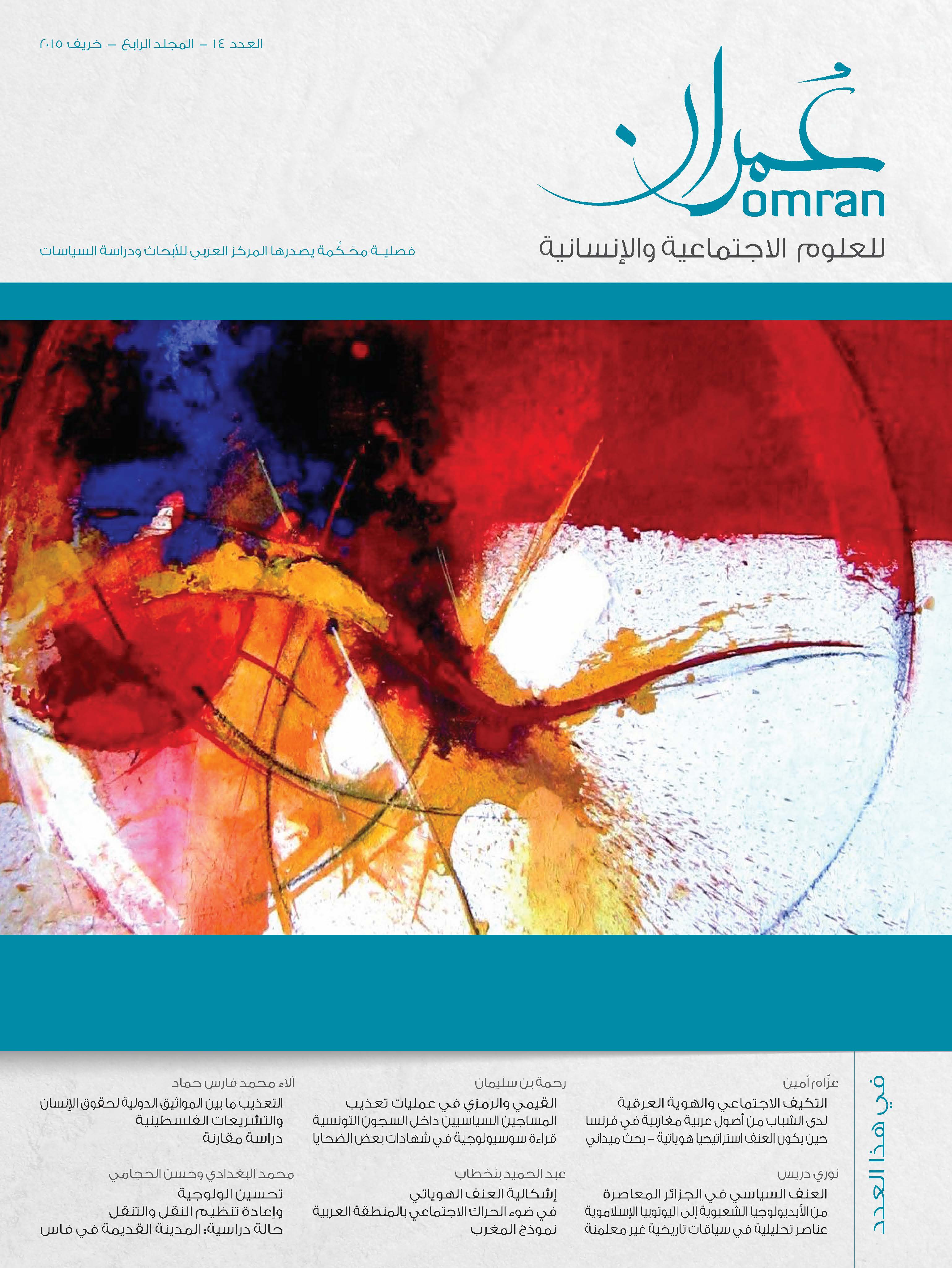
Social Adaptation and Ethnic Identity among Youth of North African Descent in France: When Violence is a Strategic Assertion
DOI:
https://doi.org/10.12816/0017231Keywords:
Social Adaptation, Ethnic Identity, Arab Immigrants in France, Violence, French Identity, Social IntegrationAbstract
This paper aims to shed light on the problem of identity and belonging among French youth of Arab and Muslim descent. It aims to trace, as much as possible, the psychosocial factors that lead some to "reject" French identity, and instead promote their ethnic identity, thereby putting their relationship with French society in a position of confrontation with their assumed identity. This paper assumes that ethnic self-identification (choice of ethnic identity) has neither to do with the individual’s desire for social integration nor with introverted identity, but is rather a defensive strategy to resist the assimilation policies imposed by France on immigrants and their offspring. This paper also assumes that young people do not refuse to integrate into French society, but only refuse to identify exclusively with it – violent behaviors are an expression of this refusal. This research suggests that mechanisms of “integration” and social adaptation can be differentiated from mechanisms of full assimilation into French society.
References
- Dominique Schnapper, Qu’est-ce que l’intégration? , Folio. Actuel ; 125 (Paris: Gallimard, 2007).
- C. Sabatier et J. W. Berry, "The Role of Family Acculturation, Parental Style, and Perceived Discrimination in the Adaptation of Second-Generation Immigrant Youth in France and Canada," European Journal of Developmental Psychology , vol. 5, no. 2 (Special Issue): Immigrant Youth in European Countries (2008).
- Gérard Noiriel, Le Creuset français: Histoire de l’immigration, XIXe-XXe siècles , l’univers historique (Paris: Ed. du Seuil, 1988).
- Audrey Gonin et Azzam Amin, "Discours des acteurs sociaux et processus d’intégration des jeunes Français issus de l’immigration," Migrations société , vol. 19, no. 113: Citoyens et enfants de l’immigration (Septembre-Octobre 2007).
- P. R. Dasen, "Intégration, assimilation et stress acculturatif, " dans: Christiane Perregaux [et al.], Intégrations et migrations, regards pluridisciplinaires , Espaces interculturels (Paris ; Budapest; Torino: L’Harmattan, 2001).
- راجع الورقة الخلفية لمؤتمر: "العنف والسياسة في المجتمعات العربية المعاصرة،" (الدورة الرابعة للمؤتمر العلمي السنوي في قضايا التحوّل الديمقراطي، المركز العربي للأبحاث ودراسة السياسات، أيلول/ سبتمبر 2015)، ص.4
- W. Doise et T. Devos, "Identité et interdépendance: Pour une psychologie sociale de l’Union Européenne," Psychologie et Société , no. 1 (1999).
- استُخدم هذا المصطلح) Acculturation (أول مرة في سنة 1880 في مجال علم الاجتماع والأنثربولوجيا الثقافية، التي اهتمت بدراسة التغيرات الثقافية التي طرأت على المهاجرين في المجتمع الأميركي، وفي منتصف القرن العشرين اعتمده علماء النفس، وراج استخدامه حتى أصبح هناك ما يُسمى علم النفس التثاقفي) interculturelle Psychologie (أو باللغة الإنكليزية Cultural Psychology - Cross.
- J. W. Berry [et al.], "Acculturation Attitudes in Plural Societies," Applied Psychology , vol. 38, no. 2 (April 1989), pp.185–206.
- Henri Tajfel et John Turner, "The Social Identity Theory of Intergroup Behaviour," in: Stephen Worchel and William G. Austin, eds., Psychology of Intergroup Relations , Nelson-Hall Series in Psychology, 2 nd ed. (Chicago: Nelson-Hall Publishers, 1986).
- Jean-Claude Abric, "Les Représentations sociales: Aspects théoriques," dans: Jean-Claude Abric, dir., Pratiques sociales et représentations, Psychologie sociale (Paris: Presses universitaires de France, 1994), et Serge Moscovici, La Psychanalyse, son image et son public , bibliothèque de psychanalyse, 2ème éd. Refondue (Paris: Presses universitaires de France, 1976).
- أو من أصول مسلمة.
- Dounia Bouzar, Comment sortir de l’emprise djihadiste? (Ivry-sur-Seine: les Éditions de l’Atelier-les Éditions ouvrières, 2015).
- J. W. Berry: "Acculturation et identité, " dans: Jacqueline Costa-Lascoux, Marie-Antoinette Hily et Geneviève Vermes, dirs., Pluralité des cultures et dynamiques identitaires: Hommage à Carmel Camilleri , Espaces interculturels (Paris; Montréal: L’Harmattan, 2000), and J.W. Berry, "Psychology of acculturation", in: J. Bernan (Eds.), Nerbraska Symposium on motivation: cross-cultural perspectives (Lincoln: University of Nerbraska Press, 1990), pp. 201-233.
- J. W. Berry [et al.], Cross-Cultural Psychology: Research and Applications (Cambridge; New York: Cambridge University Press, 1992).
- Tajfel et Turner, "The Social Identity Theory".
- John C. Turner [et al.], Rediscovering the Social Group: Self-categorization Theory (Oxford, UK; New York, NY: B. Blackwell, 1987).
- L. Licata, "La théorie de l’identité sociale et la théorie de l’autocatégorisation: le Soi, le groupe et le changement social", Revue électronique de Psychologie Sociale , 1 (2007), pp. 19-33.
- Moscovici, La Psychanalyse.
- Serge Moscovici, "Why a Theory of Social Representations?," in: Kay Deaux and Gina Philogène, eds., Representations of the Social: Bridging Theoretical Traditions (Oxford, UK; Malden, Mass.: Blackwell Publishers,
- Abric, "Les Représentations sociales".
- Willem Doise, "L’Ancrage dans les études sur les représentations sociales," Bulletin de psychologie , vol. 45, fasc. 4-7, no. 405: Nouvelles voies en psychologie sociale (1992),
- Moscovici, La Psychanalyse.
- معارف اجتماعية وليست علمية.
- Jean-Claude Deschamps et Pascal Moliner, L’Identité en psychologie sociale: Des processus identitaires aux représentations sociales, collection Cursus. Psychologie (Paris: A. Colin, DL 2008).
- Abric, "Les Représentations sociales".
- Azzam Amin et Élise Vinet, "Auto-catégorisation ethnique, attitudes d’acculturation et représentations sociales chez les jeunes Français issus de l’immigration maghrébine et turque," Canadian Journal of Behavioural Science= Revue canadienne des sciences du comportement , vol. 46, no. 2 (April 2014).
- Serge Guimond, Psychologie sociale: Perspective multiculturelle , PSY. Individus, groupes, cultures; 4 (Wavre: Mardaga, cop., 2010), and C. Sabatier et J. W. Berry, "Immigration et acculturation," dans: Richard Y. Bourhis et Jacques-Philippe Leyens, dirs., Stéréotypes, discrimination et relations intergroupes , Psychologie et sciences humaines; 204 (Liège: Mardaga, 1994).
- Fasal Kanouté, "Profils d’acculturation d’élèves issus de l’immigration récente à Montréal," Revue des sciences de l’éducation , vol. 28, no. 1 (2002).
- F. Neto, "Quelques contributions de la recherche psychologique à la compréhension du phénomène migratoire portugais," dans: Psychologie clinique et interrogations culturelles: Le Psychologue, le psychothérapeute face aux enfants, aux jeunes et aux familles de cultures différentes: Colloque international, Genève, 7 et 8 Mars 1991 , organisé par le GRAPHIC, Groupe de recherches actions de psychologues pour une éducation interculturelle; sous la dir. de Micheline Rey-von Allmen, recherches universitaires et migrations (Paris: L’Harmattan, 1993), et Michel Oriol, "L’Ordre des identités," Revue européenne des migrations internationals , vol. 1, no. 2 (Décembre 1985).
- Giovanna Campani et Maurizio Catani, " Les Réseaux associatifs italiens en France et les jeunes, " Revue européenne des migrations internationales , vol. 1, no. 2 (Décembre 1985).
- C. Temple, " Stratégies identitaires, trajectoires migratoires et processus d’interculturation: solutions déployées dans le contact culturel par des migrants d’origine japonaise et sénégalaise en France," sous la direction de L. Baugnet et P. Denoux (Thèse de doctorat, Université de Picardie Jules Verne, Amiens, 2006).
- Carmel Camilleri, "Identité et gestion de disparité culturelle: Essai d’une typologie," dans: Carmel Camilleri [et al.], Stratégies identitaires , Psychologie d’aujourd’hui (Paris: Presses universitaires de France, 1990).
- Z. Guerraoui, "L’adolescence d’origine maghrébine en France: quels choix indentificatoires?", Revue de Recherches en Éducation , 20 (1997), pp. 155-170.
- Vijé Franchi, " Ethnicisation des rapports entre élèves: une approche identitaire," Ville-Ecole-Intégration Enjeux (hors série), no. 6 (Décembre 2002).
- ليس لديهم الجنسية الفرنسية.
- Hanna Malewska-Peyre, "L’Identité négative chez les jeunes immigrés," Santé mentale au Québec , vol. 18, no. 1 (Printemps 1993).
- Cécile Sabatier, "Appartenances identitaires de jeunes Français-Maghrébins à l’école élémentaire française: Entre maux et pratiques", Child Health and Education, vol. 3 , no.1 (2011), pp. 62-90.
- Adelhak Qribi, Amélie Courtinat et Yves Prêteur, " Socialisation interculturelle et dynamiques identitaires chez les jeunes adultes issus de l’immigration maghrébine en France, " International Review of Education , vol. 56, no. 5 (December 2010).
- R. Y. Bourhis [et al.], "Etude sur les orientations d’acculturation de Maghrébins et de Français d’origine en région Parisienne," dans: Colette Sabatier, Hanna Malewska et Fabienne Tanon, dirs., Identités, acculturation et altérité , Espaces interculturels (Paris; Budapest; Torino: L’Harmattan, 2002).
- J. W. Berry et Colette Sabatier, "Acculturation, Discrimination, and Adaptation among Second Generation Immigrant Youth in Montreal and Paris," International Journal of Intercultural Relations , vol. 34, no. 3 (2009).
- Dasen, " Intégration, assimilation". النسبة = 2.13 في المئة
- J. W. Berry [et al.], "Immigrant Youth: Acculturation, Identity, and Adaptation," Applied Psychology , vol. 55, no. 3 (July 2006).
- جميع المحكمين فرنسيون، باستثناء جون بيري، وهم من المختصين في البحوث في مجال علم النفس التثاقفي.
- لن نتطرق إلى التهميش لأنه، بحسب بيري، يشكّل نوعًا ما حالة مرضية، وهذا لا يدخل في مجال بحثنا. انظر: J. W. Berry and U. Kim, "Acculturation and Mental Health," in: P. R. Dasen, J. W. Berry and N. Sartorius, eds., Health and Cross-Cultural Psychology: Toward Applications , Cross-Cultural Research and Methodology Series; 10 (Newbury Park: Sage Publications, 1988).
- أصل هذا الاختبار النفسي أميركي، ووضعه بوجونتال وزيلين سنة 5019، وتم تطويره وترجمته إلى كثير من اللغات. انظر: Manford H. Kuhn and Thomas S. McPartland, "An Empirical Investigation of Self-Attitudes," American Sociological Review, vol. 19, no. 1 (February 1954).
- Guimond, Psychologie sociale.
- Vijé Franchi, "Approche clinique et sociocognitive des processus identitaires et de la représentation de soi en interculturel," sous la direction de Anne Andronikof-Sanglade (Thèse de doctorat en Psychologie, Paris X, Nanterre, 1999); Malewska-Peyre, "L’Identité négative "; I. Taboada-Léonetti, " De l’aliénation à la prise de conscience: L’Itinéraires de l’identité des migrants réunionnais en Métropole," (Thèse de doctorat en psychologie, non publiée, Paris, Université Paris IV, Sorbonne, 1975), et Centre de formation et de recherche de l’éducation surveillée (C.F.R.E.S.), Crise d’identité et déviance chez les jeunes immigrés: Recherche pluridisciplinaire , recherche effectuée pour le Ministère de la justice, Service de coordination de la recherche; sous la direction de H. Malewska-Peyre (Paris: La Documentation française, 1982).
- بواسطة اختبار بونفيروني) Test de Bonferroni (تأكد الباحث من إمكانية اعتبار المشاركين من أصول جزائرية وتونسية ومغربية عينة واحدة، فالنتائج أظهرت عدم وجود أي فروق ذات دلالة إحصائية بين المتوسطات الحسابية. للتأكد من الفرضييات الرابعة (Coefficient de corrélation linéaire de Pravais-Pearson)
- E. Goffman, Stigmate: les usages sociaux des handicaps. Trad. Franc., par A. Kihm (Paris: Minuit, 1963). ن148 =
- عشرة من أفراد هذه العينة لم يجاوبوا على اختبار "من أكون؟." بين التصنيف الذاتي على (Coefficient de corrélation linéaire de Vravais-Pearson) بيرسون
- Dasen, " Intégration, assimilation," et Guimond, Psychologie sociale.
- Sabatier et Berry, "Immigration et acculturation".
- W. Doise & F. Lorenzi-Cioldi, "L’identité comme représentation sociale", in: V. Aebischer, J.P. Deconchy, E. M. Lipiiansky (Eds.), Idéologies et représentations sociales (Cousset, Suisse: Delval, 1991), pp. 273-286.
- Moscovici, La Psychanalyse.
- Roger Fauroux, La Lutte contre les discriminations ethniques dans le domaine de l’emploi (Paris: La documentation française, 2005) ; Laurent Mucchielli, " Délinquance et immigration en France: Un Regard sociologique," Criminologie , vol. 36, no. 2 (Automne 2003), et Didier Lapeyronnie et Laurent Courtois, Ghetto urbain: Ségrégation, violence, pauvreté en France aujourd’hui , le monde comme il va (Paris: R. Laffont, 2008).
- La Documentation française, Immigrations, qu’en savons nous?: Un Bilan des connaissances , réd. par François Dubet avec la collab. de Catherine Flé, notes et études documentaires; 4887 (Paris: La Documentation française, 1989).
- Schnapper, Qu’est-ce que l’intégration?.
- J. M. Olson and C. L. Hafer, "Affect, Motivation, and Cognition in Relative-Deprivation Research," in: Richard M. Sorrentino and E. Tory Higgins., eds., Handbook of Motivation and Cognition: Foundations of Social Behavior , 3 vols. (New York: Guilford Press, 1986-1996), vol. 3: Interpersonal Context.
- S. Guimond et F. Tougas, " Sentiments d’injustice et actions collectives: La Privation relative," dans: Bourhis et Leyens, dirs., Stéréotypes, 1994.
- Henri Tajfel et John Turner: "The Social Identity Theory," and "An Integrative Theory of Intergroup Conflict," in: William G. Austin and Stephen Worchel, eds., The Social Psychology of Intergroup Relations (Monterey, Calif.: Brooks/ Cole Pub. Co., 1979).
- Maykel Verkuyten and Angela de Wolf, "Ethnic Minority Identity and Group Context: Self-Descriptions, Acculturation Attitudes and Group Evaluations in an Intra- and Intergroup Situation," European Journal of Social Psychology , vol. 32, no. 6 (November-December 2002).
- I. Taboada-Léonetti, " Citoyenneté, nationalité et stratégies d’appartenance," dans: Costa-Lascoux, Hily et Vermes, dirs., Pluralité des cultures et dynamiques identitaires.
- Pierre Tap, "Préface, " in: Altay Manço, Intégration et identités: Stratégies et positions des jeunes issus de l’immigration , préf. de Pierre Tap, L’homme, l’étranger (Bruxelles; [Paris]: De Boeck université, 1999).
- Nimmi Hutnik: "Patterns of Ethnic Minority Identification and Modes of Social Adaptation," Ethnic and Racial Studies , vol. 9, no. 2 (April 1986), and N. Hutnik, Ethnic minority identity: A social psychological perspective (Oxford, UK: Clarendon, 1991).
- Anders Lange, "Identifications, Perceived Cultural Distance and Stereotypes in Yugoslav and Turkish Youth in Stockholm," in: Karmela Liebkind., ed., New Identities in Europe: Immigrant Ancestry and the Ethnic Identity of Youth (Aldershot, England; Brookfield, Vt.: Gower, 1989).
- Boris Snauwaert [et al.], "When Integration Does Not Necessarily Imply Integration Different Conceptualizations of Acculturation Orientations Lead to Different Classifications," Journal of Cross-Cultural Psychology , vol. 34, no. 2 (March 2003).
- Sabatier et Berry, "The Role of Family Acculturation," and Noiriel, Le Creuset français.
- Claude Clanet, L’Interculturel: Introduction aux approches interculturelles en éducation et en sciences humaines , Interculturels (Toulouse: Presses universitaires du Mirail, 1990), and Guimond, Psychologie sociale.
- الواقع يختلف عمّا هو موجود في القوانين.
- G. Felouzis, "Ethnicité et ségrégation dans les écoles française", in: J. Polard, A-G Gagnon, & B. Gagnon (Eds), Diversité et identité au Québec et dans les régions d’Europe (Québec: Presse de l’Université Laval, 2006), pp. 305-318.
- Bouzar, Comment sortir de l’emprise djihadiste?.
- Dasen, " Intégration, assimilation".
- Bernard Lorreyte, " Français et immigrés: Des Miroirs ambigus, " dans: Carmel Camilleri et Margalit Cohen- Emerique, dirs., Chocs de cultures: Concepts et enjeux pratiques de l’interculturel , Espaces interculturels (Paris: L’Harmattan, 1989).
- Julien Vidal et Anne Brissaud-Le Poizat, "De l’exploration des liens entre représentation sociale, catégorisation et stéréotype," dans: Patrick Rateau et Pascal Moliner, eds., Représentations sociales et processus sociocognitifs , Didact. Psychologie sociale (Rennes: Presses universitaires de Rennes, 2009).
- Glynis M. Breakwell, "Integrating Paradigms, Methodological Implications," in: Glynis M. Breakwell and David V. Canter, eds., Empirical Approaches to Social Representations (Oxford: Clarendon Press; New York: Oxford University Press, 1993), and Patrick Rateau et Pascal Moliner, " Introduction: Représentations sociales et processus sociocognitifs," in: Rateau et Moliner, eds., Représentations sociales.
- المسلم لا يُقدَّم على أنه مواطن وإنما على أنه الآخر المختلف. Dubet, François et Didier Lapeyronnie. Les Quartiers d’exil. Paris: Éd. du Seuil, 1992. (l’épreuve des faits) Barrette, Geneviève [et al.]. " Acculturation Orientations of French and North African Undergraduates in Paris." International Journal of Intercultural Relations: vol. 28, no. 5 (2004). Boutry-Avezou, V., C. Sabatier et C. Brisset. "Bien-être, adaptation et discrimination. Les adolescents de seconde génération à l’école." Revue Francophone du Stress et du Trauma: vol. 7, no. 3, 2007.
Downloads
Published
Usage statistics
Issue
Section
License
Copyright (c) 2015 Omran for Social Sciences and Humanities

This work is licensed under a Creative Commons Attribution-NonCommercial 4.0 International License.
