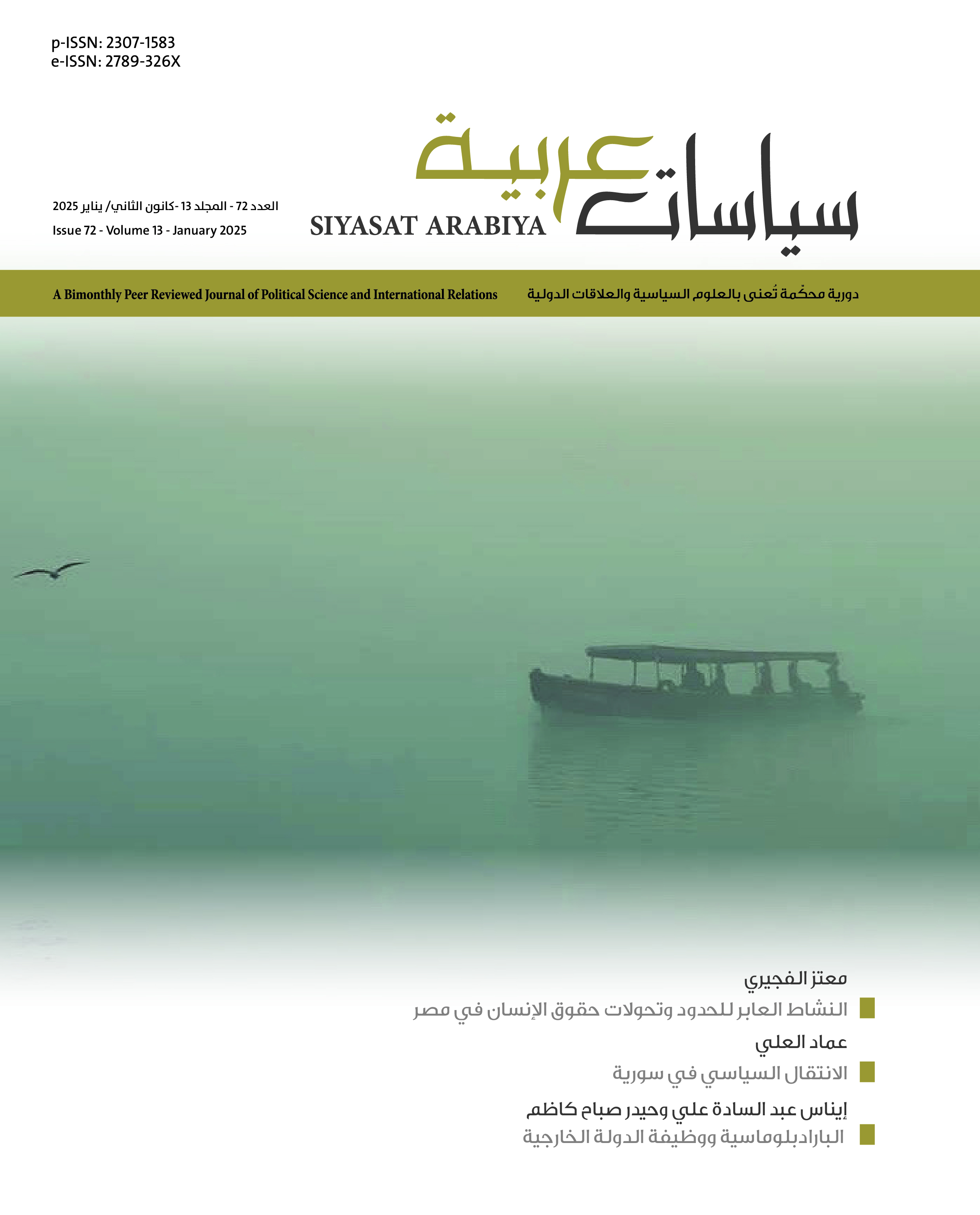
Paradiplomacy and State’s Foreign Function: Adaptation or Restructuring?
DOI:
https://doi.org/10.31430/EGCP1164Keywords:
Paradiplomacy, Foreign Affairs, DecentralizationAbstract
In the past two decades of the twentieth century, global politics witnessed significant transformations in the structures of international actors and their patterns of interaction. Among these was the rise of decentralized governments that were granted greater powers and authorities, enabling them to advance their economic, cultural, and political interests and to participate alongside the central government in managing foreign affairs. This phenomenon, known as paradiplomacy, contributed to restructuring relations between the center and the peripheries on the one hand and between the peripheries and the outside world on the other, posing new challenges to the state system established by the Treaty of Westphalia, upon which the modern international order is based. The paper concludes that this phenomenon can offer the state an opportunity to achieve the desired balance between control and guidance as part of its efforts to maintain its traditional functions and its status as a Westphalian actor within a system of multi-level and multi-layered global governance characterized by complex and overlapping relationships.References
- ينظر على سبيل المثال: Ivo D. Duchacek, "The International Dimension of Subnational Self- Government," Publius: The Journal of Federalism , vol. 14, no. 4 (Autumn 1984); Ivo D. Duchacek, "Perforated Sovereignties: Towards a Typology of New Actors in International Relations," in: H. Michaelmann & P. Soldatos (eds.), Federalism and International Relations: the Role of Subnational Units (New York: Oxford University Press, 1990); Brian Hocking, Localizing Foreign Policy: Non-Central Government and Multilayered Diplomacy (London: Macmillian Press, 1993); Michael Keating, "Regions and International Affairs: Motives, Opportunities and Strategies," in: Francisco Aldecoa & Michael Keating (eds.), Paradiplomacy in Action: The Foreign Relations of Subnational Governments (London: Frank Cass & Co. Ltd, 1999); Michael Keating, "Regions and International Affairs: Motives, Opportunities and Strategies," Regional and Federal Studies , vol. 9, no. 1 (December 1999).
- ينظر على سبيل المثال: Brian Hocking, "Managing Foreign Relations in Federal States: Linking Central and Non-Central International Interests," in: Brian Hocking (ed.), Foreign Relations and Federal States (New York: St. Martin's Press, 1993); Aldecoa & Keating (eds.); André Lecours, "Paradiplomacy: Reflections on the Foreign Policy and International Relations of Regions," International Negotiation , vol. 7, no. 1 (January 2002); Rob Jenkins, "India's States and the Making of Foreign Economic Policy: The Limits of the Constituent Diplomacy Paradigm," Publius: The Journal of Federalism , vol. 33, no. 4 (Autumn 2003); Matthew S. Mingus, "Transnationalism and Subnational Paradiplomacy: Are Governance Networks Perforating Sovereignty?" International Journal of Public Administration , vol. 29, no. 8 (Septmber 2006).
- أيمن إبراهيم الدسوقي، الدبلوماسية الموازية، سلسلة مفاهيم (القاهرة: المركز الدولي للدراسات المستقبلية، 2008)؛ أيمن الدسوقي، الدبلوماسية الموازية: دراسة نظرية وتطبيقية، سلسلة البحوث السياسية 164 (القاهرة: جامعة القاهرة، مركز البحوث والدراسات السياسية، 2008)؛ أيمن إبراهيم الدسوقي، "الدبلوماسية الموازية: الفاعلية الدولية للحكومات الإقليمية: دراسة مقارنة لبعض الأقاليم"، مجلة النهضة، مج 9، العدد 3 (2008)، ص 163-155؛ أيمن إبراهيم الدسوقي، "القومية والدبلوماسية الموازية: تحليل مقارن"، مجلة النهضة، مج 9، العدد 4 (2008)، ص 142-101؛ أيمن إبراهيم الدسوقي، "عالمية الدبلوماسية الموازية وآفاق تطورها"، السياسة الدولية، العدد 219 (كانون الثاني/ يناير 2020)، ص 81-64؛ إيناس عبد السادة علي وعلي حسين حميد، "البارادبلوماسي: دور الوحدات دون الدولة في السياسة الخارجية"، مجلة جيل الدراسات السياسية والعلاقات الدولية، مج 4، العدد 21 (كانون الأول/ ديسمبر 2018)، ص 66-55؛ إيناس عبد السادة علي، "البارادبلوماسي: لمحة تعريفية موجزة"، المجلة العربية للنشر العلمي، العدد 15 (كانون الثاني/ يناير 2020)، ص 39 -.58
- أيمن إبراهيم الدسوقي، "تنامي العلاقات الخارجية والتوجّه الانفصالي لكردستان العراق"، شؤون خليجية، مج 12، العدد 63 (أيلول/ سبتمبر 2010)، ص 28-10؛ سكالا حسين حمة أمين وناريان رؤوف عزيز، "بارادبلوماسية إقليم كوردستان العراق: بين ثبات الأهداف وتغّير المواقف"، مجلة جامعة كرميان، مج 4، العدد 3 (تموز/ يوليو 2017)، ص 451-431؛ أيمن إبراهيم الدسوقي وياسين محمود عبابكر، "المتغيرات الداخلية للدبلوماسية الموازية لإقليم كردستان العراق بعد "1991، مجلة جامعة دهوك، مج 22، العدد 1 (2019)، ص 31-1؛ ياسين عبابكر، "التوجّه الانفصالي في الدبلوماسية الموازية دراسة حالة إقليم كردستان العراق (2017-2003)"، أطروحة أعدت لنيل درجة الدكتوراه، جامعة القاهرة، القاهرة، 2020؛ نهيل صادق مصطفى وأرمان اسمعيل دادفر، "الدبلوماسية الموازية لإقليم كوردستان العراق أثناء حرب داعش ")2017-2014(، مجلة جامعة دهوك، مج 25، العدد 2 (2022)، ص 943-925؛ ياسين محمود جوماني، الدبلوماسية الموازية بين النظرية والتطبيق دراسة حالة إقليم كوردستان (أربيل: دار التفسير للطبع والنشر، 2023)؛ حيدر صباح كاظم، "الصلاحيات الخارجية للأقاليم في الأنظمة الفيدرالية: بارادبلوماسية إقليم كردستان دراسة حالة"، رسالة أعدت لنيل شهادة الماجستير، جامعة بغداد،.2023
- جميلة عباوي، "الدبلوماسية الموازية وخوصصة السياسة الخارجية"، مجلة الحقوق، العدد 16 - 17 (كانون الأول/ ديسمبر 2014)، ص 212 -.240
- أيمن الدسوقي، "الدبلوماسية التأسيسية للأقاليم الساعية للانفصال... دراسة نظرية وتطبيقية"، السياسة الدولية، العدد 223 (كانون الثاني/ يناير 2021)، ص 38 -.55
- Ayman I. El-Dessuki, "Structural Contexts and Paradiplomacy of Iraqi Kurdistan," Al-Nahd ̣ ah , vol. 13, no. 2 (April 2012), pp.1-38; Sardar Mosa Sharif, An Analysis of Kurdistan Region of Iraq Diplomacy and Foreign Policy objectives 2003 - 2013 Case Study (Duhok: Dissertation Submitted To Faculty Board of Administration & Economic Duhok University, 2015); Ayman el-Dessouki, "Domestic Structure and Sub-National Foreign Policy: An Explanatory Framework," Review of Economics and Political Science , vol. 3, no. 3 / 4 (November 2018), pp. 102-118; Yasin Mahmood Ababakr, "Iraqi Kurdistan Region: from Paradiplomacy to Protodiplomacy," Review of Economics and Political Science (August 2020).
- Inass Abdulsada Ali & Faieq Hassen Jasem, "Sub-National Governments' Interactions in International Affairs: An Arab Perspective on Paradiplomacy," International Area Studies Review , vol. 27, no. 4 (2024), p. 435.
- Rohan Butler, "Paradiplomacy," in: A. O. Sarkissian (ed.), Studies in Diplomatic History and Historiography in Honour of G.P. Gooch (London: Longmans, 1961), p. 13.
- Iñaki Aguirre, "Making Sense of Paradiplomacy? An Intertextual Enquiry about a Concept in Search of a Definition," Regional and Federal Studies , vol. 9, no. 1 (December 1999), pp. 185, 187.
- Keating, "Regions and International Affairs: Motives, Opportunities and Strategies," p. 1.
- Ronald G. Atkey, "The Role of the Provinces in International Affairs," International Journal: Canada's Journal of Global Policy Analysis , vol. 26, no. 1 (Winter 1970/ 1971).
- Thomas Allen Levy, "The Role of the Canadian Provinces in External Affairs: A Study in Canadian Federalism," A Paper Presented to the Annual Meeting of the Canadian Political Science Association at McGill University,
- Duchacek, "The International Dimension of Subnational Self- Government."
- Panayotis Soldatos, "An Explanatory Framework for the Study of Federated States as Foreign Policy Actors," in: Hans J. Michelmann & Panayotis Soldatos (eds.), Federalism and International Relations: The Role of Subnational Units (Oxford: Clarendon Press, 1990), p. 17.
- Noe Cornago, "On the Normalization of Sub-State Diplomacy," The Hague Journal of Diplomacy , vol. 5, no. 1 - 2 (February 2010), p. 40.
- Stefan Wolff, "Paradiplomacy: Scope, Opportunities and Challenges," The Bologna Center Journal of International Affairs , vol. 10 (April 2007), p. 141.
- Ramón Lohmar Sainz de Vicu ň a, "Catalan Paradiplomacy, Secessionism and State Sovereignty: The Effects of the 2006 Statute of Autonomy and the Artur Mas Government on Catalan Paradiplomacy," Master Thesis, Institute of Political Science/ Faculty of Social & Behavioural Sciences/ Leiden University, Leiden, 2015, p. 8.
- John Kincaid, "The American Governors in International Affairs," Publius: The Journal of Federalism , vol. 14, no. 4 (Autumn 1984), pp. 96 - 100.
- Hubert Rioux Ouimet, "From Sub-state Nationalism to Subnational Competition States: The Development and Institutionalization of Commercial Paradiplomacy in Scotland and Quebec," Regional & Federal Studies , vol. 25, no. 2 (March 2015), p. 111.
- Jean Marc Blondeau, "Québec's Experiences in Global Relations," Paper Presented at the Conference: Foreign Relations of Constituent Units, Winnipeg, Manitoba, 11-12/5/2001; Rodrigo Tavares, Paradiplomacy: Cities and States as Global Players (UK: Oxford University Press, 2016), pp. 10 - 11.
- Marylis Fantoni & Claudia Avellaneda, "Explaining Paradiplomacy: Do Local Pro International Structures and Political Support Matter?" Global Public Policy and Governance , vol. 2, no. 3 (September 2022), p. 361.
- Daniel Thürer, "Federalism and Foreign Relations," in: Raoul Blindenbacher & Arnold Koller (eds.), Federalism in a Changing World: Learning from Each Other (Canada: McGill-Queen's University Press, 2003), p. 28.
- John Kincaid, "Foreign Relations of Sub-national Units," in: Blindenbacher & Koller (eds.), p. 75.
- بتول حسين علوان، "مفهوم الدولة وأركانها في الفكر الإسلامي المعاصر"، مجلة العلوم السياسية، العدد 43 (كانون الثاني/ يناير 2011)، ص 150 -.152
- سعدي كريم سلمان، "وظائف الدولة (في الفكر السياسي العربي الإسلامي")، مجلة العلوم السياسية، العدد 35 (كانون الأول/ ديسمبر 2007)، ص 105 -.106
- علي عباس عبيد، "القضايا العالقة بين الحكومة الاتحادية وإقليم كردستان (الحلول الدستورية والقانونية")، مجلة العلوم السياسية، العدد 61 (أيلول/ سبتمبر 2021)، ص.421
- ابتسام محمد عبد، "الفيدرالية وإشكالية العلاقة بين المركز والإقليم في العراق"، مجلة العلوم السياسية، العدد 51 (شباط/ فبراير 2019)، ص 150 -.151
- E. C. Kamarck, "Globalization and Public Administration Reform," in: Joseph S. Nye Jr. & John D. Donahue (eds.), Governance in a Globalizing World (Washington, D.C: Brookings Institution Press, 2000).
- Robert I. Rotberg, "The New Nature of Nation-State Failure," The Washington Quarterly , vol. 25, no. 3 (Summer 2002).
- Pippa Norris, "Global Governance and Cosmopolitan Citizens," in: Nye Jr. & Donahue (eds.).
- Aldecoa & Keating (eds.).
- Cornago, pp. 40 - 41.
- Ibid., pp. 48 - 49.
- André Lecours, "Political Issues of Paradiplomacy: Lessons from the Developed World," Discussion Papers in Diplomacy , Netherlands Institute of International Relations 'Clingendael', 2008, p. 1.
- مريم وحيد مخيمر، "السلطة غير المركزية: تحّولّات شكل السلطة في مراحل ما بعد الثورات العربية"، السياسة الدولية، (الملحق)، العدد 189 (2012)، ص.11
- Francis Fukuyama, State-Building: Governance and World Order in the 21st Century (New York: Cornell University Press, 2004).
- Francisco Aldecoa & Michael Keating, "Introduction," in: Aldecoa & Keating (eds.); Aguirre.
- Peter Marshall, Positive Diplomacy (New York: Palgrave Publishers Ltd,
- Jan Aart Scholte, "The Globalization of World Politics," in: John Baylis & Steve Smith, The Globalization of World Politics: An Introduction to International Relations , 2 nd ed. (New York: Oxford University Press, 2001).
- Anne-Marie Slaughter, "The Real New World Order," Foreign Affairs , vol. 76, no. 5 (Septmber/ October 1997).
- هيدلي بول، المجتمع الفوضوي: دراسة النظام في السياسة العالمية (دبي: مركز الخليج للأبحاث، 2006)، ص 347 -.348
- محمد سعدي، مستقبل العلاقات الدولية من صراع الحضارات إلى أنسنة الحضارة وثقافة السلام، ط 2 (بيروت: مركز دراسات الوحدة العربية، 2008)، ص 290 -.291
- إسماعيل صبري مقلّد، العلاقات السياسية الدولية: النظرية والواقع (القاهرة: المكتبة الأكاديمية، 2011)، ص 93 -.94
- Brian Hocking, "Patrolling the 'Frontier': Globalization, Localization and the 'Actorness' of Noncentral Governments," Regional & Federal Studies , vol. 9, no. 1 (1999). المصدر: من إعداد الباحَثيَن.
- Geoffrey A. Pigman, Contemporary Diplomacy (Cambridge: Polity Press, 2010).
- Samuel Lucas McMillan, "Subnational Foreign Policy Actors: How and Why Governors Participate in U.S. Foreign Policy," Foreign Policy Analysis , vol. 4, no. 3 (July 2008).
- Keating, "Regions and International Affairs: Motives, Opportunities and Strategies."
- Aldecoa & Keating, "Introduction." المصدر: المرجع نفسه.
- حوارات حول العلاقات الخارجية في الدول الفيدرالية، راؤول بليندنباخر وشاندرا باسما (محرران)، سلسلة كتيبات حوار عالمي حول الفيدرالية، ج 5 (تورينو: منشورات منتدى الاتحادات الفيدرالية والرابطة الدولية لمراكز الدراسات الفيدرالية، 2007)، ص.3
- لويد جنسن، تفسير السياسة الخارجية، ترجمة محمد بن أحمد المفتي ومحمد السيد سليم (الرياض: جامعة الملك سعود، 1989)، ص 132 -.134
- محمد السيد سليم، تحليل السياسة الخارجية (القاهرة: مكتبة النهضة المصرية، 1998)، ص.131 الهياكل ا وارد الدوافع ا هداف اساتيجيات ا شاركة المصدر: المرجع نفسه.
- حوارات حول العلاقات الخارجية في الدول الفيدرالية، ص 4،.8
- Pertti Joenniemi & Alexander Sergunin, "Paradiplomacy as a Capacity- Building Strategy," Problems of Post-Communism , vol. 61, no. 6 (November 2014), p. 20.
- Robert Kaiser, "Sub-State Governments in International Arenas: Paradiplomacy and Multi-level Governance in Europe and North America," in: S. Paquin & G. Lachapelle (eds.), Mastering Globalization: New Sub-States' Governance and Strategies (UK: Routledge, 2005).
- Hendrik Spruyt, The Sovereign State and its Competitors (New Jersey: Princeton University Press, 1994).
- سعيد الصديقي، "السياسة الخارجية والديمقراطية: تعارض أم توافق؟"، المجلة العربية للعلوم السياسية، العدد 15 (كانون الثاني/ يناير 2007)، ص.148
Downloads
Published
2025-01-01
Article dates
Received: March 12, 2024 Revised: September 4, 2024 Accepted: December 11, 2024
Usage statistics
40 views 61 downloads
Issue
Section
Studies
License
Copyright (c) 2024 Inass Abdulsada Ali, Hayder Sabah Kadhim (Author)

This work is licensed under a Creative Commons Attribution-NonCommercial 4.0 International License.