Vol. 2 No. 006 (2014): Issue 006
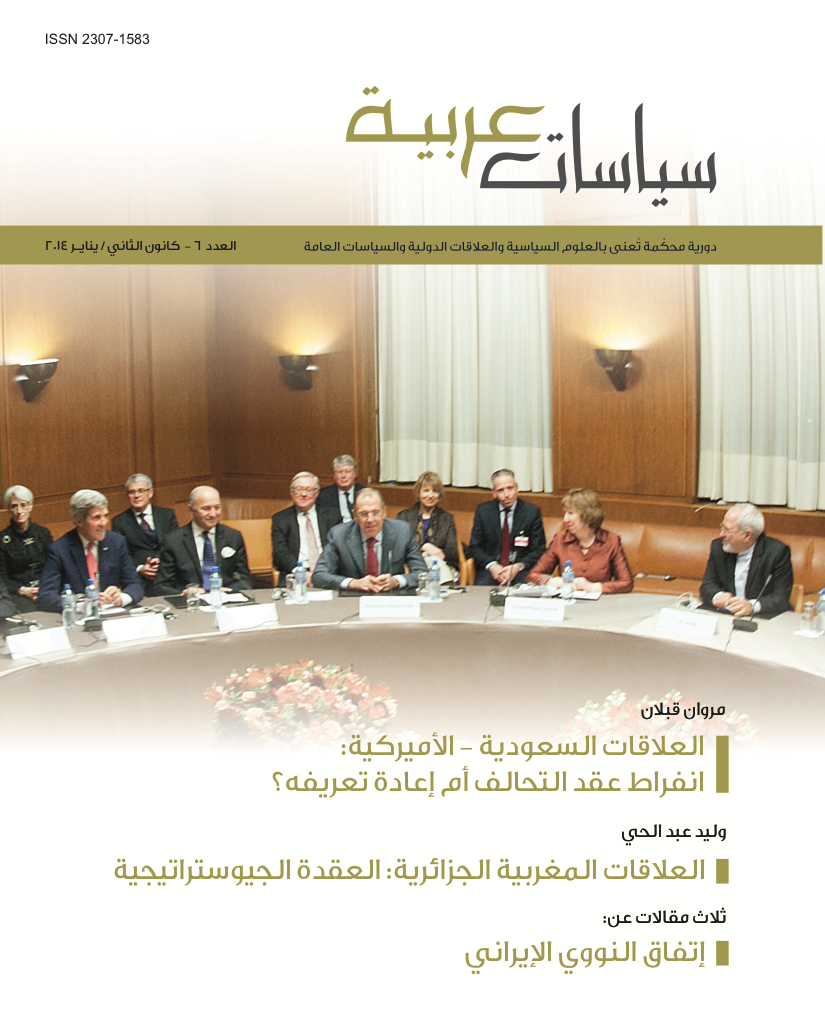
​ACRPS has published issue 6 of the bi-monthly peer-reviewed academic journal Siyasat Arabia, a journal devoted to political science and international relations. This issue features the following studies and articles: “Saudi-American Relations: Alliance Unraveling or Redefined?” (Marwan Kabalan); “Unprecedented Settler Attacks are the Netanyahu Government’s Sole Project” (Mahmoud Muhareb); “Moroccan-Algerian Relations: The Geo-Strategic Knot” (Walid Abdulhay); “How will the Conflict between Erdogan and Gulen Affect the Turkish Political Scene?” (ACRPS Policy Analysis Unit); “The Iranian Nuclear Agreement: Necessity, Self-Interest, and a Change in Tune” (Fatima Samadi); “Iran and the Geneva Agreement: Legitimacy Renewed or Meeting the Latest Challenge?” (Mahjoob Zweiri); “Regional and International Implications of the Iranian Nuclear Agreement” (Ibrahim Sharqieh); “Confessionalism and Civil War’s Fuse in Yemen” (Anwar ben Qassem al-Khodari); “The Political Scene in Tunisia: The Long Road to Concord” (Anouar Jamaoui); “The Ramifications of Designating the Muslim Brotherhood as Terrorist Group” (ACRPS Policy Analysis Unit); “Are State and Society in Egypt Ready for Transitional Justice and National Reconciliation?” (Rawia Tawfik); “Egyptian Media Strategies During Mohammad Morsi’s Rule and Following the Coup” (Osama al-Rashidi); “The Role of the International Criminal Court in Punishing Crimes of Aggression in Light of the Kampala Amendments” (Shumama Kheireddine); “Brazil and the Arab Spring Revolutions” (Sodfa Mohammed Mahmoud); and “Public Opinion Trends Regarding State Institutions” (Mohammed al-Masri).The book review section features a number of reviews, including Salma Mousa’s review of Soldiers, Spies and Statesmen: Egypt’s Road to Revolt; a review by Khaled al-Aswar of the second part of Egypt and its Islamists after the January 25 revolution; and Mona Sukkarieh’s review of “Theories of International Relations”. There are four book presentations by Ziad Muna: Hitler’s Hatred for the Jews: Stereotype and Reality; British Empire: Resistance, Persecution, Revolutions; Fortress Israel; and Of Empires and Citizens. The issue also contains reports on the ACRPS’s Second Annual Conference of Arab Research Centers, “The Question of Palestine and the Future of the Palestinian National Project”, and another on an ACRPS seminar “The Plan for Democratic Transformation in Syria.” The journal also chronicles the most significant milestones of democratic transition in the Arab world, and the latest Palestinian developments.

Original Website (English) | Original Website (Arabic)

Published: 2014-01-01

Articles

  • US-Saudi Relations: The Disintegration of an Alliance or its Redefinition?

    Author: Marwan Kabalan
    5-18

    This study attempts to determine the latest changes in the US-Saudi alliance and reflect on its destabilization.

  • The Unprecedented Settlement Surge is the Sole Project of Netanyahu’s

    Author: Mahmoud Muhareb
    19-30

    Settlement and occupation of Arab lands constitute paramount values in Zionist ideology and are highly important in the politics of all Zionist currents

  • Moroccan-Algerian Relations: The Geostrategic Complex

    Author: Walid Abdulhay
    31-40

    This paper tackles the Algerian-Moroccan rivalry over the position of central state in North Africa and explores the stages of the Algerian-Moroccan conflict.

  • The Erdogan-Gulen Rift: the Impact on Turkish Politics

    Author: Policy Analysis Unit- ACRPS
    41-44

    In December of 2013, Turkish Prime Minister Recep Tayyip Erdogan reshuffled his cabinet, dismissing four ministers linked to a nationwide corruption scandal.

  • The Iranian Nuclear Deal: Needs, Interests and Change of Rhetoric

    Author: Fatima Samadi
    45-51

    The Iranian nuclear agreement was the result of a pressing domestic need.

  • Iran and the Geneva Interim Agreement: Renewal of Legitimacy or Response to a Temporary Challenge?

    Author: Mahjoob Al Zweiri
    52-58

    The Iranian political regime represented by the ruling establishment decided to sign the Geneva Interim Agreement or the Joint Plan of Action in order to renew its legitimacy domestically.

  • Regional and International Implications of the Iranian Nuclear Deal

    Author: Ibrahim Sharqieh
    59-63

    The Iranian nuclear agreement with the P5+1 countries raised speculations and questions that perhaps outnumber and outweigh those that accompanied the public and secret negotiations in the past...

  • Sectarianism and Strife in Yemen

    Author: Anwar ben Qassem al-Khodari
    64-71

    This paper explores the roots and developments of the rivalry between the Houthis and the Salafis

  • The Political Situation in Tunisia: A Long Way to Consensus

    Author: Anouar Jamaoui
    72-85

    For months, the transitional phase in Tunisia underwent a critical historical period that almost foiled efforts to establish a newly-born democratic state and undermined the foundational work of...

  • The Designation of the Muslim Brotherhood as a Terrorist Organization in Egypt

    Author: Policy Analysis Unit- ACRPS
    86-89

    This paper explores the decision by the Egyptian government to designate the Muslim Brotherhood as a terrorist organization

  • Are Egypt’s State and Society Ready for Transitional Justice and National Reconciliation? Lessons from South Africa

    Author: Rawia Tawfik
    90-100

    Rights groups and social movements in Egypt, including the April 6 Youth Movement developed the Transitional Justice Law based on previous experiences worldwide such as the South African one.

  • Egyptian Media during Mohamed Morsi’s Rule and after the Coup

    Author: Osama Al Rashidi
    101-116

    Many analysts and observers believe the opposition media played a critical role in ousting Morsi through their printed and television outlets, which reported against him for a whole year.

  • Role of the International Criminal Court in Punishing the Crime of Aggression in Light of the Kampala Amendments

    Author: Shumama Kheireddine
    117-131

    Aggression is the door that lets in all other forms of crime. Therefore, it is necessary to criminalize it rather than just ban it.

  • Brazil and the Arab Spring Revolutions: Dimensions and Repercussions of Brazil’s Stance

    Author: Sodfa Mohammed Mahmoud
    132-144

    Brazil is considered a rising power in the world order of the post-Cold War era, and some see it as an emerging middle power. Several motives and caveats drive Brazil’s stance vis-à-vis the Arab...

  • Arab Public Opinion towards State Institutions

    Author: Mohammed al-Masri
    147-159

    This paper examines Arab public attitudes towards state institutions, determined from a series of questions asking respondents about their opinions towards the states of their home countries in...

  • Milestones in Democratic Transition in Arab World

    163-171

    Milestones in Democratic Transition in Arab World

  • Palestine Over Two Months

    172-174

    Palestine Over Two Months

  • A Plan for the Democratic Transition of Syria

    207-212

    A Plan for the Democratic Transition of Syria

  • The Palestinian Cause and the Future of the Palestinian National Project

    214-221

    Palestinian National Project

  • Soldiers, Spies and Statesmen: Egypt’s Road to Revolt

    Author: Salma Mousa
    177-181

    Soldiers, Spies and Statesmen: Egypt’s Road to Revolt

  • Of Empires and Citizens: Pro-American Democracy or No Democracy at All [English]

    Author: Ziad Muna
    196-197

    Of Empires and Citizens: Pro-American Democracy or No Democracy at All [English]

  • Hitler’s hatred for the Jews: stereotype and reality

    Author: Ziad Muna
    188-190

    Hitler’s hatred for the Jews: stereotype and reality

  • Egypt and its Islamists After the January 25 Revolution (Part 2)

    Author: Khaled al-Aswar
    182-187

    Egypt and its Islamists After the January 25 Revolution

  • Fortress Israel: The Inside Story of the Military Elite Who Run the Country--and Why They Can't Make Peace

    Author: Ziad Muna
    194-195

    Fortress Israel: The Inside Story of the Military Elite Who Run the Country--and Why They Can't Make Peace [English]