Vol. 2 No. 008 (2014): Issue 008
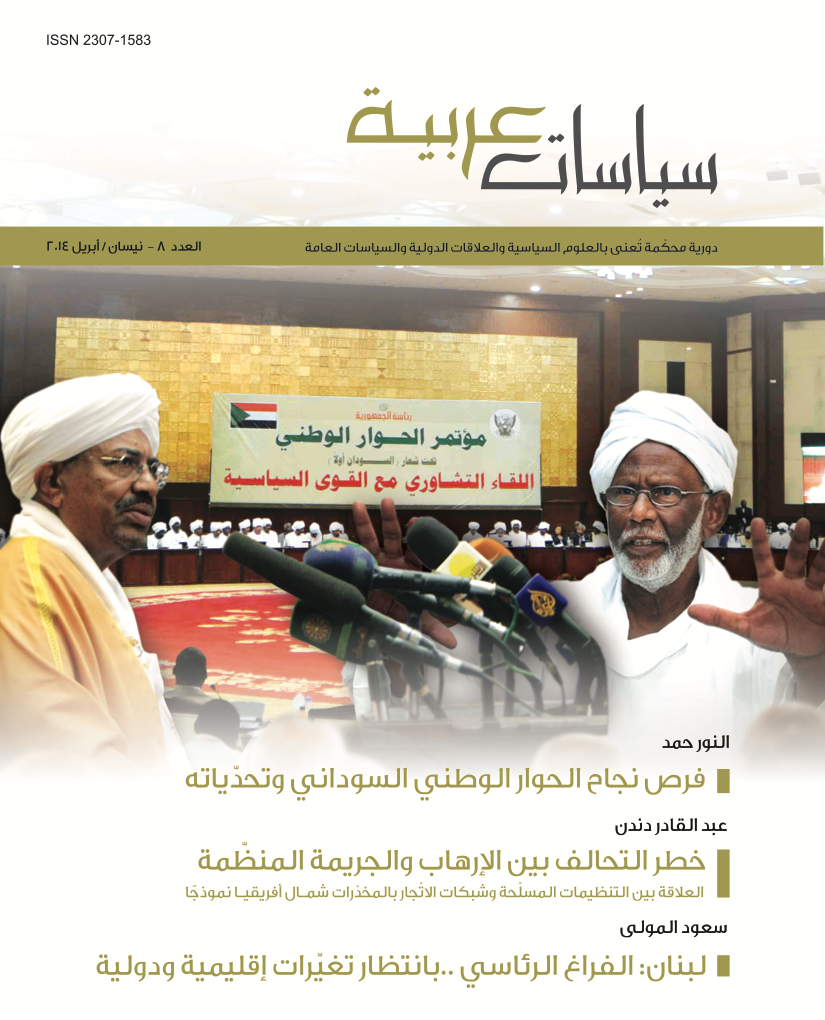
​ACRPS has published issue 8 of the bi-monthly peer-reviewed academic journal Siyasat Arabia, a journal devoted to political science, international relations, and public policy. This issue contains the following articles: “Israel and the Boycott Movement” (Mahmoud Muhareb); “Eurasian Russia and the Issues of the Arab Levant” (Mohammed Adel Shreih); “International Law: Present Reality and the Prospects for Global Jurisdiction in Light of Globalization” (Roderigue Elia Abi Khalil); “Sudan’s National Dialogue: Opportunities for Success and Challenges” (Elnour Hamad); “Lebanon: The Presidential Vacuum Awaits Regional and International Changes” (Saoud al-Mawla); “Non-state Violent Actors: An Examination of the Conceptual and Theoretical Frameworks” (Scheherazade Admam); “The Threat Posed by an Alliance of Terrorism and Organized Crime: Relations between Armed Groups and Drug Trafficking Networks in the Case of North Africa” (Abdelkader Dandan); “The Yemeni Spring and the Challenges of Development” (Qais al-Aryani); “Political Opposition in Morocco between Containment and Exclusion” (Noureddine Elhouti); “Local Government Elections in Turkey: Voters Show their Cunning” (Marwan Kabalan); “Palestinian Reconciliation: Driving Factors and Prospects” (ACRPS Policy Analysis Unit); “Yemeni and Palestinian Public Opinion on Topical Issues of National Concern” (Mohammed al-Masri). In its book reviews section, this issue contains three reviews: Saleh Soliman Abdelazim’s review of National Intellectual Capital and the Financial Crisis in Indonesia, Malaysia, The Philippines, and Thailand; Khaled Waleed Mahmoud’s review of “the Plight of Palestine and its Secrets: Correcting the myth that there were no orders”; and Naiema Abou Mostafa’s review of The Daily Struggle for Palestinian Women in the Realm of Life. There are two book presentations: Nerouz Satik’s review of The Geostrategic Repercussions of the Arab Revolutions; and Ziad Muna’s review of Prisoners of the White House: The Isolation of American Presidents and the Crisis of Leadership. Finally, this issue of Siyasat Arabia also includes a chronological breakdown of significant steps taken toward democratization in the Arab Homeland, as well as a background briefing on Palestinian affairs from March to April 2014.

Original Website (English) | Original Website (Arabic)

Published: 2014-05-01

Articles

  • Eurasian Russia and the Arab Mashreq Issues

    Author: Mohammed Adel Shreih
    19-27

    This paper highlights the mental and political changes that took place in Russian society after the fall of the Soviet Union.

  • The State of International Law and Global Governance during Globalization

    Author: Roderigue Elia Abi Khalil
    28-42

    Qatar is on a path to ever widening global production and trade, its networks today including the entire global market.

  • Israel and the BDS Movement

    Author: Mahmoud Muhareb
    5-18

    The steady growth of the international movement to boycott Israel, known as the Boycott Divestment and Sanctions campaign (BDS), its opportunities, and impacts, is the focus of this study.

  • Sudanese National Dialogue: Challenges and Chances for Success

    Author: Elnour Hamad
    43-55

    Sudanese President Omar al-Bashir’s call for national dialogue marks a critical turning point in the nation’s recent politics.

  • Lebanon’s Presidential Vacuum: Awaiting Regional and International Changes

    Author: Saoud al-Mawla
    57-67

    The election of a president in Lebanon is an important event not because of the person or their powers—since indeed the role lost its power after the Taif Agreement—

  • Violent Non-State Actors: A Conceptual and Theoretical Framework Study

    Author: Scheherazade Admam
    69-82

    Developments in the international system have led to a diminishing role of nations within international affairs.

  • Terrorism and Organized Crime: Dangers of Alliance in Armed Groups with Drug Trafficking Networks with North Africa as an Ex

    Author: Abdelkader Dandan
    83-95

    International alliances, cooperation, and coordination are no longer limited to state bodies or international organizations;

  • Yemen’s Spring and Challenges of Development

    Author: Qais al-Aryani
    96-113

    The current political scene has warned that Yemen could face huge threats in the coming years. The worst of these is the collapse of the country itself, in facing a comprehensive civil war.

  • Political Opposition in Morocco: Between Inclusion and Exclusion

    Author: Noureddine Elhouti
    114-123

    The revolutions in the MENA region were accompanied by many political shifts. These, in turn, led to what might be called primary outcomes; produced before the revolutions have come to an end.

  • Turkish Municipal Elections: Voters’ Reprisal for Sense

    Author: وحدة تحليل السياسات
    125-131

    Although the Justice and Development Party (AKP) victory in the 2015 Turkish municipal elections was generally expected, the percentage of votes surprised many, including the leaders of the...

  • The Palestinian Reconciliation: Motives and Prospects for Success

    Author: Policy Analysis Unit- ACRPS
    133-136

    This paper seeks to investigate the reasons behind the latest Palestinian national reconciliation, signed on April 23, 2014, and the circumstances in which it took place

  • Public Attitudes towards the Syrian Crisis in the Arab World

    Author: Mohammed al-Masri
    139-151

    This paper presents an overview of trends in public opinion in four Arab countries—Jordan, Iraq, Lebanon and Palestine (covering the West Bank and the Gaza Strip) towards events in the Syrian...

  • Milestones in Democratic Transition in Arab World

    155-159

    Milestones in Democratic Transition in Arab World

  • Palestine Over Two Months

    160-163

    Palestine Over Two Months

  • National Intellectual Capital and the Financial Crisis in Indonesia, Malaysia, the Philippines, and Thailand

    Author: Saleh Soliman Abdelazim
    166-170
  • The Geostrategic Implications of the Arab Revolutions

    Author: Nerouz Satik
    172-174
  • The Ordeal of Palestine and its Secrets: Correcting the Idea that “There Were no Orders”

    Author: Khalid Walid Mahmoud
    175-177

    The Women of Palestine in the Struggle to Live [Arabic]

  • The Women of Palestine in the Struggle to Live

    Author: Naiema Abou Mostafa
    178-185
  • Prisoners of the White House: The Isolation of America's Presidents and the Crisis of Leadership

    Author: Ziad Muna
    187-189