Vol. 3 No. 013 (2015): Issue 013
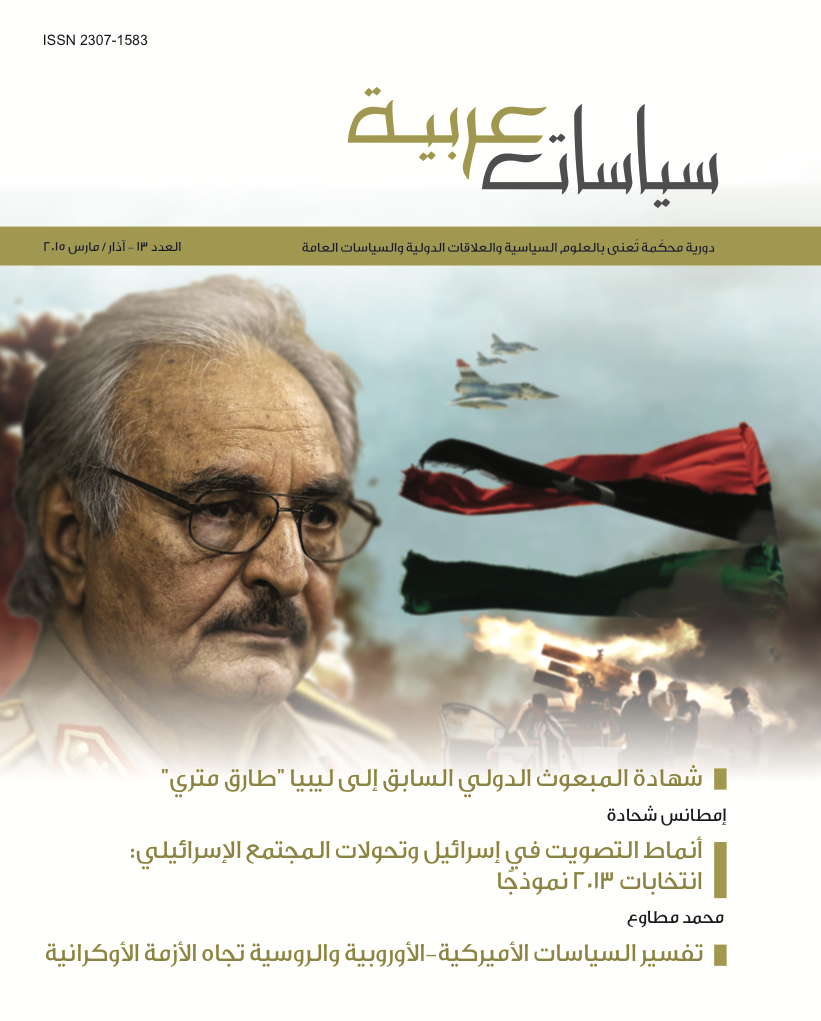
​ACRPS has published issue 13 of the bi-monthly peer-reviewed academic journal Siyasat Arabia, a journal devoted to political science and international relations. This edition includes the following studies and articles: “Interpreting US-European and Russian Policy towards the Ukrainian Crisis” (Mohammed Mutawa); “The Constitutional Crisis in Libya: Dimensions of the Conflict between Political Components” (Khayri Omar); “The Coalition Government in Tunisia: Interpreting the Profiles, the Implications and the Challenges” (Anouar Jamaoui); “The Legacy of Mubarak Still Rules Egypt” (Abdou Moussa); “The WTO from the Perspective of Developing Countries” (Noureddine Daoudi); “Hamas between Efforts to Politicize the Court and the Requirements of Justice” (Adib Ziadeh); “The Shebaa Operation: A Restrained Response from Hezbollah” (Policy Analysis Unit); “Voting Patterns in Israel and Shifts in Israeli Society: the Model of the 2013 Elections” (Mtanes Shihadeh); “Trends in University Youth in Participation in the Algerian Presidential Elections” (Abdelhalim Mahour-Bacha); and “Trends in Palestinian Public Opinion towards Democracy” (Isra Batayneh).The section of book reviews features Nerouz Satik’s presentation of Muamar Khauli’s book Turkish-Russian Relations: From the Heritage of the Past to the Horizons of the Future;  Baaliousaid Ahmed’s review  of Qassem Hajjaj’s Dawn of the New Globalization; Khaled Walid Mahmoud’s review of Muhannad Mustafa’s book, The Israeli Academy as Institution: Knowledge, Politics and Economics; Muhannad Mustafa’s review of The Arab Spring, Democracy and Security: Domestic and International Repercussions, a book edited by Efraim Inbar. This issue also contains, in its reports section, testimony by former Special Representative of the UN Secretary General to Libya, Tarek Mitri.

Original Website (English) | Original Website (Arabic)

Published: 2015-03-01

Articles

  • American-European and Russian Policies on Ukraine’s Crisis: Different Perceptions, Conflicting and Interrelated Interests, and Future Scenarios

    Author: Mohammed Mutawa
    5-22

    Where the Cold War crises took place in the context of a bilateral international system represented by the Western and Soviet entities, the recent Ukrainian crisis is played out on an...

  • Libya’s Constitutional Crisis: Dimensions of the Conflict Among Political Factions

    Author: Khayri Omar
    23-37

    Examining the dimensions of the constitutional crisis in Libya, this paper begins by explaining the situation of the country’s political factions.

  • Tunisia’s Coalition Government: Features, Implications and Challenges

    Author: Anouar Jamaoui
    38-48

    Beginning with a look at Tunisia’s current coalition government, formed by Habib Essid, this paper discusses the challenges that this government faces going forward.

  • Mubarak’s Legacy Still Rules Egypt: Where Will the Next Parliamentary Elections Take Us?

    Author: Abdou Moussa
    49-60

    Following the ouster of President elect Mohamed Morsi after only one year in power, this paper looks at the future of elections in Egypt.

  • Developing Countries View of the WTO: 20 Years of Judicial Arbitration (1995-2015)

    Author: Noureddine Daoudi
    61-70

    Establishing a genuine and effective system to settle disputes through ministerial conferences is an essential point of progress for developing countries.

  • Un-listing Hamas as ‘Terrorist’ Organization: European Court between Politics and Justice

    Author: Adeeb Ziadeh
    71-80

    The European General Court (EGC) decision on the Liberation Tigers of Tamil Eelam case cast a shadow so long that it has influenced the Court’s more recent decision to delist Hamas as a...