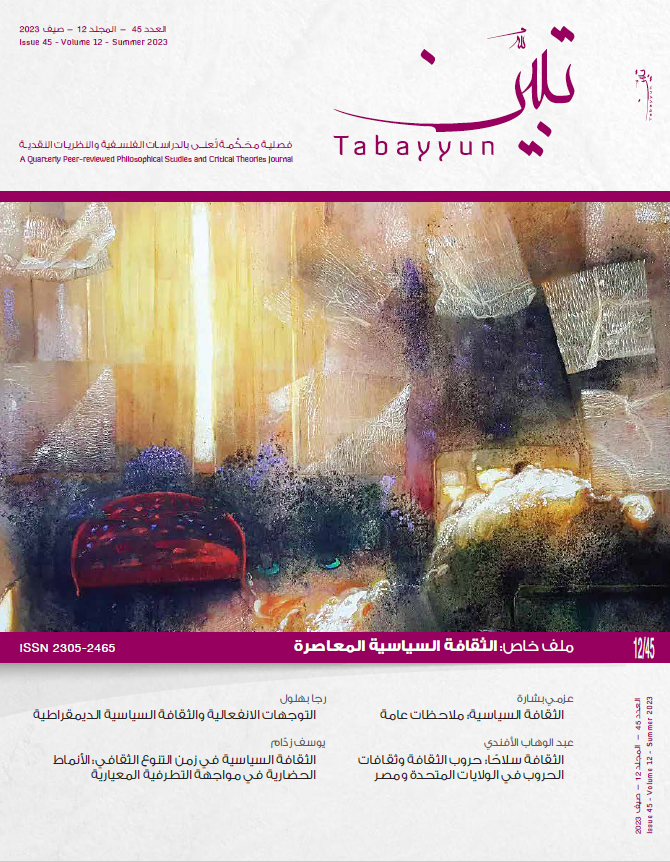
Culture as a Weapon: Culture Wars in the United States and Egypt
DOI:
https://doi.org/10.31430/ewek8129Keywords:
Culture, Political Culture, Culture Wars, Cultures of War, United States, EgyptAbstract
This article discusses the phenomenon known as "culture wars" in the United States – an ongoing development that attracted attention in the 1990s and reached its apex during the tenure of former President Donald Trump – and compares it with similar events in Egypt prior to the July 2013 coup. These phenomena pose a great challenge to theories of political culture and the assumption that dominant cultures strongly influence political behaviour. The study concludes that the dynamics of this "cultural" conflict reveal that culture's central role in crafting identity and giving meaning to political and social action also interacts with a variety of potential uses as an instrument of conflict and division. Contrary to Samuel Huntington's argument that cultural differences will delineate the clash of civilizations, the analysis of the cases under study (and, more broadly, of the nature of conflict in today's world) indicates that differences within societies with a common cultural identity can create deeper and more protracted conflicts, and that polarization can drive the parties thereto to enter alliances with actors outside of their cultural setting with whom they are even less compatible. This affirms that cultures are in perpetual transformation, and that transitional experiences (and resistance thereto) may create intense conflict, as happened during the Wars of Religion after the Protestant Reformation in Europe or the American Civil War over the abolition of slavery. Thus, the role of culture does not predetermine the political process, which instead depends on solidarity and apprehension among a culture's constituent groups. Culture itself may be considered the product of conflict and dispute resolution: whether peacefully through adaptation and coexistence or violently through schism (e.g., the American Revolution).
References
- Patrick Buchanan, "Culture War Speech: Address to the Republican National Convention," Voices of Democracy: The U.S. Oratory Project , 17/8/1992, accessed on 23/9/2022, at: https://cutt.us/RTy1Z
- ينظر :(James Davison Hunter, Culture Wars: The Struggle to Define America: Making Sense of the Battles over the Family. Art, Education, Law, and Politics (New York: Basic Books; Reprint, 1992).
- Irene Taviss Thomson, Culture Wars and Enduring American Dilemmas (Michigan: University of Michigan Press, 2010), pp. 1–4.
- Valerie Scatamburlo–D’Annibale, "The 'Culture Wars' Reloaded: Trump, Anti–Political Correctness and the Right’s 'Free Speech' Hypocrisy," Journal for Critical Education Policy Studies , vol. 17, no. 1 (2019), pp. 72–73.
- Ibid., pp. 73–74.
- Thomson, pp. 3–4.
- William Henry Riddington, "The Right, Rights and the Culture Wars in the United States, 1981–1989," PhD. Dissertation, University of Cambridge, 2017, pp. 10–14.
- James Davison Hunter, "Cultural Conflict in America," in: Lane Crothers & Charles Lockhart (eds.), Culture and Politics (New York: Palgrave Macmillan, 2000), pp. 90–288.
- Ibid., pp. 9–10.
- Richard Jensen, "The Culture Wars, 1965–1995: A Historian’s Map," Journal of Social History , vol. 29, no. 1 (1995), pp. 19–20.
- Hunter, "Cultural Conflict," p. 299.
- Ibid., pp. 27–29.
- Robert Dahl, Dilemmas of Pluralist Democracy: Autonomy vs. Control (New Haven: Yale University Press, 1983), pp. 1–11.
- عزمي بشارة، الانتقال الديمقراطي وإشكالياته: دراسة نظرية وتطبيقية مقارنة (الدوحة/ بيروت: المركز العربي للأبحاث ودراسة السياسات، 2020)، ص.408
- David Elkins & Richard Simeon, "A Cause in Search of Its Effect, or What Does Political Culture Explain?" in: Crothers & Lockhart, pp. 22–23.
- Ibid., pp. 26–31.
- Marc Howard Ross, "Culture and Identity in Comparative Political Analysis" in: Crothers & Lockhart, pp. 39–70,
- Ibid., pp. 42–43.
- Ibid., pp. 42–58.
- Ann Swidler, "Cultural Power and Social Movements," in: Crothers & Lockhart, pp. 269–273, 283.
- Ibid., pp. 4–273.
- ينظر 2:(Allan Bloom, Closing of the American Mind: How Higher Education Has Failed Democracy and Impoverished the Souls of Today’s Students (New York: Simon & Schuster, 1987).
- Lovett–Graff Bennett, "Culture Wars II: A Review Essay," Modern Language Studies , vol. 25, no. 3 (1995), pp. 99–
- Ibid., pp. 103–107; Gerald Graff, Beyond the Culture Wars: How Teaching the Conflicts Can Revitalize American Education (New York: Norton, 1992).
- Bennett, pp. 110–114; Russell Jacoby, Dogmatic Wisdom: How the Culture Wars Divert Education and Distract America (New York: Anchor–Doubleday, 1994).
- Eric Kaufmann, "The New Culture Wars: Why Critical Race Theory Matters more than Cancel Culture," Social Science Quarterly , vol. 103, no. 4 (2022), accessed on 5/7/2023, at: https://cutt.us/3xFQM
- Scatamburlo–D’Annibale, p. 75.
- ينظر 3:(Samuel Huntington, "The Clash of Civilizations?," Foreign Affairs , vol. 72, no. 3 (1993).
- Scatamburlo–D’Annibale, pp. 98–104.
- :(ينظر Jennifer De Forest, "The Rise of Conservatism on Campus: The Role of the John M. Olin Foundation," Change , vol. 38, no. 2 (2006), pp. 2, 32, 37, 38; Satamburlo–D’Annibale, p. 72.
- Mark Davis, "A New, Online Culture War? The Communication World of Breitbart.com," Communication Research and Practice , vol. 5, no. 3 (2019), pp. 3–5, 44–243.
- اسم الحركة مقتبس من قيام محتجين في مدينة بوسطن في عام 1773 بمنع سفينة تتبع لشركة الهند الشرقية من إنزال شحنتها من الشاي في المرفأ، وقاموا بإلقاء الشحنة في البحر احتجاجًا ضد ضرائب على استيراد الشاي. وسميت الحادثة التي فجرت الثورة الأميركية بعد قمعها من قبل بريطانيا، ب "حفلة الشاي في بوسطن" Party Tea Boston The.
- Davis, pp. 3–5, 241–254.
- Ibid., pp. 247–249.
- Ibid., pp. 106–108.
- Romi Mukherjee, "Make America Great Again as White Political Theology," Lisa Revue , vol. 16, no. 2 (2018), accessed on 5/7/2023, at: https://cutt.us/y1mdt
- 4عزمي بشارة، ثورة مصر، ج 2: من الثورة إلى الانقلاب (الدوحة/ بيروت: المركز العربي للأبحاث ودراسة السياسات، 2016)، ص 357؛ "نشطاء ينتقدون 'إحنا شعب وإنتو شعب'"، الجزيرة نت، 2013/9/7، شوهد في 2022/10/31، في: https://cutt.us/LB1vL
- بشارة، ثورة مصر، ج 2، ص 175–165، 188–186،.202–199
- محمد شومان، "الجوانب الثقافية في الثورة المصرية"، في: مجموعة مؤلفين، الانفجار العربي الكبير: في الأبعاد الثقافية والسياسية (الدوحة/ بيروت: المركز العربي للأبحاث ودراسة السياسات، 2012)، ص.127–123
- بشارة، ثورة مصر، ج 2 ص،.334–225
- ينظر 4:(Georges Tamer, "Nasr Hamid Abu Zayd," International Journal of Middle East Studies , vol. 43, no. 1 (2011), pp. 193–
- Samia Mehrez, Egypt’s Culture Wars: Politics and Practice (United Kingdom: Routledge, 2008), pp. 18–20.
- Ibid., pp. 14–16.
- Ibid., pp. 230–250.
- إليزابيث سوزان كساب، تنوير عشية الثورة: النقاشات المصرية والسورية، ترجمة محمود محمد الحرثاني (الدوحة/ بيروت: المركز العربي للأبحاث ودارسة السياسات، 2020)، ص.61–56
- المرجع نفسه، ص.70–62
- المرجع نفسه، ص.89–86
- Abdelwahab El–Affendi, "Waiting for Armageddon: The Mother of all Empires and its Middle East Quagmire," in: David Held & Mathias Koenig–Archibugi (eds.), American Power in the Twenty–first Century (Oxford: Polity Press, 2004), pp. 252–276.
- بشارة، الانتقال الديمقراطي، ص.420–419
- وحيد عبد المجيد، "العلمانية والأديان: رواد التنوير في مصر بين العلمانية والادينية"، مركز الأهرام للدراسات السياسية والاستراتيجية، 2021/3/31، شوهد في 2022/11/16، في: https://cutt.us/2VuGS
- "حقيقة الخاف بين الإخوان المسلمون وعبد الناصر، الموسوعة التاريخية (ويكيبيديا الإخوان المسلمون)، شوهد في 2022/11/13، في: https://encr.pw/9d0sq
- ينظر: محمد جال كشك، النكسة والغزو الفكري (بيروت: مكتبة الأمل،.)1967
- Samuel Huntington, "Patterns of Response," in: Crothers & Lockhart, pp. 348–357.
- Gore Vidal, Armageddon? Essays 1983–1987 (London: Andre Deutsch, 1987), p. 110.
- Abdelwahab El–Affendi, "The Souls of Muslim Folk: The 'Obama Phenomenon' and the Paradoxes of Paranoid anti–Multiculturalism," American Journal of Islamic Social Sciences , vol. 29, no. 4 (2012), pp. 63–86.
- Sydney Verba & Lucien Pye, Political Culture and Political Development (Princeton, NJ: Princeton University Press, 2015 [1965]), p. 7.
- Ernest Gellner, Conditions of Liberty: Civil Society and Its Rivals (London: Allen Lane, Penguin, 1994), p. 101.
- Samuel Huntington, "The Clash of Civilizations?," pp. 22–49.
- Ido Oren, Our Eenemies and US: America’s Rivalries and the Making of Political Science (Ithaca: Cornell University Press, 2003).
- Jeffrey Hadden,"The Rise and Fall of American Televangelism," The Annals of the American Academy of Political and Social Science , vol. 527, no. 1 (1993), pp. 113–130.
Citing articles in ACRPS journals (1)
- (2024) سياسات "الإبادة الثقافية العميقة" في الحرب الإسرائيلية على غزة: منظور ثقافي - إعلامي. https://doi.org/10.31430/RKTJ3814
Sources: Crossref Cited-by, and the references (notes and reference lists) of the Center's own articles
Downloads
Published
Article dates
Usage statistics
Issue
Section
License
Copyright (c) 2023 Tabayyun

This work is licensed under a Creative Commons Attribution-NonCommercial 4.0 International License.
