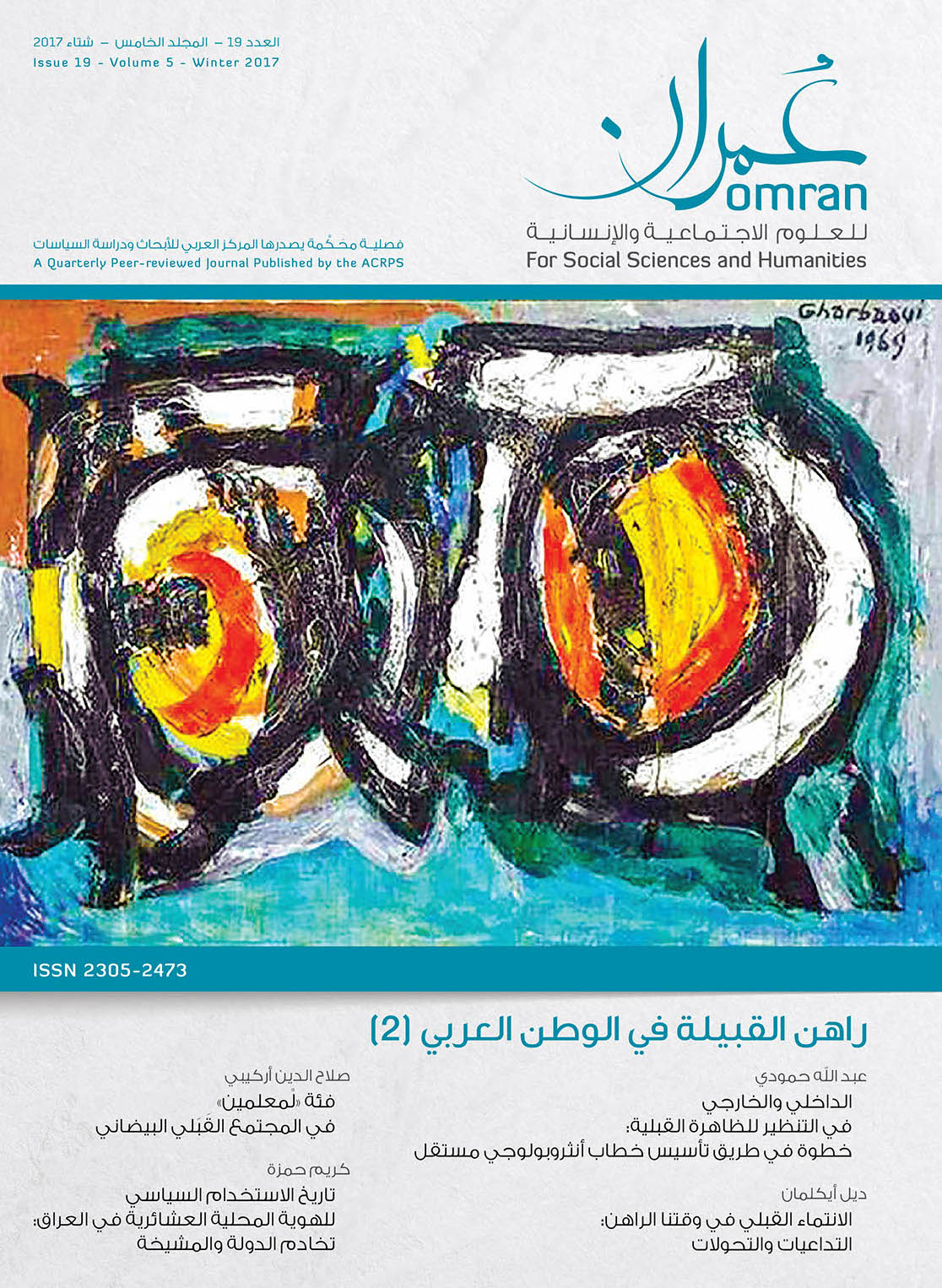
Emic and Etic in Re-theorizing "Tribe" A Step toward an Arab Anthropological Discourse
DOI:
https://doi.org/10.12816/0040997Keywords:
Emic / Etic, Tribe, Asabyya, AnthropologyAbstract
The aim of this article is twofold. The first is to reconsider a phenomenon that has been neglected or marginalized by nationalist thought and the postcolonial critique in anthropology: tribe and tribalism in the Maghreb- Machreq region. The second is an experiment in how to produce a new discourse in anthropology which results from a confrontation between the epistemic tradition of that discipline on the one hand, and the epistemic tradition of that region on the other hand. This is one response – admittedly limited and tentative - to a lament frequently formulated by writers from the region: "how come we are powerless at developing knowledge from our own tradition"?
References
- عبد الله حمودي، في إعادة صياغة الأنثروبولوجيا (الرباط: منشورات كلية الآداب والعلوم الإنسانية، 2010.)
- المرجع نفسه، ص.20-18
- انظر: نذير معروف، فوزي عادل وخديجة عادل (إشراف)، أي مستقبل ل نأأثروبولوجيا في الجزائر؟ (وهران: مركز البحث في الأنثروبولوجية الاجتماعية والثقافية، 0022)، ص 63-47. أخذ المؤلفون عن بعض الأنثروبولوجيين الفرنسيين أفكارهم في نقد الأنثروبولوجيا الكلاسيكية، منها أن الأنثروبولوجيا لم تعد اليوم تتخصص في ما هو "بدائي"، وأنها أصبحت تدرس كل المجتمعات المعاصرة على حد سواء، وأن ظاهرة الهجرات والعولمة تطرح مشكل الهوية والاختلاف في كل مكان. وهذا أيضًا برنامج فرنسي غربي يُستورد باسم التأسيس لخطاب عربي متميز في الأنثروبولوجيا.
- David Scott, "The Trouble of Thinking: An Interview with Talal Asad," in: David Scott and Charles Hirschkind (eds.), Powers of the Secular Modern: Talal Asad and his Interlocutors , Cultural Memory in the Present (Stanford, Calif.: Stanford University Press, 2006), pp. 250-251.
- Lila Abu-Lughod, "Zones of Theory in the Anthropology of the Arab World," in: Annual Review of Anthropology (Palo Alto, Calif.: Annual Reviews Inc., 1989), pp. 280-284 and 287.
- المختار الهراس، القبيلة والسلطة: تطور البنيات الاجتماعية في شمال المغرب (الرباط: المركز الوطني لتنسيق وتخطيط البحث العلمي والتقني، 1988)؛ رحمة بورقية، الدولة والسلطة والمجتمع: دراسة في الثابت والمتحول في علاقة الدولة بالقبائل في المغرب (بيروت: دار الطليعة، 1991)؛ Hosham Dawod: "Tribus et pouvoirs en Irak: De Saddam Hussein au général Petraeus," dans: Hosham Dawod (dir.), La Constante tribu: Variations arabo-musulmanes , quaero (Paris: Demopolis; Fondation maison des sciences de l’homme (FMSH), 2013), pp. 215-239, et Tribus et pouvoirs en terre d’islam , sociétales (Paris: A. Colin, 2014); Yazid Ben Hounet, "Gérer la tribu?: Le Traitement du fait tribal dans l’Algérie indépendante (1962-1989)," Cahiers d’études africaines , vol. 48, no. 191 (2008), pp. 487-512; Pierre Bonte [et al.], La Quête des origines: Anthropologie historique de la société tribale arabe (Paris: Ed. de la Maison des sciences de l’homme, 1991); Dawn Chatty (ed.), Nomadic Societies in the Middle East and North Africa: Entering the 21st Century , Handbook of Oriental studies. Section one, Near and Middle East; 81 (Netherlands; Boston: Brill, 2006); Abdellah Hammoudi [et al.]: Projet de développement des parcours de l’Oriental, phase I (Rabat: MARA; IAV, 1990), et Projet de développement des parcours de l’Oriental: Etude sur le changement et l’innovation, phase II (Rabat: MARA; IAV, 1992); Myriam Benraad, "Une lecture de la sòahòwĀ ou les mille et un visages du tribalisme irakien," Etudes rurales , no. 184: La Tribu à l’heure de la globalisation (2009), pp. 95-106; Mohamed Mahdi, "La Tribu au secours du développement pastoral," Etudes rurales , no. 184: La Tribu à l’heure de la globalisation (2009), pp. 133-148, et Pascal Mulet, "Exploiter les territoires, maîtriser l’espace: Economies de montagne dans le Haut-Atlas marocain," thèse de doctorat en Anthropologie sociale et ethnologie, Ecole doctorale de l’Ecole des hautes études en sciences, Ecole normale supérieure, Paris, 2015.
- Hosham Dawod: "Étatiser les tribus et tribaliser l’État," Esprit, no. 272 (Février 2001), pp. 21–41, et Tribus et pouvoirs en terre d’islam , sociétales (Paris: A. Colin, 2004).
- وهي معرفة أخذها الأنثروبولوجيون شفويًا عن مخبرين أمازيغ وعرب، ومن معرفة مدونة باللغة العربية.
- معروف أن التقليد الأنثروبولوجي كان يبدأ بتشخيص تصورات المجتمعات بناء على البحث الميداني، أو أخيرًا بتسجيل خطابات النساء والرجال الذين قابلهم الأنثروبولوجي في الميدان، أو استقى خطاباتهم من وسائل الاتصال المتعددة. لكن غالبًا ما لا تُعتبر تلك التصورات بمثابة مفاهيم أنثروبولوجية، فأحيانا يسميها الأنثروبولوجيون رموزًا، كما فعل غيرتز، أو خطابات كما فعل آخرون، ولكنهم لم يعتبروها مفاهيم أنثروبولوجية.
- أتحاشى هنا عن قصد استعمال كلمة "غرب" وثنائية "شرق"/ "غرب."
- Talal Asad, The Kababish Arabs: Power, Authority and Consent in a Nomadic Tribe (London: C. Hurst, 1970), p. 240; "Political Inequality in the Kababish tribe," in: Ian Cunnison and Wendy James (eds.), Essays in Sudan ethnography, Presented to Sir Edward Evans-Pritchard (New York: Humanities Press, 1972), pp. 135-138, and Steven C. Caton, "Anthropological Theories of Tribe and State Formation in the Middle East: Ideology and the Semiotics of Power," in: Philip S. Khoury and Joseph Kostiner (eds.), Tribes and State Formation in the Middle East (Berkeley, Calif.: University of California Press, 1990), pp. 89-90.
- Dale F. Eickelman, The Middle East: An Anthropological Approach , Prentice-Hall Series in Anthropology (Englewood Cliffs, NJ: Prentice-Hall, 1981).
- Dale F. Eickelman: The Middle East , p. 88, and Moroccan Islam: Tradition and Society in a Pilgrimage Center , Modern Middle East Series; no. 1 (Austin: University of Texas Press, 1976), pp. 105-121.
- Maurice Godelier, Les Tribus dans l’histoire et face aux États (Paris: CNRS éd., 2010), p. 17.
- Ibid., pp. 17 et 22.
- Émile Masqueray, Formation des cités chez les populations sédentaires de l’Algérie (Kabyles du Djurdjura, Chaouïa de l’Aourâs, Beni Mezâb) (Paris: E. Leroux, 1886), et Jacques Berque: Structures sociales du Haut-Atlas (Paris: Presses universitaires de France, 1955), and L’Intérieur du Maghreb: XVe-XIXe siècle , bibliothèque des histoires (Paris: Gallimard, 1978).
- Emile Benveniste, Le Vocabulaire des institutions indo-européennes, 1: Economie, parenté, société , sommaires, tableau et index établis par Jean Lallot (Paris: Editions de Minuit, 1969), p. 258; Maurice Godelier, "Le Concept de tribu. Crise d’un concept ou crise des fondements empiriques de l’anthropologie?," Diogène , vol. 81, no. 1 (1973), pp. 3-28, et Bonte [et al.], pp. 15 et 17.
- Bonte [et al.], La Quête des origines.
- Joseph Chelhod, "Les Structures dualistes de la société bédouine," L’Homme , vol. 9, no. 2 (1969), pp. 89-112, et Jean Cuisenier, Economie et parenté: Leurs affinités de structure dans le domaine turc et dans le domaine arabe , le monde d’outre-mer passé et présent. 1e série, études; 40 (Paris; La Haye: Mouton; Paris: Ecole pratique des hautes études, 1975), resp.
- Abdellah Hammoudi, "Segmentarité, stratification sociale, pouvoir politique et sainteté. Réflexions sur les thèses de Gellner," Hespéris-Tamuda , vol. 15 (1974), pp. 147-180; Larbi Mezzine, Le Tafilalt: Contribution à l’histoire du Maroc aux XVIIe et XVIIIe siècles , préf. de Claude Cahen, publications de la faculté des lettres et des sciences humaines: Thèses et mémoires; 13 (Casablanca: Impr. Najah el jadida, 1987), pp. 273-274 et 278; Pierre Bonte, "Pasteurs et nomades, l’exemple de la Mauritanie," dans: Pastoral Production and Society/Production pastorale et société (Cambridge; New York: Cambridge University Press; Paris: Maison des sciences de l’homme, 1979); Khoury and Kostiner (eds.), p. 3; Lisa Anderson, "Tribe and State: Libyan Anomalies," in: Khoury and Kostiner (eds.), pp. 300-301, and Godelier, Les Tribus , p. 47.
- Richard Tapper, "Anthropologists, Historians, and Tribespeople on Tribe and State Formation in the Middle East," in: Khoury and Kostiner (eds.), pp. 49-50.
- William Lancaster, The Rwala Bedouin Today , Changing Cultures (Cambridge; New York: Cambridge University Press, 1981).
- Eickelman, Moroccan Islam , pp. 105-121.
- Eickelman, The Middle East , pp. 90-91.
- Ibid., pp. 81 ff.
- Ibid., graph 5-2, p. 90.
- Eickelman, Moroccan Islam , pp. 108 and 116 resp.
- Ibid., pp. 105-107.
- Ibid., pp. 106-108.
- Emrys L. Peters: "Some Structural Aspects of the Feud among the Camel-Herding Bedouin of Cyrenaica," Africa: Journal of the International African Institute , vol. 37, no. 3 (July 1967), pp. 261-282, and "The Tied and the Free: An Account of a Type of Patron-Client Relationship among the Bedouin Pastoralists of Cyrenaica," in: J.-G. Péristiany (ed.), Contributions to Mediterranean Sociology; Mediterranean Rural Communities and Social Change; Acts of the Mediterranean Sociological Conference, Athens, July 1963 , Publications of the Social Sciences Centre, Athens; 4 (Paris; The Hague: Mouton, 1968).
- Ernest Gellner, Saints of the Atlas (Chicago: University of Chicago Press, 1969).
- Edward Evan Evans-Pritchard and Meyer Fortes (eds.), African Political Systems (London: Oxford University Press; H. Milford, 1940).
- Peters, "The Tied and the Free," pp. 172-173.
- Donald P. Cole, Nomads of the Nomads: The Āl Murrah Bedouin of the Empty Quarter , Worlds of Man (Chicago: Aldine Pub. Co., 1975).
- Donald P. Cole, "The Enmeshment of Nomads in Saudi Arabian Society: The Case of I Murrah," in: Cynthia Nelson (ed.), The Desert and the Sown; Nomads in the Wider Society , Research Series; no. 21 (Berkeley: Institute of International Studies, University of California, 1973), pp. 113-128, 144 and 275 ff.
- Cole, Nomads of the Nomads , pp. 91-93 and 101.
- انظر الرسم البياني، في: Ibid., p. 92.
- يسهل لهن زيارة الأهل مثلً: Ibid., pp. 43-46.
- Ibid., pp. 552-561.
- Henry Munson, "Rethinking Gellner’s Segmentary Analysis of Morocco’s Ait c Atta," Man , vol. 28, no. 2 (June 1993), p. 268.
- Gellner, Saints , pp. 144-148.
- David Hart, Dadda' Atta and his Forty Grandsons: The Socio-Political Organisation of the Ait' Atta of Southern Morocco (Cambridge: Middle East and North African Studies Press, 1981), p. 8.
- Gellner, Saints , pp. 37-39.
- Ernest Gellner, Muslim Society , Cambridge Studies in Social Anthropology; 32 (Cambridge; New York: Cambridge University Press, 1981), pp. 60-61.
- Gellner, Saints , pp. 41-42 and 54-55. في ما يخص الس لااات التي تنحدر من الأولياء، لاحظ بعضهم أن شخصيات أخرى محترمة، أو ذات نفوذ، كانت تقوم أيضًا بالوساطة. هذا صحيح، ولكن ما ينقض ذلك هو تغيير النظرية على أساس تعدد الوساطات، ويبقى دور الأولياء حاسمًا في الأوساط القبلية.
- Gellner, Saints , pp. 44-45, 64, 84-85 and 91.
- Ibid., pp. 41-43, 52-53 and 66-68.
- Ibid., pp. 74-78, 85-87 and 126-136, and Ernest Gellner, "Pouvoir politique et fonction religieuse dans l’islam marocain," trad. Lucette Valensi, Annales, économies, sociétés, civilisations , vol. 25, no. 3 (1970), pp. 699-713.
- Gellner, Saints , p. 92.
- (ونجد هذا أيضًا في الأسماء العائلية، كما في مثال بن شريفة وبن عطية وبن حليمة وبن حضرية (في المغرب) وبن هنية وبن زينة (في تونس)، وغيرها.
- W. Robertson Smith, Kinship and Marriage in Early Arabia (Cambridge: Cambridge University Press, [1885]; 1967), pp. 7 and 41-43.
- Jacques Berque: "Qu’est-ce qu’une tribu nord-africaine?," dans: Éventail de l’histoire vivante: Hommage à Lucien Febvre , 2 vols. (Paris: Armand Colin, 1953), p. 26, et Une cause jamais perdue: Pour une Méditerranée plurielle, écrits politiques, 1956-1995 (Paris: A. Michel, 1998), pp. 226-227.
- تتردد مقولة الأصول المختلفة في تكوين القبائل والمجموعات في إطار نقد الأنثروبولوجيا الكلاسيكية، وذلك في تجاهل لما قدمت أنثروبولوجيا المغرب الكبير في هذا الموضوع. وتطبيقًا لنظرية فوكو حول العلاقة بين المعرفة والسلطة، فإن طلال أسد، مثلً، يُرجع تكون القبائل إلى سياسة الشيوخ، ولا أحد زعم أن السياسة كانت غائبة. كما أن أمسال ومبكولو ألحا على اختلاف أصول مكونات الإثنيات في أفريقيا جنوب الصحراء من دون الإشارة إلى إثنوغرافيا شمال أفريقيا.
- Lancaster, pp. 10-14 and 23-24.
- Eickelman, Moroccan Islam , pp. 99-104 and 111.
- Bonte [et al.], p. 36.
- Hildred Geertz, "The Meanings of Family Ties," in: Clifford Geertz, Hildred Geertz and Lawrence Rosen, Meaning and Order in Moroccan Society: Three Essays in Cultural Analysis , with a photographic essay by Paul Hyman (Cambridge: Cambridge University Press, 1979), pp. 356-363.
- Godelier: "Le Concept de tribu," pp. 188-193, et Les Tribus , pp. 14, 17 et 22; Raymond Jamous, Honneur et baraka: Les Structures sociales traditionnelles dans le Rif , atelier d’anthropologie sociale (Cambridge; New York: Cambridge University Press; Paris: Editions de la Maison des sciences de l’homme, 1981), p. 7, et Bonte [et al.], p. 41.
- Bonte [et al.], pp. 39-41.
- Hammoudi [et al.], Projet de développement (1990).
- Bonte [et al.], pp. 109-110 and 118-120.
- Hammoudi, "Segmentarité".
- الهراس، القبيلة والسلطة، ص 53-49؛ , pp. 20, 98-104 and Moroccan Islam Hammoudi, "Segmentarité"; Eickelman, 120-181; Lancaster, pp. 161-162, and Munson, pp. 272-276.
- Pierre Bonte, "L’Herbe ou le sol? l’évolution du système foncier pastoral en Mauritanie du Sud-Ouest," dans: Marceau Gast (ed.), Hériter en pays musulman: Habus, lait vivant, manyahuli (Paris: CNRS éditions, 1987), pp. 193-214, et Pierre Bonte, Edouard Conte et Paul Dresch (dirs.), Emirs et présidents: Figures de la parenté et du politique dans le monde arabe , préf. de Jean-Claude Vatin (Paris: CNRS éd., 2001), p. 41.
- Abdellah Hammoudi: "Segmentarité," et "Sainteté, pouvoir et société: Tamgrout aux XVIIe et XVIIIe siècles," Annales. Histoire, sciences sociales , vol. 35, nos. 3-4: Recherches sur L’Islam: Histoire et anthropologie (May - August 1980), pp. 615-641, et Mezzine, pp. 268-269.
- Hammoudi: "Segmentarité," et "Sainteté, pouvoir et société"; Abdallah Laroui, Les Origines sociales et culturelles du nationalisme marocain: 1830-1912 , textes à l’appui (Paris: F. Maspero, 1977), pp. 175-186; Paul Pascon, Le Haouz de Marrakech , 2 vols. (Rabat; Tanger: Éditions marocaines et internationales, 1977), p. 145, et René Gallissot, L’Economie de l’Afrique du Nord , que sais-je ?; 965, 4 ème éd. mise à jour (Paris: PUF, 1978), pp. 30, 41-43 et 145.
- Godelier, Les Tribus , pp. 37 et 47.
- (مدخل القبيلة، في: , Second Edition (Leiden; Boston: Brill, Encyclopaedia of Islam P. Bearman [et al.] (eds.), 2005-2006), pp. 12-38.
- Jeanne Favret, "Relations de dépendance et manipulation de la violence en Kabylie," L’Homme , vol. 8, no. 4 (1968), et Jacob Black-Michaud, Cohesive Force: Feud in the Mediterranean and the Middle East , with a foreword by E. L. Peters (Oxford: B. Blackwell, 1975), p. 182.
- Abdellah Hammoudi: "Segmentarité"; "Aspects de la mobilisation populaire à la campagne vue à travers la biographie d’un mahdi mort en 1919," dans: Ernest Gellner et Jean-Claude Vatin (eds.), Islam et politique au Maghreb: Table ronde du Centre de recherches et d’études sur les sociétés méditerranéennes, Aix, juin 1979 , collection recherches sur les sociétés méditerranéennes (Paris: Editions du Centre national de la recherche scientifique, 1981), pp. 49-52, et "The Path of Sainthood: Structure and Danger," Princeton Papers in Near Eastern Studies , no. 3 (1994), p. 73, and Jacques Berque: L’Intérieur du Maghreb , chaps. 2 et 8, et Ulémas, fondateurs, insurgés du Maghreb: XVIIe siècle , bibliothèque arabe. Collection hommes et sociétés (Paris: Sindbad, 1982), pp. 21-27.
- Paul Dresch, "The Significance of the Course Events Take in Segmentary Systems," American Ethnologist , vol. 13, no. 2 (May 1986), pp. 318-319.
- Abdellah Hammoudi, "Phénoménologie et ethnographie: À propos de l’habitus kabyle chez Pierre Bourdieu," L’Homme , no. 184 (2007), pp. 77-78.
- Lancaster, pp. 7, 15-22 and 151, and Saad E. Ibrahim and Donald P. Cole, "Saudi Arabian Bedouin," American University of Cairo, Humanities and Social Sciences, Cairo Papers, volume 1, Monograph 5, 1978.
- Kevin Dwyer, Moroccan Dialogues: Anthropology in Question (Baltimore: Johns Hopkins University Press, 1982), and Brinkley Messick, The Calligraphic State: Textual Domination and History in a Muslim Society , Comparative Studies on Muslim Societies; 16 (Berkeley: University of California Press, 1993).
- والثنائية معروفة باللغة الإنكليزية emic etic.
- والتي أظن أن لا مناص من الرجوع إليها، لكن بعد التمحيص الذي أشرت إليه (لا قبله.)
- عبد الله حمودي، الحداثة والهوية: سياسة الخطاب والحكم المعرفي حول الدين واللغة (الدار البيضاء: المركز الثقافي العربي، 0152)، الفصلان 1 و.2
- Hammoudi, "Phénoménologie et ethnographie".
- Pierre Bonte et Yazid Ben Hounet, "Introduction," Etudes rurales , no. 184: La Tribu à l’heure de la globalisation (2009), p. 14.
- Clifford Geertz: The Interpretation of Cultures: Selected Essays (New York: Basic Books 1973), pp. 14-15 and 27, and Local Knowledge: Further Essays in Interpretive Anthropology (New York: Basic Books, 1976), chap. 1.
- النقاش في ثنائية "الداخل" و"الخارج" (emic/etic) قديم، وليس غرضي هنا الإسهاب في عرضه. ترجع الثنائية إلى اللسانيات، وخصوصًا إلى ك. بايك، وكذلك للسانيات العلاقة؛ وكانت الثنائية موضع نقد مارفين هاريس، وهو الأنثروبولوجي الذي نصح بالتخلي عن "الداخلي". هناك مناقشات مهمة لموضوع "الداخلي" لأولفيي دي ساردون، وهي مناقشة طويلة لا تخلص إلى نتائج واضحة. والمناقشة الأخرى لسيمون سرٌوتي وهي مهمة. انظر: Simona Cerutti, "Histoire pragmatique, ou de la rencontre entre histoire sociale et histoire culturelle," Tracés: Revue de sciences humaines, no. 15 (2008), pp. 147-168.
- عالجت الموضوع في محاولة سابقة: عبد الله حمودي، حكاية حج: موسم في مكة (بيروت: دار الساقي، 2010)، ص 11 -.20
- Robert Montagne, Les Berbères et le Makhzen dans le sud du Maroc, essai sur la transformation politique des Berbères sédentaires (groupe chleuh) (Paris: F. Alcan, 1930), p. 140.
- Ibid., p. 150, and Abdellah Hammoudi, "Construction de l’ordre et usage de la science coloniale: Robert Montagne, penseur de la tribu et de la civilization," dans: François Pouillon et Daniel Rivet (dirs.), La Sociologie musulmane de Robert Montagne: Actes du colloque EHESS et Collège de France, Paris, 5-7 Juin 1997 , collection raisons ethnologiques (Paris: Maisonneuve et Larose, 2000), pp. 276-279.
- Louis Dumont, Homo hierarchicus: Essai sur le système des castes , bibliothèque des sciences humaines (Paris: Gallimard, 1967).
- Paul Dresch, "The Significance of the Course Events Take in Segmentary Systems," American Ethnologist , vol. 13, no. 2 (May 1986), pp. 309-324.
- Montagne, Les Berbères et le Makhzen ; Antonin Jaussen, Coutumes des Arabes au pays de Moab (Paris: Maisonneuve, 1908), p. 437; Chelhod, p. 96, and Lancaster, The Rwala.
- Cuisenier, p. 271.
- Ibid., pp. 279-281.
- Article "Kabila", in: Bearman [et al.] (eds.), Encyclopaedia of Islam.
- أبو العباس أحمد بن علي القلقشندي، نهاية الأرب في معرفة أنساب العرب، تحقيق إبراهيم الأبياري، ط 2 (بيروت: دار الكتاب اللبناني، 1980)، ص.14-13
- Robert Montagne, La Civilisation du désert: Nomades d’Orient et d’Afrique , le tour du monde (Paris: Hachette, 1947), p. 50.
- Lancaster, pp. 28-29.
- Chelhod, pp. 92 et 105.
- Ibid., pp. 13-14.
- راجع مداخل قبيلة، بطن، فخذ، إلخ.
- أبو زيد عبد الرحمن بن محمد بن خلدون، المقدمة، ط 2 (بيروت: دار الكتاب اللبناني، 1979)، ج 2، ص 1-22523؛ محمد عابد الجابري، فكر ابن خلدون: العصبية والدولة: معالم نظرية خلدونية في التاريخ الإسلامي، ط 3 (بيروت: دار الطليعة للطباعة والنشر، 1982)؛ المختار الهراس، "القبيلة والدورة العصبية: قراءة في التحليل الخلدوني للمجتمع القروي المغاربي"، في: أزداد أحمد علي [وآخرون]، الفكر الاجتماعي الخلدوني: المنهج والمفاهيم والأزمة المعرفية، سلسلة كتب المستقبل العربي؛ 1 (بيروت: مركز دراسات الوحدة العربية، 0042)، و Ibn Khaldûn's Philosophy of History: A Study in the Philosophic Muhsin Mahdi, Foundation of the Science of Culture (London: G. Allen and Unwin, 1957), pp. 89-93.
- Gellner, Muslim Society.
- قام فريد العطاس بوصف التبعية العلمية من خ لاا تقسيم العمل على الصعيد العالمي. واقترح بعض سبل التخلص من التبعية الأكاديمية. ولكن مشروعي هذا، زيادة على محاولة العطاس، يروم التخلص من التبعية المعرفية بوسيلة الابتكار المفاهيمي؛ Syed Farid Alatas, "Academic Dependency and the Global Division of Labour in:وهذا لا ينفي أهمية مقال العطار. انظر the Social Sciences," Current Sociology , vol. 51, no. 6 (November 2003), pp. 599-613.
- Edward Said: Orientalism (New York: Pantheon Books, 1978), and "Representing the Colonized: Anthropology’s Interlocutors," Critical Inquiry , vol. 15, no. 2 (Winter 1989), pp. 205-225.
- Lila Abu-Lughod, "Writing Against Culture," in: Richard G. Fox, Recapturing (11(خاصة في كتابات ليلى أبو لغد:(Anthropology: Working in the Present , School of American Research Advanced Seminar Series (Santa Fe, NM: School of American Research Press, 1991).
- Timothy Mitchell, Rule of Experts: Egypt, Techno-Politics, Modernity (Berkeley: University of California Press,
- حمودي، في إعادة صياغة الأنثروبولوجيا.
Citing articles in ACRPS journals (4)
- (2025) مراجعة كتاب: وادي موسى والبترا في القرنين التاسع عشر والعشرين. https://doi.org/10.31430/uzfd6796
- (2023) ما قبل الحداثة: اجتهادات في تصوّر علوم اجتماعية عربية. https://doi.org/10.31430/tret1290
- (2022) نوعان من البشر: تشريح العنصرية العادية. https://doi.org/10.31430/zvcx9568
- (2020) التذويت والموضعة: الداخلي والخارجي في التحليل العلمي الاجتماعي. https://doi.org/10.31430/uebu3388
Citing articles from external sources (2)
- Kaltham Ali Al-Ghanim (2026) Consanguinity and Marriage Selection in a Developing Society: A Case Study of Three Generations in Qatari Society. https://doi.org/10.3390/socsci15100716
- Elmehdi Lahmamed (2019) The Anthropological Issue for Abdellah Hammoudi: Critical Reading of Current and Potential Issues in Arab Anthropology based on Hammoudi’s Book: Convergence and Analysis towards the Elaboration of an Arab Anthropology. https://doi.org/10.29117/tis.2019.0017
Sources: Crossref Cited-by, and the references (notes and reference lists) of the Center's own articles
Downloads
Published
Usage statistics
Issue
Section
License
Copyright (c) 2017 Omran for Social Sciences and Humanities

This work is licensed under a Creative Commons Attribution-NonCommercial 4.0 International License.
