Vol. 5 No. 019 (2017): Issue 019
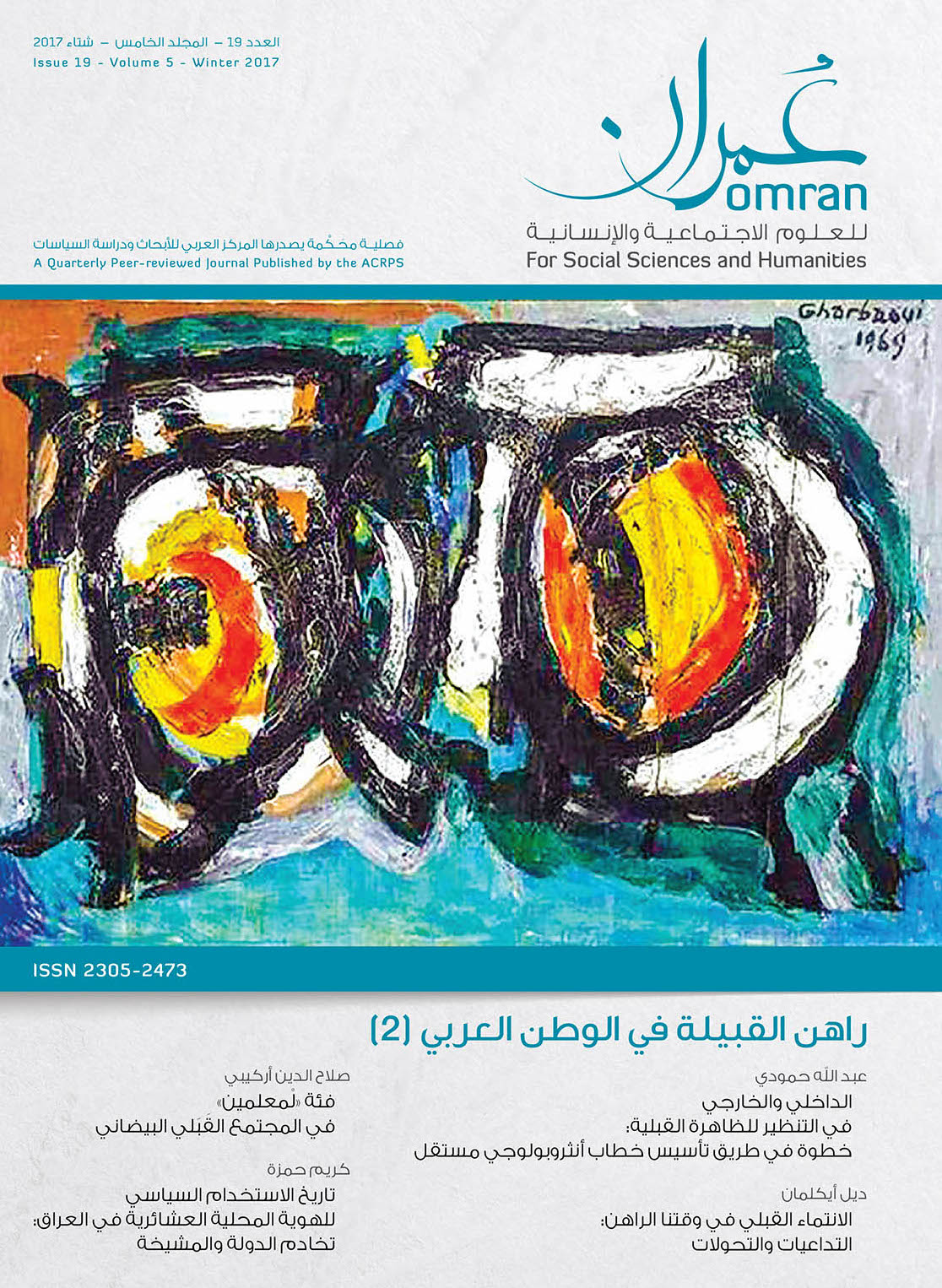
غلاف العدد 19 من دورية عمران

Issue 19 of Omran for Social Sciences and Humanities (Winter 2017) includes the following studies and articles: “Emic and Etic in Re-theorizing «Tribe» A Step toward an Arab Anthropological Discourse” (Abdallah Hammoudi); “Tribal «Belonging» Today Implications and Transformations” (Dale F. Eickelman); “Lamalmin in Beidane Tribal Society” (Salah Eddine Rguibi); “History of the Political Usage of Local Tribal Identity in Iraq State and Sheikhs Serving Each Other” (Karim Hamza); “The Structure of the Mind and the Trifunctional Theory of Georges Dumézil” (yassine Yahyaoui); “Protest in Morocco Dynamic of Struggle and Transformation” (Elhabib Stati Zineddine); “Sociology, Political and Social Issues in Paul Pascon’s Work An Introduction” (Mohammed El Idrissi); “Émique” (Jean-Pierre Olivier De Sardan); “Sufism and Religious Policy in Morocco” (Rachid Jarmouni).

Published: 2017-01-01

Studies

  • The Structure of the Mind and the Trifunctional Theory of Georges Dumézil

    Author: yassine Yahyaoui (Author)
    121-140

    Georges Dumézil, the French philologist, historian, and sociologist, is considered to be one of the leading thinkers of the modern period. His work led to an intellectual leap forward in the...

  • Protest in Morocco Dynamic of Struggle and Transformation Cited once

    Author: Elhabib Stati Zineddine (Author)
    141-162

    The 1990s protest movement in Morocco expresses the degree of coexistence achieved by political and social activists, their renouncement to violence and acceptance of divergence in political...

Issue Focus

  • Emic and Etic in Re-theorizing «Tribe» A Step toward an Arab Anthropological Discourse Cited once

    Author: Abdallah Hammoudi (Author)
    11-56

    The aim of this article is twofold. The first is to reconsider a phenomenon that has been neglected or marginalized by nationalist thought and the postcolonial critique in anthropology: tribe...

  • Tribal «Belonging» Today Implications and Transformations Cited once

    Author: Dale F. Eickelman (Author)
    57-68

    Tribes, clans, and extended families affect — positively and negatively, overtly and subtly — the social systems of the countries and regions of which they are a part. We identify areas and...

  • Lamalmin in Beidane Tribal Society

    Author: Salah Eddine Rguibi (Author)
    69-88

    Despite significant advances in the study of the social structure of the Beidan, knowledge of the lamalmin (craftsmen) remains relatively modest. This paper attempts to rectify this gap by...

  • History of the Political Usage of Local Tribal Identity in Iraq State and Sheikhs Serving Each Other Cited once

    Author: Karim Hamza (Author)
    89-118

    The strained bipartite relationship between the state and the tribes has formed since the mid-19th century, an important part of Iraq’s modern socio-political history. In this study, the author...

Discussions

  • Sociology, Political and Social Issues in Paul Pascon’s Work An Introduction

    Author: Mohammed El Idrissi (Author)
    185-196

    This paper is in honor of the social scientist Paul Pascon on the 30th anniversary of his death. Pascon is considered one of the most important sociologists to have touched upon the...

Translation

  • Émique

    Author: Jean-Pierre Olivier De Sardan (Author)
    165-181

    To explore «the native point of view,» and to think as much as possible as local actors do, remain the central concern of the anthropologist. Emic is the technical suffix that covers popular or...

Book Reviews

  • Sufism and Religious Policy in Morocco

    Author: Rachid Jarmouni (Author)
    199-204

    Author: several (coordinator: Mohammed Gahhah) Place of publication: Casablanca Publisher: Ifriqya al-Sharq Date of publication: 2016 Number of pages: 192

  • السلفية والسلفيون الجدد: من أفغانستان إلى لبنان

    Author: ساري حنفي (Author)
    205-212

    الكتاب : السلفية والسلفيون الجدد: من أفغانستان إلى لبنان الكاتب: سعود المولى الناشر: سائر المشرق مكان النشر: بيروت تاريخ النشر: 2016 عدد الصفحات: 408