Archives
-
Issue 023
748 views 1022 downloadsVol. 11 No. 023 (2025)Issue 23 of Ostour for Historical Studies (2025) includes the following studies and articles: “From Imposed Peace to Peace Subject to Renegotiation” (Odile Moreau); “The Significance of Lausanne for Arabs and Turks” (Mahmoud Haddad); “The Exclusion of Arabs at Lausanne: A Decisive Historical Turn” (Elizabeth F. Thompson); “Alongside the Lausanne Negotiations The Belated Arab-Turkish Reconciliation Agreement” (Mohamed Jamal Barout); “Separating Sultanate from Caliphate The Historical Context and Consequences of” (Wajih Kawtharani); “The End of the Ottoman Caliphate and Muslims of the Subcontinent” (Azmi Özcan); “History and Psychoanalysis: The Genealogy of a Relationship” (Anas Riri); “Ottoman Documents on the House of Hussein Pasha of Tunis in Istanbul” (Mouayed Mnari); “Importance of the Serial and Quantitative Methodology in History and its Application in the History of Lebanon” (Souad Abou El-Rousse Slim); “The Historiography of Lebanese Cities” (Khaled Ziadeh); “Local History in Mount Lebanon in the First Half of the Twentieth Century” (Simon Abdelmassih); “Atatürk. Eine Biographie By Klaus Kreiser” (Sayyar Jamil); “Wadi Musa and Petra in the Nineteenth and Twentieth Centuries” (Mothana Almasri); “Wadi Musa and Petra in the Nineteenth and Twentieth Centuries” (Youness Ghab); “The Achievement of Saladin” (Hamilton Gibb); “Hamilton Gibb and His Works on Islam and the Crusades: Between the Mirror of Orientalism and History” (Ahmed Mohamed Sheir).
-
Issue 022
536 views 729 downloadsVol. 11 No. 022 (2025)Issue 22 of Ostour for Historical Studies (2025) includes the following studies and articles: “Contemporary Historical Methodologies: From Comparative History To Connected History” (Soumaya Louhichi); “The Scientific Journey through Biographical Dictionaries: Examples from the 17th and 18th Centuries” (Lassaad Yansi); “The History of the Beginnings of the French Protectorate of Tunisia (1881-1884)” (Mounir Snoussi); “The Evolution of Social Roles and Intellectual Orientations among Jerusalem’s Notables during the Nineteenth and Early Twentieth Centuries” (Mohannad Abusarah); “A War of Telegrams: The Young Turk Revolution and the Anti-Notables Movement in Aleppo 1908-1913” (Amr Al Mallah); “The Roots of the 1919 Egyptian Revolution from the Perspective of the German Archives” (Taqadum Al-Khatib); “From Kushan to Caravan: Toward a Historical Framework for Studying Land Governance and the Colonization of Palestine” (Munir Fakhr al-Din); “World History Education around the World” (Ross Edmunds Dunn); “The Israeli Army’s Overseas Volunteers in the War of 1948” (Mahmoud Muhareb); “Review of Disclosures of Memory and Documents as Witnesses by M’Barek Bouderka (Abbas)” (Said El Hajji); “Review of Morocco in the Face of Colonialism: Studies on the Question of Borders and Reform” (Abdelhak Tahri); “Review of The History of the Print and Publishing Movement in Morocco During the Protectorate Period (1912-1955)” (Youssef Madrari).
-
Issue 021
574 views 822 downloadsVol. 10 No. 021 (2024)Issue 21 of Ostour for Historical Studies (2024) includes the following studies and articles: “A Thematic Reading of Ancient Historical Geography: North Africa through Pliny's Natural History as a Case Study” (Zakaria Bokjij, Saïd El Bouzidi); “Transformations of the Urban Area in Volubilis during the Mauretanian Period” (Nabil Zairi); “The Iconographic Debate between the Umayyads and Byzantines between the Second Half of the 7th Century and the Beginning of the 8th Century CE: Ideological and Political Implications” (Moez Omri); “The Cultural and Religious History of Modern Morocco” (Lotfi Bouchentouf); “Between Empires and Nation: Memories of the Great War and Iraqi National Identity” (Dina Khoury); “Subsistence Crises in Tangier during the Protectorate (1912-1956)” (Nabil Touihri); “Memory and History in Modern and Contemporary Morocco” (Abdelaaziz Ettahiri); “A Critique of Local History: The Return of the Longue Durée from an Anglo-American Perspective” (David Armitage, Jo Guldi); “Hamdan Khoja’s Opinions on the Question of Algeria in His Correspondence to the Sublime Porte (1834-1835)” (Kheireddine Saidi); “Book review The Historical Roots of the Maghreb, The Dialectic of Power, Society, and Sphere” (Hasan Hafdi Aloui); “Between Two Temporalities: A Reading into the Past of Globalization” (Lotfi Aïssa); “Innovations and Religion in Morocco in the 19th and 20th Centuries” (Ahmed Elhabchi).
-
Issue 020
576 views 889 downloadsVol. 10 No. 020 (2024)Issue 20 of Ostour for Historical Studies (2024) includes the following studies and articles: “France's Madrassas: Education as Mediator in Colonial Algeria (1850-1951)” (Ahmed Sarri); “Mu'tazilite Kalām as a Trans-religious Phenomenon: A Contextual and Observational Search for a Christian Mu'tazilite Orientation” (Najib George Awad); “The hijaba and the hujjab in Ifriqiya during the Hafsid era” (Hamed Ajili); “The Sulaha of Sijilmasa during the Almoravid and Almohad eras” (Abdelhak Tahri); “Slaves at Royal Palaces in Morocco's Tafilalt-Sijilmassa in the 19th Century” (Hassane Mharzi); “Archives et histoire: Dépasser les tournants” (Olivier Poncet, Mohammed Hatmi); “Muhammad Ali Jauhar’s Burial at the Al-Aqsa Mosque: A Model of Indian-Palestinian Relations During the British Mandate” (Farida Mohamed Ali Gamus); “Highlights on the Outcome of Archaeological Research at Ancient Historical Sites Through Moroccan Writings” (Ali Wahidi); “A Thematic Reading of Moroccan Historiography in Writings on the History of Ancient Morocco” (Saïd El Bouzidi); “Outcomes of Research on Morocco’s 20th Century History: An Evaluation” (Kacem El hadeg); “The History of Jewish Groups in Morocco The Functionality of Academic Research in the Re-Creation of the Moroccan Personality” (Mohammed Hatmi); “Book review Crops and Gardens in the Far Maghreb During the Medieval and Early Modern Period: Distribution, Functions, and Decline” (Abdelilah Benmlih); “Book Review: The Berbers Between Maghreb and Mashreq (VII-XV Century)” (Khalid Jeddi); “Turkish Historical Writing Through Moroccan Eyes” (Houbaida Mohamed).
-
Issue 019
640 views 930 downloadsVol. 9 No. 019 (2023)Issue 19 of Ostour for Historical Studies (2023) includes the following studies and articles: “The Periodization and Writing of Morocco’s History” (Houbaida Mohamed); “Egypt As Seen by a Persian Traveler (438-444 AH/ 1045-1052 AD)” (Abdelmajid Bihini); “Social History of 18th- and 19th- Century Morocco: The Role of the Makhzen in Deepening Livelihood Crises” (Mohamed Aitjamal); “British Colonial Knowledge and the Case of Oman: Approaches and Political Implementation” (Nassar bin Saif Alsaadi); “Rewriting the Prophetic Sīra in Egypt in the 1930s and 1940s” (Amr Osman); “A Historical Approach to the Teaching of Human Rights Values in Morocco” (Mostafa Hassani Idrissi, Mohammed Zernine); “Le catéchisme révolutionnaire” (François Furet, Houbaida Mohamed); “The Social and Economic Circumstances of Tripoli in the Mid-17th Century (According to the Tahrir Defteri Dated 1645)” (Enver Çakar, Ghina Mrad); “Rosetta, Summer of 1799: A Reading into Oil and Rice Documents” (Nasser Ahmed Ibrahim); “History and Society” (Abdelmajid Kaddouri); “Writing Social and Intellectual History in Light of the Experience of the Training and Research Unit on the Economic and Soc” (Ibrahim al-Qadiri Boutchiche); “Research Findings in Ottoman and Iranian Studies in Morocco” (Abderrahim Benhadda); “Review of Fragmented Identities and the Diaspora of Elites on the Margins of the Islamic World” (Hasan Hafdi Aloui); “Review of From the Year of the Elephant to the Year of Lamerican: Oral Memory and the Historical Record” (Abdellah Herhar).
-
Issue 018
623 views 949 downloads 1 citationsVol. 9 No. 018 (2023)Issue 18 of Ostour for Historical Studies (2023) includes the following studies and articles: “The Problem of Hadith Codification: The History of the” (Mohamed Jamal Barout); “The Catastrophe of Abū Ayyūb al-Mūryānī: Ahvazi Vizier in the Court of the Abbasid Caliphate” (Aref Abdollah Nasr); “Approaching Historical Demography Through Biographical Dictionaries: The Scholars of 8-9th Century AH/14-15th Century CE as an Example” (Hichem Smair); “Pig breeding in Morocco during the nineteenth century: a study in the history of taboos” (Bouzid Laghla); “Representations of the Ottoman-Turkish Past in Arabic Discourse and the Formation of the Collective Arab Memory: The Case of MK Atatürk” (Soumaya Louhichi); “Meaning and Understanding in the History of Ideas” (Quentin Skinner, Ali Hakim Saleh); “Emergency Telephone: The June 1967 War and Its Impact on Nablus as Reflected in the Correspondence between Hamdi Kanaan and Akram Zuaytir” (Bilal Mohammed Shalash); “The Moroccan Experience of Writing Morocco's Economic History in the Modern Period” (Othman Emansouri); “Writing Economic History in Morocco: The Path of Production and the Question of Method” (Tayeb Biad); “Women's Echo in Moroccan Historical Writings: Initial Findings of Historical Research” (Latifa El Bouhsini); “The Paths of Social History in the Moroccan University My Experience of Researching the Topic of Slavery in the Medieval Islamic West” (Abdelilah Benmlih); “Review of The Sociology of Values, the Ethics of Society and Authority in Andalusia and Medieval Morocco” (Abdelhadi El Biade); “Review of From the Memory of the Oasis of Figuig: A Documentary Collection (1882-1912)” (Ahmed Bouhsane).
-
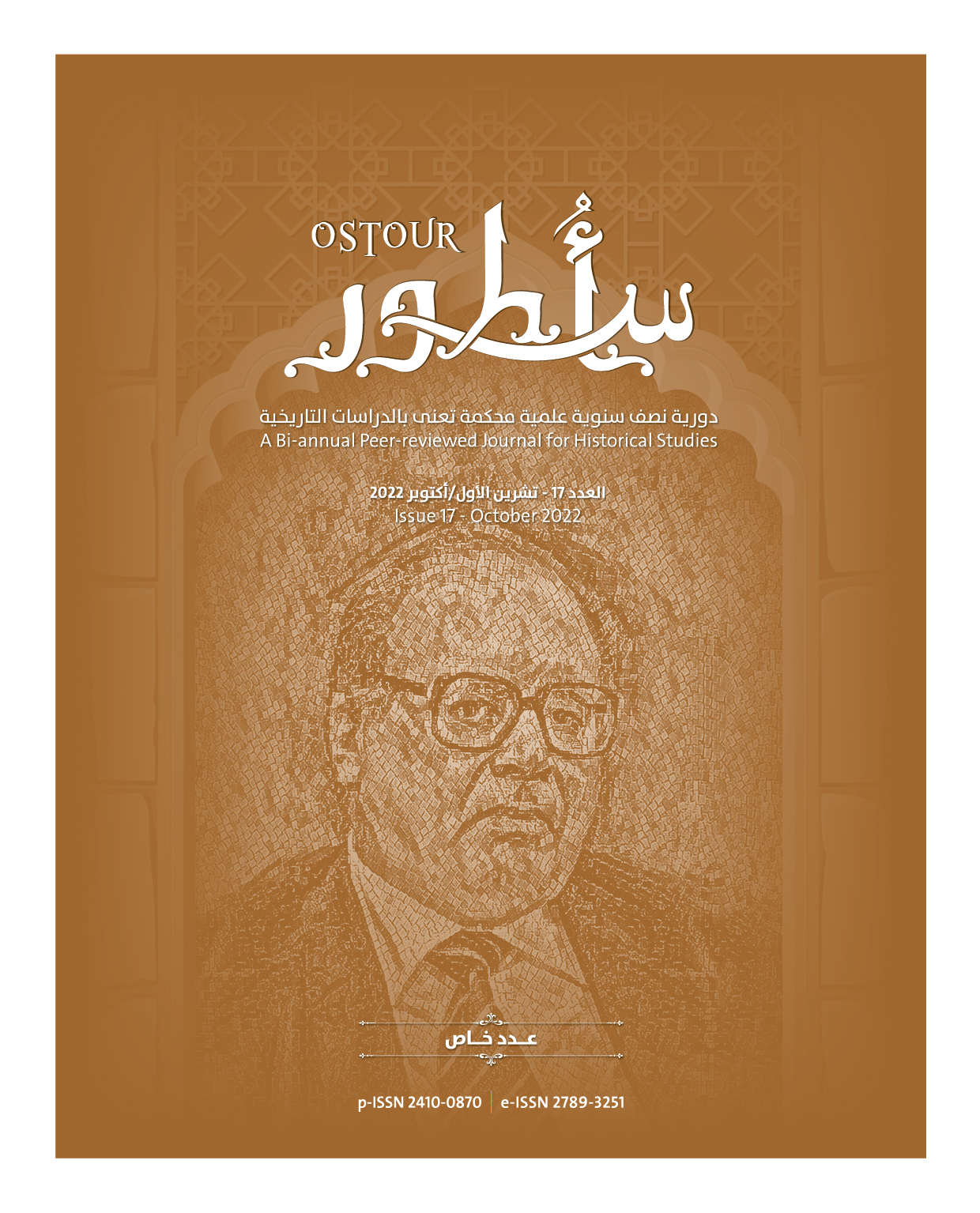
Issue 017
225 views 302 downloads 1 citationsVol. 8 No. 017 (2022)Issue 17 of Ostour for Historical Studies (2022) includes the following studies and articles: “Hichem Djaït and the Orientalists” (Hayet Amamo); “Hichem Djaït and the Foundations for Arab Enlightenment” (Kamal Abdellatif); “On Hichem Djaït and Modern Prophetic Biography” (Soumaya Louhichi); “Hichem Djaït and Prophet Muhammad's Biograph: A Methodological Critique” (Amr Osman); “The Contribution of Hichem Djaït to the History of Systems and Institutions in the Maghreb” (Hassan Hafidi Alaoui); “On the Early Works of Hichem Djaït: The Question of the Past and the Preoccupation with Fate” (محمد حسن); “Review of Hichem Djaït: Itinéraire d’un Universitaire Et Intellectuel Tunisien” (Abdelhamid Hénia); “Review of Hichem Djaït: Itinéraire d’un Universitaire Et Intellectuel Tunisien” (Kamal Abdellatif); “Review of Penser l'histoire, penser la religion” (Hayet Amamo).
-
Issue 016
595 views 741 downloadsVol. 2022 No. 016 (2022)Issue 16 of Ostour for Historical Studies (2022) includes the following studies and articles: “The” (حافظ عبدولي); “Historical Sources of the Revolution and the Mahdist State in Sudan (1881 - 1898): The Problem of Diversity and a Methodological Criteria” (Ahmed Abu Shouk); “Tangier-Tetouan Road in the Nineteenth and Early Twentieth Century” (عبد الحفيظ حمان); “German Foreign Policy towards Turkey in the Context of the WWII: A Vision from a War Economy Perspective” (محمد غاشي); “Ahmad ibn Yahya al-Baladhuri and His Book Futuh al-Buldan” (Mohannad Al Mubaidin); “Venus in Two Acts” (عبد الرحيم الشيخ, سايدية هارتمان); “Royal Legislation during the 19th Century: Morocco's Port Regulation Law” (Basraoui Yahya); “The Egyptian School and Muhammad Ali Pasha's Economic Experiment” (Ahmed El Sherbini); “The Historical Narrative of Archaeology in Egypt” (خالد عزب); “Trends in Writing the History of Egypt in the Ottoman Era During the Last Quarter of the Twentieth Century” (حسام عبد المعطي); “Review of Dhofar: The Monsoon Revolution: Republicans, Sultans and Empires in Oman (1965-1976)” (أمل غزال); “A Reading of Europe in the Nineteenth Century: Napoleon” (Adil ET-Tahiri).
-
Issue 015
700 views 1099 downloads 3 citationsVol. 2022 No. 015 (2022)Issue 15 of Ostour for Historical Studies (2022) includes the following studies and articles: “The Path to Renewal: The French Annales School from Emergence to Collapse (2)” (ناصر الدين سعيدوني); “The Emergence and Development of Ottoman Historical Writing up until the End of the Fifteenth Century” (Anis A. Mahmoud); “Epidemics and Pandemics in the Ancient Near East - From Ancient Times until the Emmaus Plague: A Study of Their Impacts on Human History” (Mohammed Maraqten); “Water and the Sacred in North Africa during the Roman Era” (Samir Ait Oumghar); “The Umayyads: Forms of Forgetting and Places of Memory” (Moez Omri); “The Twelve Articles: A Sketch of the Relationship between Religion and Law in Lutheran Germany” (Talal Aljassar); “Islam and the Early Founders of the English Colonies in North America 1607-1789” (Nagham Talib); “Universal History (2)” (Susan Buck-Morss, Ali Hakim Saleh); “Translation and Study of Four Letters in the Ottoman Language on the French Siege of the Algerian Coast in 1827” (Kheireddine Saidi); “Historical Writing in Egypt” (Abderrahim Benhadda); “The Efforts of Egyptian Historians in Studying the History of the Crusades: Processes and Developments” (Hatem El-Tahay); “The Academic School and the Development of Historical Writing in Egypt in the First Half of the Twentieth Century” (Ahmed El Shelek); “Unknown, Forgotten, Neglected: Observations on the Historiography of Modern Egyptian Art in the Twentieth Century” (Yasser Mongy); “The Crisis of Historical Writing in 1960s Thought: A Reading in the Writings of Raouf Abbas” (Nasser Ahmed Ibrahim); “Book review of Introducing and Briefing Some of What Needs to Be Done on the Hijaz Road” (Mustapha el Ghachi); “The Epistemological and Dialectical Foundations for Re-reading History in Morocco Review of the book Historical Thought and Learning History” (Abdelaaziz Ettahiri); “Book review of Histoire Du Monde Au XIXe Siècle” (محمد غاشي).
-
Issue 014
744 views 1089 downloadsVol. 7 No. 014 (2021)Issue 14 of Ostour for Historical Studies (2021) includes the following studies and articles: “The Path to Renewal: The French Annales School from Emergence to Collapse (1)” (ناصر الدين سعيدوني); “Nineteenth Century Slave Markets: The Moroccan Slave Trade” (رحال بوبريك); “The Problematic Religious and Political Relationship between the Sultanate and the Christian Awqāf (Endowments) in Ottoman Jerusalem” (Musa Sroor); “The Balancing Powers in Kuwait During the 1938 Majlis Movement: New Insights From the Legislative Council’s Minutes” (Abdulrahman Alebrahim); “Makhzen and Beylik: Observations on the Features of Authority and Mechanisms of Government in the Maghreb: Tunisia and Morocco” (Abdelmajid Ait Elcaid); “State Memory and Territory between Memory and History: Tunisia and Morocco before Colonialism.” (Adnane Elkarssi); “Universal History (1)” (Ali Hakim Saleh, Susan Buck-Morss); “Archives in Israel, the Israeli Historical Narrative, and the Nakba: Unveiling the Report that Refutes the Israeli Historical Narrative” (Mahmoud Muhareb); “Historical Writing in Iraq” (Abderrahim Benhadda); “The Historian and The State” (Haider Saeed); “Contemporary Academic History in Iraq: Critical Approaches to the Study of Modern and Contemporary History” (جميل النجار); “Modern Iraqi history encyclopedias: Tracing their development from totalitarianism to regionalism” (Nasir al-Kaabi); “Iraqi historiography before and after 2003: Multiple variables, overlapping methodologies” (Nahar Muhammed Nuri); “The Challenges of Historiography in post-2003 Iraq” (سعد إسكندر); “Book review of The Adventures of Ibn Battuta: A Muslim Traveler of the Fourteenth Century” (Said Benhammada); “Book review of The Adventures of Ibn Battuta: A Muslim Traveler of the Fourteenth Century” (Fahmi Romdhani).
-
Issue 013
507 views 788 downloadsVol. 7 No. 013 (2021)Issue 13 of Ostour for Historical Studies (2021) includes the following studies and articles: “Historical Writing: Epistemological Junctures” (Adil ET-Tahiri); “Ottoman Historians and State Reform A Study Through Historical Sources” (Abdelhay EL Khili); “Critical Issues in the Early Modern History of Morocco: History and Jurisprudence between Moroccans and Iberian Occupiers” (Mohamed Cherif); “Managing Memory in the Context of Transitional Justice: A Comparative Study of Moroccan Experience” (Abdelaaziz Ettahiri); “Historical Knowledge between Pain Recollected and Societal Reconciliation Realised: the Moroccan Experience as a Model” (Mohammad Mahmoud Al Tanahy); “Religious, Customary and Civilian Institutions of Authority in M’zab, Algeria: Origins and Developments” (Sofia Hanezla); “Trickster Travels: A Sixteenth Century Muslim between Worlds” (Thaer Deeb, Natalie Zemon Davis); “Rif War Prisoners Through Spanish Documents” (Mohamed Abdel Moumen); “Popular Song and Literary Fiction: Sources for Writing History” (Abdelwahed Mokni); “The Joke as a Historical Source Do Funny Texts Contribute to Writing Arab History?” (Brahim Elkadiri Boutchich); “From Journalism to Civil Status: The Historian's Questions and the Path in Search for Sources” (Fatima Zohra Guechi); “A Reading of Historian Andrew Mango's” (محمد عثمانلي); “Mudar Badran's Memoirs: The Road from Damascusto the Madrid Conference” (Muhannad Mubaidin).
-
Issue 012
775 views 963 downloadsVol. 6 No. 012 (2020)Issue 12 of Ostour for Historical Studies (2020) includes the following studies and articles: “Intellectual History: Origin, Subject, Curriculum and Its Status in Modern Arab Historical Studies” (Amr Osman); “Methods of Historical Classification through the Introductions of History Books” (Ali Mazyan); “State Presence and Representations in Peripheral Areas: The Regency of Tunis in the Modern Period” (Mustapha Tlili); “Looking at the Safavid Harem in a new light” (Mahboobeh Majeedzadeh); “Historiography and Constructing the Modern Nation-State in Turkey” (Souad Benali); “Transformations in Historiography: from elite history toward a history of the marginalized” (محمد غاشي); “The Algerian Revolution in the United Nations” (Noureddine Teniou); “Approaches in the Social Sciences and Humanities: Articles Translated from French” (Mustapha Tlili); “Jewish Trade Mediation between Morocco and the Netherlands in the Nineteenth Century: By way of documents in the National Archive, The Hague” (Abdulghani al-Omrani); “Arab Historians and Their Sources” (Ostour Editorial Commitee); “Towards an Exit Plan from Micro- to Macro-History: the Documents of the Jerusalem Waqf as a Historical Source” (Musa Sroor); “The History of the Marginalized in Palestine: from the Ottoman Rule to the Nakba and Beyond” (Adel Manaa); “Colonialism in the Imaginary: Jerusalem in the Early Photograph.” (Issam Nassar); “Arab Historical Knowledge Production: Contexts of Constructing Meaning and Forms of Interpreting the Representative” (Lotfi Aïssa); “The City in the Islamic World: From Imitation to Modernization (A Reading of the book The Arab City and Modernity)” (Abderrahim Benhadda).
-
Issue 011
689 views 984 downloadsVol. 6 No. 011 (2020)Issue 11 of Ostour for Historical Studies (2020) includes the following studies and articles: “The Hermeneutic Approach to History: Towards Involving the Historian in the Interpretation of Historical Texts” (Brahim Elkadiri Boutchich); “Memory Studies in social and human sciences: An international interest and an arabic deficiencies” (Zouheir Soukah); “The Geography of History in Light of Interdisciplinarity: An Attempt to Reshape the Concept” (Ali el-Salah Moula); “Prosopography: An Approach to Studying Elites and Social Groups” (Rajae Ankoud); “Water and Settlement in Ancient North Africa” (Samir Ait Oumghar); “Ceuta in the Strategy of the Powers of the Western Mediterranean (Part 2)” (Mohamed Cherif); “Proving and Silencing: How Palestinian Fighters Ended “Annexation” (15 May 1948 – January 1949) in the writings of Qassem Al Rimawi on al-Jihad al-Muqaddas” (Bilal Mohammed Shalash); “The Value of Narrativity in the Representation of Reality” (Hayden White); “Notes on the translation of the texts of treaties concluded between the Mamluk Sultans and the Italian Cities” (Pierre Moukarzel); “Summary of Ostour Seminar: Arab Historians and their Sources, Part 2” (Ostour Editorial Commitee); “Historians and Travel, or, How Can Travel Sit at the Heartof the Historian's Writing? Moroccan and Eastern Ottoman Travel as an Example” (Mustapha el Ghachi); “Mutual Ignorance of Ottoman and Moroccan Sources” (Abderrahim Benhadda); “Historical Sources and their Uses in the Relationship of Minorities to Otherness in Tunisia” (Abdelhamid Hénia); “The Historian of Modernity in the Arab World and the Problem of Sources: General Observations on Tunisia and Libya” (Fathi Lissir); “Trade in Wadi Noun during the 19th Century and the Early 20th Century By Abdul Hadi Al-Maden” (Bouzid Laghla); “A Review of The Socio-Cultural and Economic Structures of The Ottoman Empire by Mübahat S. Kütükoğlu” (Kheireddine Saidi).
-
Issue 010
682 views 1103 downloadsVol. 10 No. 010 (2019)Issue 10 of Ostour for Historical Studies (2019) includes the following studies and articles: “The Historian and Quantitative Approaches: Demographic Studies of Islamic Cities Hypotheses and Questions” (Tariq Madani); “Religious and sectarian diversity in the early Islamic period: A study of Dirar b. ‘Amr al-Ghatafani’s (d.c. 200AH / 815 AD) Kitab at-Tahrish” (Abdulrahman Helli); “Power and Political Criminalization of the Opposition in the Maghreb and al,Andalus of the 10th century CE/4th century AH” (Said Benhammada); “Ceuta in the Strategy of the Powers of the Western Mediterranean” (Mohamed Cherif); “Arabic Origins of the Foundational Myth of Western Identity: Between Histories of the Conquest of America and the Conquest of al-Andalus” (Mohamed Abderrahman Hasan); “Monk and Faqih: An Intersecting Biography of Nicholas Kleinard and Muhammad bin Kharouf” (Mohamed Bekkour); “French Islamic School Alumni Associations and the Moroccan National Movement (1921-1956)” (Ilyas Foutouh); “Narrative and the Real World: An Argument for Continuity” (Thaer Deeb, David Carr); “Four buried letters on Bayt al,Maghrib in Cairo” (Salwa al-Zahiri); “Arab Historians And Their Sources” (Abderrahim Benhadda); “Arab Historians And Their Sources (Background paper)”; “Researching the Archive of the French Foreign Ministry: Data Analysis in Social and Political Affairs” (Wajih Kawtharani); “A Reseach Experience in Tunisia’s Modern Ottoman Archives”; “My Experience in the Portuguese Archives”; “Review of The Dialectic of Identity and History: Tunisian Readings of Hicham Djait” (Fahmi Romdhani); “Renewal in Ibrahim al-Qadiri Boutchiche’s Historiography: A Reading of Marginalized People in the History of the Islamic West: Theoretical and Practical Problems in Subaltern History” (Khaled Belarbi); “On the Need to Define the Historian’s Trade: A Reading of Bayadh al-Tayyeb’s The Press and History” (Jamal Fazzeh).
-
Issue 009
676 views 999 downloadsVol. 9 No. 009 (2019)Issue 9 of Ostour for Historical Studies (2019) includes the following studies and articles: “Time Bandits: A Study of the Development of European Mentalities during the Renaissance” (Khaled Tahtah); “A Toponymical Reading of the Africa Gate of Idrissi Fez” (Elhassane Laghraib); “Seghir Ben Youssef al-Baji: Between the Science of History and the Science of Biography” (Jamel bentahar); “A Debate on Paul Wittek's Thesis about the Rise of Ottoman Empire” (Anis A. Mahmoud); “From the History of Ruling Dynasties to the History of the Present” (Abdel-Rahman al-Mouden); “The Contribution of India's Muslims to Religious Endowments and Charitable Works in Palestine - A Historical Study Based on British Documents” (Sahibe Alam Azami Nadwi); “Role of the Israeli Communist Party in the Nakba” (Mahmoud Muhareb); “The Power in the Story” (Michel-Rolph Trouillot); “A Spanish Document on Redemption of Captives in Salé 1632” (Mohamed Abdel Moumen); “The second part of the Ostour seminar”; “The Impact of the Balfour Declaration inside and outside Palestine over one year” (Johnny Mansour); “The Leaderships of the Arab Movement and the Balfour Declaration (1917-1920)” (Fathi Lissir); “The Role of Herbert Samuel in Instituting and Implementing the Balfour Declaration 1914-1925” (Mohammed Majid Al-Hazmawi); “Revisions of Ottoman Turkish History: A Reading of We and Our History by Ilbert Ortayli” (Abderrahim Benhadda); “Review of the Stirring Times or Records from Jerusalem Consular Chronicles of 1853-1856 by James Finn.” (Salih Alshora); “Review of The Movement of Algerian Youth at the Beginning of the Twentieth Century by Nikolay Dyakov” (Nafissa Douida).
-
Issue 008
638 views 920 downloadsVol. 4 No. 008 (2018)Issue 8 of Ostour for Historical Studies (2018) includes the following studies and articles: “History Writing for Jules Michelet” (Yassine Zainoune); “The Murder of Hujr ibn Adi and the Ideological Reading of History” (Amr Osman); “Aspects of Relational History: Morocco and the Ottoman State between the 16th and 18th Century” (Abdel-Rahman al-Mouden); “Late Piracy off the Rif Coast in the 19th Century” (Mohamed Ahmian); “Iraqi Specificities and the Refutation of the “Artificialness” of Iraq” (Nahar Muhammed Nuri); “The Cheese and the Worms: The Cosmos of a Sixteenth Century Miller by Carlo Ginzburg” (Carlo Ginzburg, Thaer Deeb); “Ostour Seminar - One Hundred Years after the Balfour Declaration: Context and Implications” (Ostour Editorial Commitee); “The Reverberation of the Balfour Declaration in Jewish, Arab, Ottoman, and International Circles 1917–1920” (Ali Mahafzah); “Echoes of the Balfour Declaration in Morocco” (Jamaa Baida); “The Balfour Declaration in Palestinian Newspapers from 1917 till the Buraq Revolution of 1929” (Saleh al-Shoura); “Land, Property Rights, and Colonial Procrastination: Between the Balfour Declaration and the Nakba” (Munir Fakhr al-Din); “A review of History of Minorities in the Far Maghreb: The Case of Christians during the Middle Ages” (Rabhi Radwan); “Reviews the Arabic translation of Mohammed al-Naji's Soldiers, Servants and Concubines: A History of Slavery in Morocco” (Faouzi Boukhriss); “Review of The Emirs of Houran: The Al Fawwaz as the Sheikhs of the Sardiya” (Mohannad Al Mubaidin).
-
Issue 007
744 views 1086 downloadsVol. 4 No. 007 (2018)Issue 7 of Ostour for Historical Studies (2018) includes the following studies and articles: “Byzantium’s Official Attitude towards Islam as imagined by Abu Sufyan: The Impact of the Imaginary on Self-Perception and Perception of the Other” (Béchir Labidi); “Sassanid Sultanic Literature in the Early Abbasid Court and the Question of its Transfer” (Nasir al-Kaabi); “Manifestations of Renewal in the Field of History in Tunisia between the 17th and 19th Centuries” (Abdelhamid Hénia); “Historical Knowledge Production” (Abderrahim Benhadda); “The Algerian Elite and its Connection to a Reform Movement” (Noureddine Teniou); “Collective Memory as a Subject of Historical Research: A Study of Selected Historians from the Third Generation of the Annales School” (Yassin al-Yahyawi); “Microhistory: Two or Three Things That I know about it” (Thaer Deeb, Carlo Ginzburg); “When History Becomes the Science of the State in the Arab World” (Abdelhamid Hénia); ““Historians in the Service of the State: Ernest Lavisse and Ahmad Al Nasseri”” (Houbaida Mohamed); ““Historical Knowledge and the State among Historians of Rural Tunisia in the Modern Era”” (Mohammed Merimi); ““Historical Writing in Nineteenth Century Tunisia: History as a Justification for the Reform-minded State”” (Slimane Ben Fatma); ““On the National Imaginary and the Birth of Nations: the Case of Lebanon”” (Wajih Kawtharani); ““From Defending the State and Modernization to Spreading the Ideals of Citizenship: Transformations in Tunisian Historical Writing”” (Jamel bentahar); “The Islamic Minority in Sicily between Integration, Confrontation and Identity Conflict (484-591AH / 1091-1194AD): Contribution to the Study of the History of Minorities.” (Mohammed Amrani Zerrifi); ““The Paradise of the Infidels” the Travel Account of Mohammed Effendi to Paris in 1721 Revised and edited: Abderrahim Benhadda” (Mustapha el Ghachi); “Biography and Contemporary History: Reading the Memoires of Salim Hijja” (Bilal Mohammed Shalash); “Sharia Court Records - A New Historiographical Method for the Arabs in the Ottoman Period” (Ghandi Mohtar).
-
Issue 006
643 views 948 downloads 1 citationsVol. 3 No. 006 (2017)Issue 6 of Ostour for Historical Studies (2017) includes the following studies and articles: “The Nature of Early Islamic Sources and Academics' Differing Views of their Historical Significance” (Hayet Amamo); “The Image of the Byzantines in Arabic Culture as Expressed in Language” (Mohamed Tahar Mansouri); “On the Road to the Abode of Felicity: Observations of a Damascene Scholar in Anatolia and Istanbul in 1530” (Abdul Rahim Abu Husayn, Tarek Abu Hussein); “Maghrebi Captives in Europe 1772 - 1775: From the Tunisian National Archives” (Lamjed Bouzid); “French Expeditions to the Moroccan South during the 19th Century Fact and Representation” (Mohamed Aitjamal); “The Historiography of Contemporary Events through Memoires and Personal Testimonies Significance and Research Cautions (The Case of Libya)” (Fatah Gdarh); “Witness and Historian in Morocco: Conflict or Complementarity?” (Abdelaaziz Ettahiri); “The Prose of Counter-Insurgency” (Ranajit Guha); “Scenes from the Hejaz at the End of the 19th Century: the Travels of Ahmad ibn al-Hasan al-Sabei 1310AH/1893AD” (Elhaj Sassioui); “Dividing the World: Centenary of Sykes-Picot” (Ostour Editorial Commitee); “From Marj Dabiq to Sykes-Picot Report on the Fourth ACRPS Annual Conference on Historical Studies” (Ghandi Mohtar); “A review of Kessrouan Campaings in Political History of Ibn Taymiyya Fatwas” (Ra'ed Alsamhouri); “A 16th-century Tunisian Atlas: A review of” (Abderrahim Benhadda); “The Ottomans and Emergence of Modernity:” (Abdelhay EL Khili).
-
Issue 005
640 views 821 downloads 2 citationsVol. 3 No. 005 (2017)Issue 5 of Ostour for Historical Studies (2017) includes the following studies and articles: “How Academic Research Contributes to Enhanced Definitions of Terms The Case of Etymology” (Elhassane Laghraib); “Echoes of Ancient Myths and Rituals in Contemporary Abrahamic Religions” (Amal Arbid); “The Transition from the Timar System to the Iltizam System in the Ottoman Sanjak of Tripoli” (Mohamed Jamal Barout); “The 1729 Peace Treaty between the Eyalet of Algiers and the Kingdom of Sweden” (Abdelhadi Radjai Salmi); “The Functions of the Traditional Amazigh Inafless Council before the French Protectorate of Morocco The Case of the Idawtana” (Rabii Rachidi); “Merchants and the Drive for Democracy in Kuwait (1921-1939)” (Mohammad Mahmoud Al Tanahy); “From Negotiations to Infiltration The relationship between the Jewish Agency and the Syrian National Bloc and the Shahbandar” (Mahmoud Muhareb); “The knowledge of everyday life Marxism as critical knowledge of everyday life” (Henri Lefebvre); “From Establishing the Palestine Students’ Union to Resisting Forced Resettlement Fathi Balawi memoirs” (Moueen Al-Taher); “The Ostour Symposium: “Teaching History in Arab Universities”” (Ostour Editorial Commitee); “A review of Educational Missions Overseas from Japan and Morocco (1840s-1940s)” (Hikmat Alabdulrahman); “A review of Religion and Secularism in Historical Context, by Azmi Bishara” (Mohamed Tahar Mansouri); “A review of Hassan II: the Maligned King: Moroccan Political History under Hassan II” (Elhaj Sassioui).
-
Issue 004
666 views 1047 downloadsVol. 2 No. 004 (2016)Issue 4 of Ostour for Historical Studies (2016) includes the following studies and articles: “History, Memory and Historiography: A Study of Sykes-Picot, the Caliphate, and the Memory of Religious Denominations in Leba” (Wajih Kawtharani); “The Biography of the Prophet: Narrators and Authors” (Hayet Amamo); “The Navigation Industry in Ibn Khaldoun's Muqaddimah” (Mohamed Tahar Mansouri); “Scholarly Endowments (Waqf) for Rasulid Women in Zabid 626 - 858 AH/1229 - 1454 AD” (Abdelhakim Seifeddin); “The Religious Obligation of the Pilgrimage from Indonesia to Mecca” (Yahya Mohamed Ahmed Ghaleb); “German Historiography and the Nazi Complexd” (Khaled Tahtah); “Tangier under Spanish Occupation (1940 - 1945)” (Zeinab Hamouda); “The Poetics of History” (Hayden White); “Who is Andrad of Seville, Author of On the Nature, Kinds, and Deeds of the Horse?” (Rachid Affaki); “Marginalized in Syria at the Turn of the Century: Oral Testimonies” (Abdullah Hanna); “Fields of Historical Research in the Arab World (Ostour's Seminar)” (Ostour Editorial Commitee); “Mohamed Tahar Al Mansuri: the Life of a Historian (1955 - 2016)” (Ostour Editorial Commitee); “A Conversation with Lebanese Historian Wajih Kawtharani” (Abderrahim Benhadda); “Arab History and the Crisis of Method seen through Mohammed Habida’s The Misery of History” (Mohamed Tahar Mansouri); “Review of Tunisia in the Middle Ages: Ifriqiya from Dependent Emirate to Independent Sultanate” (Yassin al-Yahyawi); “Review and Discussion of Educational Missions in the Period of Sultan Moulay Hassan” (Yehya Boulehya); “A Reading of Le frère, le sujet et le citoyen: Dynamique du statut politique de l'Individu en Tunisie” (Mohamed Tahar Mansouri); “Review of Tunisia in the Middle Ages: Ifriqiya from Dependent Emirate to Independent Sultanate” (Chamseddin Alkilani).
-
Issue 003
723 views 1038 downloads 7 citationsVol. 2 No. 003 (2016)Issue 3 of Ostour for Historical Studies (2016) includes the following studies and articles: “Lecture” (Hichem Djait); “Observations on the Climate of the Ancient Maghreb” (Samir Ait Oumghar); “The Constitution of Medina: The History of the Reception of a Text” (Amr Osman); “Units of Measurement in Islamic Societies: The Finger, the Fist, and Large and Small Spans” (Mohammed Amrani Zerrifi); “Urban Space Management in Cordoba” (Youssef Ngadi); “Wheat and Mohammad Ali Pasha's Independence Project during the Continental Blockade Crisis (1807-1815)” (Nasser Ahmed Ibrahim); “Subaltern Studies and Postcolonial Historiography” (Dipesh Chakrabarty); “The Uses of Biography” (Giovanni Levi); “Ottoman Census of Damascus in the Year 1086 Hijri (1675-1676)” (Mustafa Öztürk, Suheil Saban); “Periodization in Arab Islamic History” (Ostour Editorial Commitee); “Masarat: Arab Scholars and their Contributions to the Writing of History A Conversation with Egyptian Historian Mahmoud Isma” (Ostour Editorial Commitee); “The Justice Discourse in Sultanic Literature by Ibrahim Al-Qadri Boutshish (Book Review)” (Chamseddin Alkilani); “Prison and Prisoners: Examples from the Middle Ages in the Maghreb by Mustafa Nashat (Book Review)” (Yehya Boulehya); “When a Nation Awakens by Sadek Hadjeres (Book Review)” (Noureddine Teniou); “The Birth Pangs of Ottoman Rule in Arab Lands at the End of the Reign of Sulieman the Magnificent” (Abderrahim Benhadda).
-
Issue 002
715 views 970 downloadsVol. 1 No. 002 (2015)Issue 2 of Ostour for Historical Studies (2015) includes the following studies and articles: “History of the Present Moment: Background and Problematics” (Khaled Tahtah); “Memory and Testimony in Writing the History of the Algerian Revolution 1954-1962 The Liberation Struggle in History of the P” (Noureddine Teniou); “The Almohads Military Strategy in the Western Mediterranean” (Azeddine Guessous); “The Battle of Kosovo 1389: From Myth Making to Ideology” (Muhammed Al-Arnaout); “"Karimi", Egypt during the Ottoman Era (1517-1630/ 923-1040 H)” (حسام عبد المعطي); “The Military Strategy of the Mahdi in Sudan (1881 - 1885)” (Ahmed Abu Shouk); “Political Conflict in Morocco Prior to the French Protectorate” (Yehya Boulehya); “Diplomacy Aspects of the Rif Liberation Movement Leader Muḥammad ibn ʿAbd al-Karīm al-Khaṭṭābī” (Kacem El hadeg); “Moroccan Northern Tribes' Awareness of Palestine's Tragedy” (Mustafa Alghadiri); “The Arabs and the first World War” (Ostour Editorial Commitee); “Masarat: Arab Scholars and their Contributions to the Writing of History A Conversation with Algerian Historian Nassereddine” (Ostour Editorial Commitee); “Historical Topography of Ancient and Medieval Syria by René Dussaud” (Ammar al-Samar); “Towards a Constitutional State: The Project of the Young Turks Intellectuals in Hurriyet Newspaper (1868 - 1870)” (Nizam Al-Abbasi); “The Revival of Japan in the Meiji Period from an Arab-Islamic Perspective: A Reading” (Aziz al-Arabawi); “Ex-Libris: Chronicles of Theft, Preservation, and Appropriating at the Jewish National Library” (Mahmoud Muhareb).
-
Issue 001
576 views 868 downloads 5 citationsVol. 1 No. 001 (2015)Issue 1 of Ostour for Historical Studies (2015) includes the following studies and articles: “World History: Themes and Methodologies through the History of Objects” (Amr Osman); “The Past as Viewed in Ancient Egypt” (Sherine El-Menshawy); “The Maqāmāt of Badīʿ al-Zamān al-Hamadhānī: Text, Manuscript and History” (Bilal Orfalli, Maurice Pomerantz); “A History of Mandean Studies with Highlights on the Study of their Origins and of their Beliefs” (Ahmed Al-Adawy); “Representation of the Central Authority and Authoritarian Practices” (Elbachir Aberzaq); “A Social History of Concubines in Egypt: The Case of Nafisa Khatun” (Nasser Ahmed Ibrahim); “The Aleppo incidents of 1850: a study in the form and impetus of urban violence during the early Ottoman tanzimat” (Feras Krimsti); “The Negotiations between the Jewish Agency and the Syrian National Bloc” (Mahmoud Muhareb); “After the Armistice: The Ottoman Response to Zidan Saadi’s Petition” (Abderrahim Benhadda); “A reading of” (Khaled Tahtah, Yousef Almohajer); “A reading of Antonio de Saldanha’s memoirs of captivity by Sultan Ahmad al-Mansur of Morocco” (Brahim Elkadiri Boutchich); “On Colonial Ethnography in Morocco: Artefacts of Colonialism” (Yahya Ben Alwaleed); “Infidels: A History of the Conflict between Christendom and Islam” (Emadeddin Ashmawy).