Vol. 4 No. 007 (2018): Issue 007
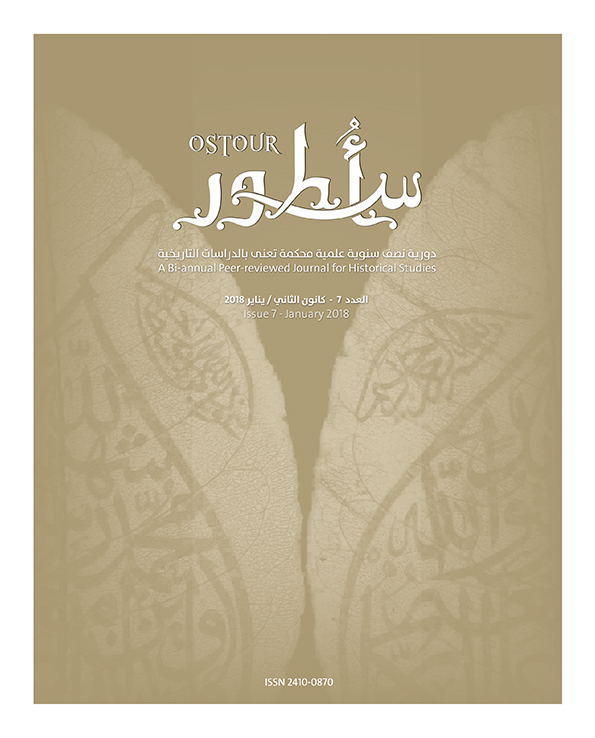
غلاف العدد 7 من دورية أسطور

Issue 7 of Ostour for Historical Studies (2018) includes the following studies and articles: “Byzantium’s Official Attitude towards Islam as imagined by Abu Sufyan: The Impact of the Imaginary on Self-Perception and Perception of the Other” (Béchir Labidi); “Sassanid Sultanic Literature in the Early Abbasid Court and the Question of its Transfer” (Nasir al-Kaabi); “Manifestations of Renewal in the Field of History in Tunisia between the 17th and 19th Centuries” (Abdelhamid Hénia); “Historical Knowledge Production” (Abderrahim Benhadda); “The Algerian Elite and its Connection to a Reform Movement” (Noureddine Teniou); “Collective Memory as a Subject of Historical Research: A Study of Selected Historians from the Third Generation of the Annales School” (Yassin al-Yahyawi); “Microhistory: Two or Three Things That I know about it” (Thaer Deeb, Carlo Ginzburg); “When History Becomes the Science of the State in the Arab World” (Abdelhamid Hénia); ““Historians in the Service of the State: Ernest Lavisse and Ahmad Al Nasseri”” (Houbaida Mohamed); ““Historical Knowledge and the State among Historians of Rural Tunisia in the Modern Era”” (Mohammed Merimi); ““Historical Writing in Nineteenth Century Tunisia: History as a Justification for the Reform-minded State”” (Slimane Ben Fatma); ““On the National Imaginary and the Birth of Nations: the Case of Lebanon”” (Wajih Kawtharani); ““From Defending the State and Modernization to Spreading the Ideals of Citizenship: Transformations in Tunisian Historical Writing”” (Jamel bentahar); “The Islamic Minority in Sicily between Integration, Confrontation and Identity Conflict (484-591AH / 1091-1194AD): Contribution to the Study of the History of Minorities.” (Mohammed Amrani Zerrifi); ““The Paradise of the Infidels” the Travel Account of Mohammed Effendi to Paris in 1721 Revised and edited: Abderrahim Benhadda” (Mustapha el Ghachi); “Biography and Contemporary History: Reading the Memoires of Salim Hijja” (Bilal Mohammed Shalash); “Sharia Court Records - A New Historiographical Method for the Arabs in the Ottoman Period” (Ghandi Mohtar).

Published: 2018-01-01

Studies

  • Byzantium’s Official Attitude towards Islam as imagined by Abu Sufyan: The Impact of the Imaginary on Self-Perception and Perception of the Other

    Author: Béchir Labidi
    7-19

    This study explores the official attitude towards Islam as imagined by Abu Sufyan, the Umayyad leader of the Quraysh tribe of Mecca. Abu Sufyan reportedly took advantage of being the envoy sent...

  • Sassanid Sultanic Literature in the Early Abbasid Court and the Question of its Transfer

    Author: Nasir al-Kaabi
    20-42

    This paper deals with the transfer of Sassanid “Sultantic” literature—that is, literature on governance and the appropriate forms of government—from its original, Persian/Zoroastrian environment...

  • Manifestations of Renewal in the Field of History in Tunisia between the 17th and 19th Centuries

    Author: Abdelhamid Hénia
    44-72

    This paper provides insight on the role of the historian and history in Tunisia during the Ottoman period. Intellectually, historians became involved in a social project based on the...

  • Historical Knowledge Production

    Author: Abderrahim Benhadda
    74-94

    This paper surveys the production of historical knowledge in post-independence Morocco. In doing so, the author divides the profession of forming historical knowledge into three distinct...

  • The Algerian Elite and its Connection to a Reform Movement

    Author: Noureddine Teniou
    96-108

    This paper attempts to illustrate a political and cultural reality witnessed by Algeria during French rule, beginning in the 1930s, following the establishment of the Algerian Muslim Scholars...

  • Collective Memory as a Subject of Historical Research: A Study of Selected Historians from the Third Generation of the Annales School

    Author: Yassin al-Yahyawi
    110-123

    This article seeks to study the evolution of research on “collective memory”, a subject of great significance to the academic tradition of history in the Francophone sphere. Three approaches are...

Translations

  • Microhistory: Two or Three Things That I know about it

    Authors: Thaer Deeb, Carlo Ginzburg
    127-147

    This article explores the origins of the term "microhistory" and, particularly, its use by the Italian school. It shows the connection and the intersection with “microhistory” and a host of...

Book Reviews

  • The Islamic Minority in Sicily between Integration, Confrontation and Identity Conflict (484-591AH / 1091-1194AD): Contribution to the Study of the History of Minorities.

    Author: Mohammed Amrani Zerrifi
    151-157

    The Islamic Minority in Sicily between Integration, Confrontation and Identity Conflict (484-591AH / 1091-1194AD): Contribution to the Study of the History of Minorities.Ibrahim Al-Qadri...

  • “The Paradise of the Infidels” the Travel Account of Mohammed Effendi to Paris in 1721 Revised and edited: Abderrahim Benhadda

    Author: Mustapha el Ghachi
    158-166

    Reviewed by: Mustapha El Ghachi, Professor of Modern and Contemporary History at the Faculty of Arts and Humanities, Abdelmalek Essaadi University in Martil, Tetouan and Director of the Doctoral...

  • Biography and Contemporary History: Reading the Memoires of Salim Hijja

    Author: Bilal Mohammed Shalash
    167-171

    Bilal Mohammed Shalash Director of Institute for Documenting Palestine (Ramallah, Palestine). He holds a research fellowship from the ACRPS for a research project on the garrison of Jaffa and...

Ostour Symposium

  • When History Becomes the Science of the State in the Arab World

    Author: Abdelhamid Hénia
    175-177

    The Doha Institute for Historical Studies in cooperation with the journal Ostour organized an academic seminar titled “When History Becomes a State-Sanctioned Discipline in the Arab Region” on...

  • “Historians in the Service of the State: Ernest Lavisse and Ahmad Al Nasseri”

    Author: Houbaida Mohamed
    178-185

    This paper provides insight on the role of the historian and history in Tunisia during the Ottoman period. Intellectually, historians became involved in a social project based on the...

  • “Historical Knowledge and the State among Historians of Rural Tunisia in the Modern Era”

    Author: Mohammed Merimi
    186-198

    “Historical Knowledge and the State among Historians of Rural Tunisia in the Modern Era”

  • “Historical Writing in Nineteenth Century Tunisia: History as a Justification for the Reform-minded State”

    Author: Slimane Ben Fatma
    199-212

    “Historical Writing in Nineteenth Century Tunisia: History as a Justification for the Reform-minded State”

  • “On the National Imaginary and the Birth of Nations: the Case of Lebanon”

    Author: Wajih Kawtharani
    213-222

    “On the National Imaginary and the Birth of Nations: the Case of Lebanon”

  • “From Defending the State and Modernization to Spreading the Ideals of Citizenship: Transformations in Tunisian Historical Writing”

    Author: Jamel bentahar
    223-237

    “From Defending the State and Modernization to Spreading the Ideals of Citizenship: Transformations in Tunisian Historical Writing”

Reports

  • Sharia Court Records - A New Historiographical Method for the Arabs in the Ottoman Period

    Author: Ghandi Mohtar
    241-256

    Records of the Sharia Courts in the Ottoman Period - Methodology and Terminology is the latest book by Khaled Ziadeh, Director of the Beirut Office of the Arab Center for Research and Policy...