Vol. 1 No. 001 (2012): Issue 001
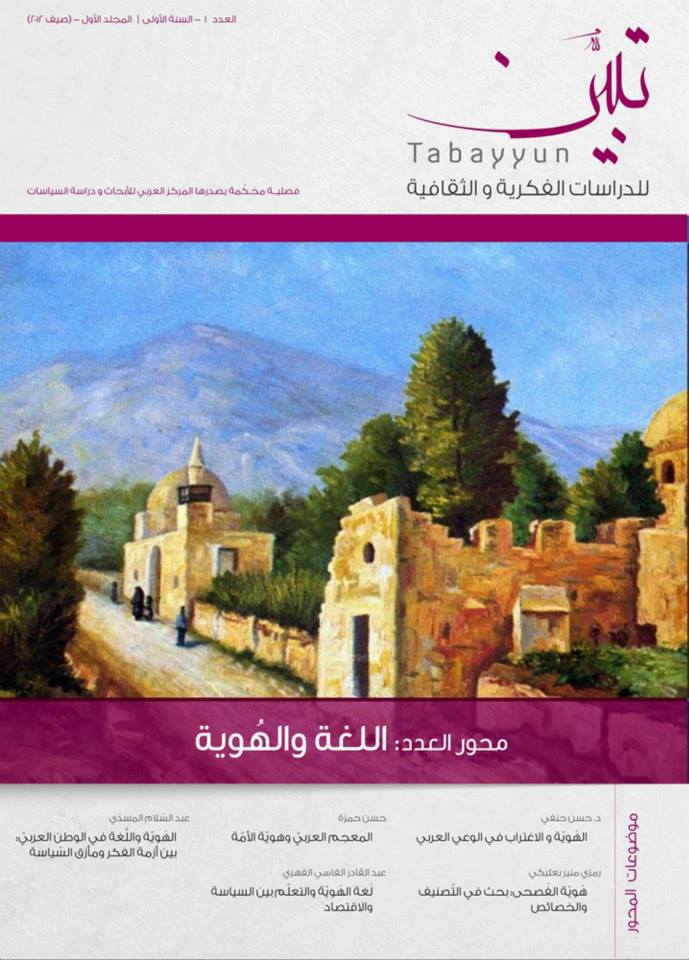
غلاف العدد 1 من دورية تبيّن

Issue 1 of Tabayyun (2012) includes the following studies and articles: “Identity and Alienation in Arab Consciousness” (Hassan Hanafi); “Fusha: Research into its Categorization and Features” (Ramzi Munir Baalbaki); “The Language of Identity and Learning in Politics and Economics: A Cohesive, Pluralist, and Diverse Model” (Abdelkader Fassi Fehri); “Arabic Lexicon and National Identity” (Hassan Hamzé); “Identity and Language in the Arab Nation: Between Intellectual Crises and Political Impasse.” (Abdessalem Mseddi); “Translation into Arabic: Strengthening Culture and Building Identity” (Bassam Baraka); “The Problem of Identity and the Language-Translation Duality in the Context of Modern Arabic” (Fayiz Suyyagh); “Two Forms of Cultural Materialism in Anthropology and in Cultural Studies” (Thaer Deeb); “The Post-Colonial State and Social Change in Libya” (Ali Abdullatif Ahmida); “From the Notion of Marc Bloch’s Sad Societies (Sociétés Tristes) to the Historiography of the Crisis of Transformation and its times” (Wajih Kawtharani); “Why did Abdallah Laroui Translate Rousseau’s Emile?” (Kamal Abdellatif); “A Reading of Amartya Sen’s The Idea of Justice” (Ahmad Baalbaki); “Review of “Philosophy of World Civilizations: Theories and Interpretations of the Truth”” (Haitham Ahmad Muzahem); “Review of “On the Arab Question: Foreword to a Manifesto for Arab Democracy.”” (Jad Karim al-Jabaei); “Text from the ACRPS Annual Conference on Language and Identity.” (Editorial Board of Tabayyun); “Modernity An Unfinished Project” (​Jurgen Habermas).

Published: 2012-02-01

Studies

  • Identity and Alienation in Arab Consciousness

    Author: Hassan Hanafi
    09-18

    In this study the author explores the meaning of identity and its dialectical relationship with language. Hanafi argues that identity metamorphoses into alienation when the self is internally...

  • Fusha: Research into its Categorization and Features

    Author: Ramzi Munir Baalbaki
    19-40

    Offering a comparative linguistic and historical archeology of the origins of Arabic as a Semitic language, this article investigates the main theories addressing the historical and linguistic...

  • The Language of Identity and Learning in Politics and Economics: A Cohesive, Pluralist, and Diverse Model

    Author: Abdelkader Fassi Fehri
    41-62

    According to the author of this study, Morocco's language crisis was brought about by the linguistic policies of Francophone political, economic, literary, and intellectual elites. Additionally,...

  • Arabic Lexicon and National Identity

    Author: Hassan Hamzé
    63-78

    Lexicon is the natural site for reflecting a language's view of the world, as well as reflecting the development of the language and its speakers. Starting from this proposition, the author...

  • Identity and Language in the Arab Nation: Between Intellectual Crises and Political Impasse.

    Author: Abdessalem Mseddi
    79-94

    The opening text of the " Language and Identity "in Annual Conference for the Social Sciences and the Humanities in Doha from March 24-26, 2012.

  • Translation into Arabic: Strengthening Culture and Building Identity

    Author: Bassam Baraka
    97-116

    The dialectic between the evolution of language and "its use" by speakers is here discussed in order to highlight how the evolution of Arabic and that of Arabic knowledge and culture is...

  • The Problem of Identity and the Language-Translation Duality in the Context of Modern Arabic

    Author: Fayiz Suyyagh
    117-134

    Identity, in its individual and collective dimensions, cannot be cloned across generations and historic eras. Cultural Interaction and borrowing are two vital factors for the formation of the...

  • Two Forms of Cultural Materialism in Anthropology and in Cultural Studies

    Author: Thaer Deeb
    135-164

    The author defends the materialism that is used in anthropology, which is a scientifically rigorous materialism based on, in his view, firm economic foundations. This is in contrast to the...

  • The Post-Colonial State and Social Change in Libya

    Author: Ali Abdullatif Ahmida
    165-180

    This study investigates the state and social transformations after Libya's independence in 1951 by evaluating the structure and features of the Senussi monarchy and the regime that followed the...

Discussions

  • From the Notion of Marc Bloch’s Sad Societies (Sociétés Tristes) to the Historiography of the Crisis of Transformation and its times

    Author: Wajih Kawtharani
    199-208

    Marc Bloch held that there were no random coincidences in history, but also no unilateral or simplifying causation, as is indicated in the context of this review. Perhaps the constant anxiety of...

  • Why did Abdallah Laroui Translate Rousseau’s Emile?

    Author: Kamal Abdellatif
    209-218

    Laroui is well aware that Rousseau's positions on religion, knowledge, and progress are complex, and at times contradictory. In different contexts in his introduction Laroui points out the...

  • A Reading of Amartya Sen’s The Idea of Justice

    Author: Ahmad Baalbaki
    219-226

    Amartya Sen proposes that an individual's focus on a particular kind of justice must start from the limits of his or her capability, which is no more than a perspective on theories of justice,...

  • Review of “Philosophy of World Civilizations: Theories and Interpretations of the Truth”

    Author: Haitham Ahmad Muzahem
    227-237

    This book aims to take philosophical dialogue over world civilizations some small steps forward. It reflects the early possibilities for exchange, and its limits, with Western interpretations of...

  • Review of “On the Arab Question: Foreword to a Manifesto for Arab Democracy.”

    Author: Jad Karim al-Jabaei
    239-259

    The author of "On the Arab Question: Foreword to a Manifesto for Arab Democracy" sets before us an open Arab "question" and a possible democratic choice, or a "national democratic question" in...

Reports

  • Text from the ACRPS Annual Conference on Language and Identity.

    Author: Editorial Board of Tabayyun
    263-269

    The Arab Center for Research and Policy Studies is organizing its first Annual Conference for Social Sciences and Humanities from March 24-26, 2012 in Doha. This year's conference will be...

From the Library

  • Modernity An Unfinished Project

    Author: Jurgen Habermas
    183-196

    The project of modernity, as formulated by the philosophers of the Enlightenment in the 18th century, consists of the relentless development of the objectivizing sciences, of the universalistic...