Archives - Page 3
-
Issue 028
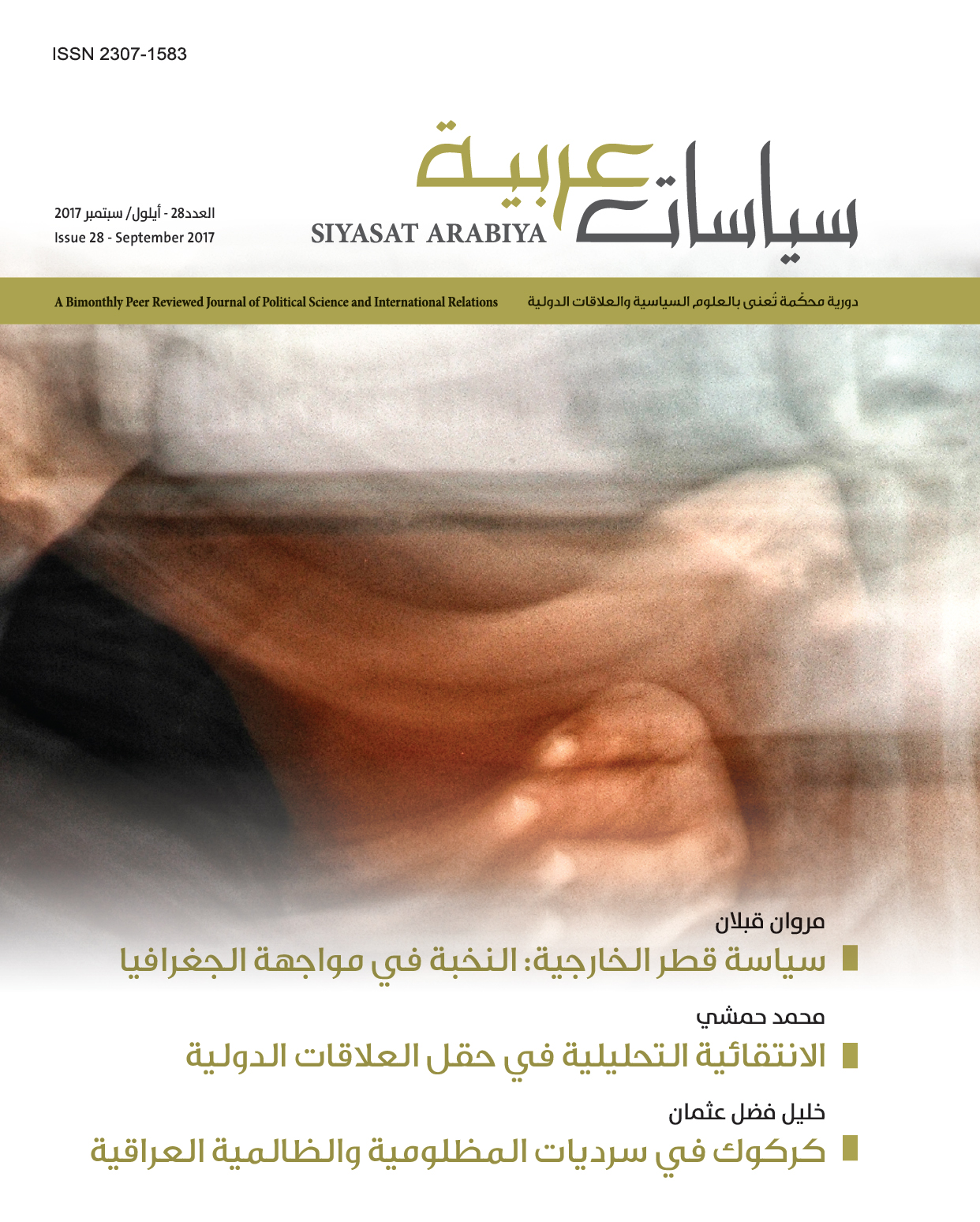
528 views 612 downloads 13 citationsVol. 5 No. 028 (2017)The twenty-eighth edition of Siyasat Arabiya, a bi-monthly political science journal published by the Arab Center for Research and Policy Studies is now available. The peer reviewed academic papers included “Elite v. Geography: Actors, Structures and Qatar Foreign policy” by Marwan Kabalan; “The Legal Ramifications of the Blockade on Qatar in Terms of International Law” by Mohamed Abdulaziz Al-Khulaifi; “Analytical Selectivity in the Discipline of International Relations” by Mohamed Hamchi; “Repeated Changes of Palestinian Cabinet Ministers and the Impact on Public Policies: the Point of View of Higher Authorities” by Jehad Alayasa; “Kirkuk in Iraqi Narratives of Victimization and the Victimizer” by Khalil Fadl Osman; and “From Diversity to Division: the Prospects for a Consociational System of Power-Sharing in Kirkuk” by Nahwi Saeed. This edition also includes a translation by Abdou Moussa of Richard N. Haass’ “World Order 2.0: The Case for Sovereign Obligation”.The section dedicated to the Arab Opinion Index includes the paper “Arab Public Opinion towards US Foreign Policy during the First Year of the Trump Presidency” by Mohammed al-Masry.
-
Issue 027
601 views 694 downloads 3 citationsVol. 5 No. 027 (2017)The twenty-seventh edition of Siyasat Arabiya, a bi-monthly political science journal published by the Arab Center for Research and Policy Studies is now available. Alongside peer reviewed academic papers covering a range of topics included in Siyasat Arabiya 27, the journal carries a special section covering the ongoing crisis in intra-Gulf relations. Specifically, these include: "Qatar's Diplomacy: Facing the Challenges of the Gulf Crisis" by Nawaf Al Tamimi; "The Repercussions, Present Reality and Future Trajectories of the Gulf Crisis: a Forecasting Approach" by Mohammad Al-Rumaihi; "The American Position towards the Gulf Crisis" by Osama Abu Irshaid; "The Changing American Perception of the Gulf Crisis" by Zouhair Much; "Iran and the Gulf Crisis: Losses and Gains" by Mahjoob Zweiri; "Another Way: Morocco, Sudan and Somalia React to the Intra-Gulf Crisis" by Abubakr Abdelrazig and Hamzeh Almoustafa; "Frameworks for Joint Arab Anti- Terrorism Efforts: the Foundation of Arab Cooperation or a Pawn in Political Disputes" by Abdou Moussa; "Al Jazeera and the Gulf Crisis: Background and History" by Ali El-Saleh Moula.
-
Issue 026
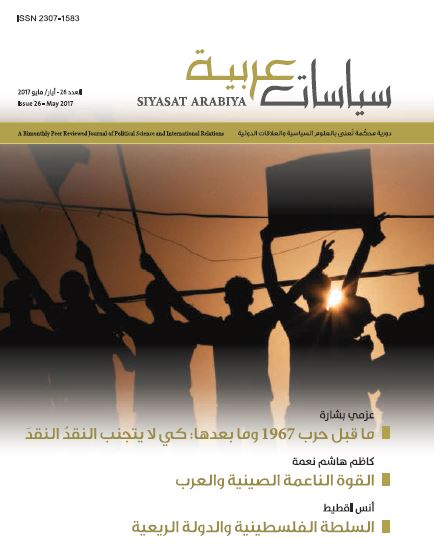
612 views 712 downloads 4 citationsVol. 5 No. 026 (2017)The twenty-sixth edition of Siyasat Arabiya, a bi-monthly political science journal, published by the Arab Center for Research and Policy Studies is now available. Alongside the usual peer reviewed academic papers, this edition also included two special sections, one devoted to commemorating the 50 year anniversary of the June, 1967 War and a second devoted to studying the 2017 intra-Gulf crisis. Within the first of these sections was Azmi Bishara’s “The Turning Point of the June, 1967 War: a Genuine Critique”; and Mahmoud Muhareb’s “The Israeli Decision to Go to War in June 1967”. The same edition also contained an in-depth discussion of the crisis in Gulf-Qatar relations, “The Crisis in Intra-Gulf Relations: Roots, Future Trajectories and Regional and Global Repercussions”, authored by the ACRPS’ Policy Analysis Unit. In addition, Siyasat Arabiya 26 includes “Chinese Soft Power and the Arabs”, by Kadhim Hashim Niama; “The EU and the Arab Spring: Rhetoric vs. Politics”, by Muriel Asseburg; “The Palestinian Authority and the Rentier State” by Anas Iqtait; “Liberal Democracy Caught between Liberal Elitism and Populism: Factors and Consequences of the Rise of Populism in American Politics”, by Abubakr Abdelrazig; and “Electoral Crisis in the Context of Demographic Change: the Case of the Kirkuk Provincial Council Elections” by Khalil Fadl Osman. In addition, Siyasat Arabiya 26 covered findings from the Arab Opinion Index, the annual public opinion survey administered by the ACRPS, as part of a regular series of articles from the Siyasat Arabiya team. This edition’s report was devoted to “Public Opinion in Saudi Arabia towards Diplomatic Normalization with Israel: Findings from the 2016 Arab Opinion Index”. “Milestones in the Arab Democratic Transition” and “Palestine over Two Months” are further regular sections included in every edition of Siyasat Arabiya. Book reviews published in Siyasat Arabiya 26 include Hassan Lfjah’s review of Ahmet Davutoglu’s Political Philosophy; and Hikmat Al-Abdulrahman’s review of John Pierre Cabestan’s Chinese Global Policy: Integration and the Force of Willpower. Finally, Siyasat Arabiya includes coverage of the proceedings of two academic conferences hosted by the ACRPS in April and May, respectively, of 2017. These were Hamzeh Almoustafa’s coverage of “Arabs and Kurds: Shared Hopes and Common Dreams” and Ahmed Qassem Hussein’s coverage of “The June, 1967 War: 50 Years On: Trajectories and Repercussions of the Conflict”.
-
Issue 025
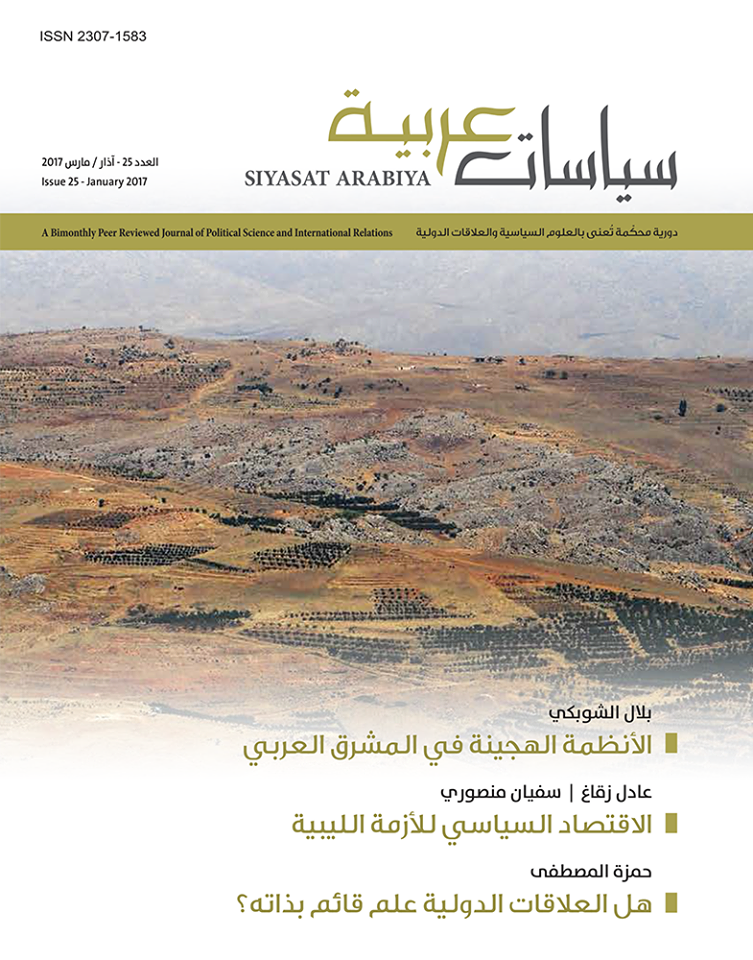
580 views 685 downloads 1 citationsVol. 5 No. 025 (2017)The ACRPS has published the 25th issue of its peer-reviewed journal Siyasat Arabia, devoted to political science and international relations and published bi-monthly in Beirut and Doha. This issue includes the following papers: “Hybrid Regimes in the Arab Mashreq and their Role in Turning Political Disputes into Identity Conflicts” (Belal M Shobaki); “The Army, Monarchy and the Establishment in Morocco” (Ihsane Elhafidi); “Social Movements in Algeria and the Hard Transition” (Arbi Boumediene); “The Political Economy of the Libyan Crisis” (Adel Zeggagh and Sofiane Mansouri); “Features of Shiite Political Discourse in Iraq after the Fall of Mosul” (Rafid Jabboori); “The Iranian Nuclear Agreement with the P5+1 and its Impact on Iranian-Saudi Relations” (Eva Haddad); “Salafism in a Sufi Society: the Case of Turkey” (Emad Y. Kaddorah) and “An Independent Discipline? A Comparative Study of Arguments over the Separation/Connection of International Relations and Political Science” (Hamzeh al-Mustafa).This edition also covers the findings from the Arab Opinion Index “How the Arabs view the United States of America at the Handover from Obama to a New Presidency” (Israa Batayneh). Additionally, it outlines the key milestones in democratic transition in the Arab World and highlights the major political events occurring in Palestine during January and February 2017.Issue 25 also comprises three important book reviews: Ahmed Qassem Hussein’s review of Nous ne sommes plus seuls au monde (We are no longer alone in the world) by Bertrand Badie, Frédéric Maatouk’s review of The Iran Wars by Jay Solomon and Louay Abdulfattah’s review of “Intelligence and Intelligence Gathering in Democracies” by Jean-Claude Cousseran and Philippe Hayez.
-
Issue 024
468 views 558 downloads 13 citationsVol. 5 No. 024 (2017)ACRPS has published issue 24 of the bi-monthly peer-reviewed academic journal Siyasat Arabia, a journal devoted to political science and international relations. A special section in this issue deals with the relationship of the military and democratic transition, specifically in the Arab context. The studies in this section are: “Armies and Democratic Transition: What Leads Militaries to Give Up Politics and Power” (Abdelfattah Mady); “The Roles of the Army in the Transition Stages in Algeria” (Eltaher Saoud); “Military Coup as Political Transition: The Army and Political Authority in Sudan” (Hassan al-Hajj Ali Ahmed); “The Possibilities of Military Reform and its Challenges in the Arab world” (Mohammed Saadi); and “The Armed Forces and Processes of Political Transition” (Zoltan Barani). The issue also contains an analytical study, “Formulations of the Trump Administration and the Post World War II Order: A Revolution in Foreign Policy or a Pale Copy of Jacksonism?” (Marwan Kabalan). In the Arab Opinion Index section there is “Trends in Public Opinion in the Arab Region according to the 2016 AOI.”In addition to the two regular sections, the issue contains important book reviews including a review by Mahmoud Abdelaal of Zoltan Barani’s How Armies Respond to Revolutions. And Why; Ibrahim Kadouni’s review of Who Rules the World? by Noam Chomsky; and Kamel Terchi’s review of Hannah Arendt’s Was ist Politik?
-
Issue 023
493 views 608 downloads 10 citationsVol. 4 No. 023 (2016)ACRPS has published issue 23 of the bi-monthly peer-reviewed academic journal Siyasat Arabia, a journal devoted to political science and international relations. This edition includes the following studies: “The Rise of the Right and the Adoption of the Clash of Civilizations: When Democracy Spawns the Antithesis of Liberalism” (Azmi Bishara); “The Responsibility to Protect: The Revival of Humanitarian Intervention” (Mohammed Alwan); “The Consensual Experiment in Iraq: Theory, Application, Results” (Harith Hasan); “European-Russian Relations in the Energy Sphere: Pressures of Cooperation and Conflict of Interests” (Ahmed Qasim Hussein); “The Issue of the Moroccan Sahara: The Complex of Partition in Western Morocco: A Moroccan Vision” (Larbi Ben Ramadan); and “The Algerian Foreign Policy Crisis between the Legacy of Principles and the Calculation of Interests: Case Study of the ‘Arab Spring’” (Rabah Zeghouni). The Arab Opinion Index section covers “Trends in Arab Public Opinion on the 2016 US presidential Elections”. The issue deals with a number of key points in democratization in the Arab world in the period September 1 to December 1, 2016, as well as events in Palestine over the same period.Also included in this edition are reviews of two important books: Yasser Djazaerly’s review of The Iran Wars: Spy Games, Bank Battles, and the Secret Deals that Reshaped the Middle East by Jay Solomon and Mohammed Muhareb’s review of The Boy Remains Missing by Shoshi Zaid. The issue also includes a report on the ACRPS conference “The Army in Politics During Democratic Transition in the Arab World” (Kamel Terchi).
-
Issue 022
225 views 252 downloadsVol. 4 No. 022 (2016)ACRPS has published issue 22 of the bi-monthly peer-reviewed academic journal Siyasat Arabia, a journal devoted to political science and international relations. This edition includes the following studies: “The Army and Political Power in the Arab Context: Theoretical Problems” (Azmi Bishara); “Trends in Deterrence in the Gulf” (Abdul Jalil Zayd al-Marhoon); “The Arab Spring and Constitutional Reform in Morocco” (Mohamed Goulferni); “Israeli-Sino Relations after the End of the Cold War” (Mahmoud Muhareb); and “The Strategy of the Chinese Presence in Africa” (Hikmat Alabdulrahman).This edition includes an extra section “Testimony” comprising two testimonies on “The Syrian Revolution from the Inside”: “Violence in the Arab Revolutions: The Syrian Case” (Tariq al-Ali) and “Undermining Authorities in the Syrian Revolution” (Ahmad Abazaid). The Arab Opinion Index section covers “Trends in Arab Public Opinion on Iranian Foreign Policy”.Also included in this edition are reviews of two important books: Mounir Kchaou’s review of Is the American Century Over? by Joseph Samuel Nye and Fatima Al-Samadi’s review of the memoirs of General Hussein Hamdhani, a commander in the Iranian Revolutionary Guard, published under the title “The Fish Letters”. In addition, there are the two regular sections: documenting key points for democratization in the Arab world and events in Palestine in July and August 2016, and two reports on conferences held by ACRPS: “The Arab World and China: Future Prospects of Relations with a Rising Power” (Ihab Maharma) and “Boycott as a Strategy against Israeli Occupation and Apartheid: Present-day Realities and Aspirations” (Ahmed Qasim Hussein).
-
Issue 021
496 views 525 downloads 3 citationsVol. 4 No. 021 (2016)ACRPS has published issue 21 of the bi-monthly peer-reviewed academic journal Siyasat Arabia, a journal devoted to political science and international relations. This issue includes the following studies: “Globalization and Extremism: Towards Revealing an Ambiguous Relationship” (Layachi Anser); “Chinese Foreign Policy from the Perspective of Strategic Culture” (Emad Mansour); “Global Climate Negotiations: Development on Paper and Doubts in Practice” (Elhoucine Chougrani and Khaled Elkadaoui); “The Zionist Lobby in Britain: Growth and Activity” (Nawaf al-Tamimi); and “Algeria and the Security Threats from the Sahel: Perception, Mechanisms, Confrontation” (Hocem Hamza). The issue contains a policy analysis, “The July 15 coup and the Future of Turkey” (Said el-Hajj) and a paper prepared by the Arab Opinion Unit at the ACRPS in the AOI section entitled, “Israel in Arab Public Opinion”.Also included in this edition are reviews of two important books: Ahmad Qassem Hussein’s review of Le Temps des humiliés: Pathologie des relations internationales by Bertrand Badie and Abubakr Abdelrazig’s review of Post-Orientalism: Knowledge and Power in Time of Terror by Hamid Dabashi. The journal also includes the two regular sections covering the most important milestones of democratic transformation in the Arab world and events in Palestine during May and June 2016.
-
Issue 020
503 views 703 downloadsVol. 4 No. 020 (2016)ACRPS has published issue 20 of the bi-monthly peer-reviewed academic journal Siyasat Arabia, a journal devoted to political science and international relations. This issue includes the following studies and analytical papers: “Terrorism and the Law: Moroccan Anti-Terror Legislation” (Hassan Tarek and Ihsan al-Hafezi); “The Debate over the Precedence of ‘the Guardian State’ or of State Responsibility: an Investigation into the Principle of Solidarity with Regard to Arab Specifics” (Amina Mostefa Della); Questions of Parliamentary Monarchy in the Moroccan Constitutional System” (Abdelilah Essatte); “Transatlantic Partnership for Trade and Investment: An Economic NATO with Geostrategic Motives” (Mohamed Metawe); “The Refugee Crisis in the Arab World and its Domestic and Regional Implications” (Alaa Abdelhafiz); and “Iranian Infiltration in East Africa and its Implications for Gulf National Security 2002-2014” (Ali Metwally Ahmed). The section on the AOI includes a paper prepared by the Arab Opinion Unit at ACRPS entitled, “Arab Public Opinion on the Performance of Parliaments according to the Results of the 2015 AOI”.There are also reviews of important books: Ahmad Qassem Hussein’s review of International Relations Theories: Discipline and Diversity by Tim Dunne et al.; Mohamed Ali Nador and Morsi Mochiri’s review of “Algerian Security Policy: Determinants, Fields and Challenges” by Mansour Lakhdari; Ahmad Jassim al-Hussein’s review of La Fabricaccion de l’ennemie [the Making of an Enemy] by Pierre Conesa; and Hikmat Abdul Rahman’s review of Les ondes de choc des révolutions arabes (Shock Waves Generated by the Arab Revolutions) by Chantal Verdeil et al. The journal also includes the two regular sections covering the most important milestones of democratic transformation in the Arab world and events in Palestine during March and April 2016.
-
Issue 019
496 views 634 downloads 6 citationsVol. 4 No. 019 (2016)ACRPS has published issue 19 of the bi-monthly peer-reviewed academic journal Siyasat Arabia, a journal devoted to political science and international relations. This issue includes the following studies and analytical papers: "Israel's Policy on al-Aqsa" (Mahmoud Muhareb); "The Geopolitics of Clandestine Migration in the Mediterranean Basin: Dimensions of the Phenomenon and Background to the European Approach" (Nabil Zakawi); "Research's Response to Policy: the Case of Research into Forced Migration in Sudan" (Khalid Mohammed Dafa-Allah); "The Relationship between the Army and Political Power in Algeria: Between the Rule of Reality and the Challenges of Demilitarization" (Fouzia Kaci and Arabi Boumediene); "Civil Society in Contemporary Algeria: Political Economy of the Experience of Incomplete Democratization" (Nouri Driss); and "The AOI 2015: Political and Civic Participation" (Arab Opinion Unit).The issue also contains reviews of selected critical books: Ali Mirza's review of Oil Policies, Oil myths: Analysis and Memoirs of an OPEC Insider by Fadhil Chalabi; Ahmad Jassim al-Hussein's review of "Terrorism and its Creators" by Ali Harb; Emad Kaddoura's review of "The Dialogue between Islam and Secularism in Kurdistan: A Study of the Confluence between Islam and Secularism" by Othman Ali et al.; Hani Awwad's review of Egypt's Desert Dreams: Development Or Disaster? by David E. Sims; and Darar Bani Yasin's review of The Idea of Human Rights by Charles Beitz. There is also a report prepared by Hamzeh al-Mustafa on the conference "The Shia Arabs: Questions of Identity and Citizenship" held by ACRPS in Doha. The journal also includes the two regular sections covering the most important milestones of democratic transformation in the Arab world and events in Palestine during January and February 2016.
-
Issue 018
748 views 970 downloads 8 citationsVol. 4 No. 018 (2016)ACRPS has published issue 18 of the bi-monthly peer-reviewed academic journal Siyasat Arabia, a journal devoted to political science and international relations. This issue devotes this edition to debate the Arab revolutions five years on, the difficult transition stages, and the transformation of some of them into violence and internal conflict. The issue includes the following studies, articles, and testimonies: “Tunisia Between Support for Democracy and Dismantlement of the State” (Hamadi Redissi); “Transformation of the Egyptian Revolution over Five Years” (Abdulfattah Madi); “Arab Islamists Five Years On from the Arab Spring: Questions of Project, Ideology, and Organization” (Khalil al-Anani); “Why did the Syrian Revolution turn Violent?” (Radwan Zyada); “Revolution and Conflict in Syria: Implications of the Failure in the Game of International Balances” (Marwan Kabalan); “Transitional Justice and Democratic Transition in the Arab Context” (Habib Belkouch); “Outcomes of the Liberation Tendency in the Arab World” (El-Houcine Akhdouche); “Elections, Armed Conflict, and Oil in the Competition for Power in Libya after Gaddafi” (Virginie Collombier); “The New Tunisian Constitution: Contextual Analysis” (Zaid al-Ali); and a Testimony by Rached Ghannouchi, “Tunisia from Revolution to Constitution” (Salah Eddin Al-Jourchi), as well as the AOI on the Arab Revolutions Five Years On.The issue also includes reviews of important books and literature: “Facts of the Televised Revolution: Presence of Sight and Absence of Insight in Reading the Events of the Arab Spring Revolutions” (Abdelwahab Alaffandi); “Israeli Knowledge Production on the Arab Spring between Ideological Stance and Orientalist Act” (Muhannad Mustafa); “A reading of the book: Civil-Military Relations and the Democratic Transformation in Egypt after the January 25 revolution” (Shamsuddin al-Kilani); and “How Interests Destroy Principles in Washington? A Review of America and the Egyptian Revolution” (Abdou Moussa). There are also two reports. The first is about the workshop held in Doha “The Future of the Revolutions in the Arab World from the Perspective and Experience of Youth” and the second on the conference “The Arab Revolutions Five Years On: The Arduous Road of Democratization and Future Prospects”. The journal also includes the two regular sections covering the most important milestones of democratic transformation in the Arab world and events in Palestine during November and December 2015.
-
Issue 017
710 views 875 downloads 3 citationsVol. 3 No. 017 (2015)ACRPS has published issue 17 of the bi-monthly peer-reviewed academic journal Siyasat Arabia, a journal devoted to political science and international relations. This edition focuses on developments in the Turkish arena and the effects of Turkish policy in Syria internally and externally. The following studies and articles are included: “Russia: Geo-Strategy Above Ideology and Above All” (Azmi Bishara); “The New Reality and the Future of the GCC States after the Arab Spring Revolutions” (Ahmed Mohammed Abu Zaid); “Israeli Settlement in the West Bank and Jerusalem: Demographic Specifics and Financial-Support Policies” (Youssef Courbage, Ameed Saabneh, and Mtanes Shihadeh); “Jewish Terrorist Organizations: from ‘Price Tag’ to ‘Revolt’” (Mahmoud Muhareb); “The issue of Sinai between Globalized Jihad and Local Oppression” (Abdou Moussa); “Dynamics of the Opposition of the February 20 movement in Morocco to the 2011 constitution” (Mohamed Koulfarni); “International and Domestic Effects of Turkish Policy in Syria” (Jean Marcou); “Parameters Influencing Turkish Foreign Policy towards Consolidating Relations with Algeria” (Naim Chelghoum); “The Turkish Parliamentary Elections: Results and Implications” (Oktay Yilmaz); and “Trends in Public Opinion on Turkey and its Policies in the Arab Region” (Mohammed al-Masri).The section on book reviews and notices includes: Ibrahim Gharayba’s review of Why Nations Fail by James A. Robinson; Tamir Badawi’s review of Iran's Political Economy since the Revolution by Suzanne Maloney; and Elnour Hamad’s review of the report The Arab-U.S. Strategic Partnership and the Changing Security Balance in the Gulf by Anthony Cordesman. The issue also includes reports on conferences and seminars held by ACRPS: a report prepared by Kamel Terchi on the conference “Violence and Politics in Contemporary Arab Societies”; a report prepared by Hamzeh al-Mustafa on the symposium “Russian Military Intervention in Syria: Motives, Goals, Implications”; and a report prepared by Samir Saifan on the symposium “The Implications of a Long-Term Drop in Oil Prices on Oil Exporting States”. The journal also includes the most important milestones of democratic transformation in the Arab world and events in Palestine during September and October 2015.
-
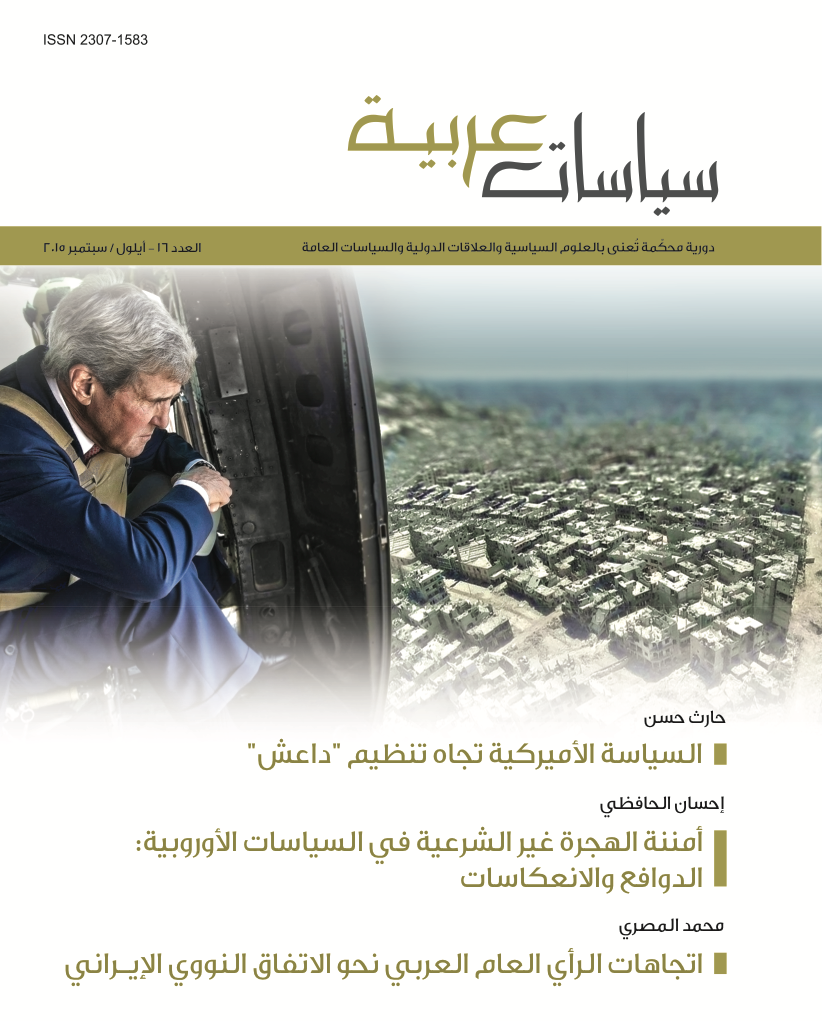
Issue 016
731 views 839 downloads 2 citationsVol. 3 No. 016 (2015)ACRPS has published issue 16 of the bi-monthly peer-reviewed academic journal Siyasat Arabia, a journal devoted to political science and international relations. This issue has two main themes: the war against ISIL and the Iranian nuclear program. The following studies and papers are included: “The War against ISIL a Year after the Formation of the International Coalition: The Case of Iraq” (Haydar Said); “The War Against ISIL a Year after the Formation of the International Coalition: the Case of Syria” (Hamzeh al-Mustafa); “American Policy towards ISIL” (Harith Hasan); “Directions for Reforming the Security Sector in Transitional Arab Regimes” (Ihsan al-Hafizi); “Algeria in the Reports on the Millennium Development Goals: a Study of Social Policy and Goals and their Course” (Youcef Zedam); “Where is Turkey Heading: Consolidation of Democracy or of Dictatorship?” (Mohammed Mahmoud Mahdi); “The Iranian Nuclear Agreement: Implications and Prospective Effect” (Mohammed al-Rumaihi); “Implications of the Iranian Nuclear Agreement: the Iranian View” (Mohammad Reza Fartousi ); “The Agreement with Iran and its Effects in the Region and for Israel and Palestine” (Yusuf Munir); “Trends in Arab Public Opinion on the Iranian Nuclear Agreement” (Mohammed al-Masri); “The Choice of Seeking Refuge in Europe and its Implications for the Crisis in Syria” (Policy Analysis Unit, ACRPS); and “The Moroccan Local Elections: Tracks of Competition and their Reflection on the General Political Scene” (Policy Analysis Unit). A new section has been added to this issue, “Translated Studies” which includes a translation of Anthony Cordesman’s “Iraqi Stability and the ‘ISIS War’”.The book review and notices sections includes: Ibrahim Gharayba’s review of “The Untold Story” by former Syrian foreign minister Farouk al-Sharaa; Elnour Hamad’s review of ISIS: Inside the Army of Terrorby Michael Weiss & Hassan Hassan; and Abdel-Rahman al-Siraj’s review of Abdullah Gul and the Making of the New Turkey by Gerald MacLean. The journal also covers the most important milestones of democratic transformation in the Arab world and events in Palestine during July and August 2015.
-
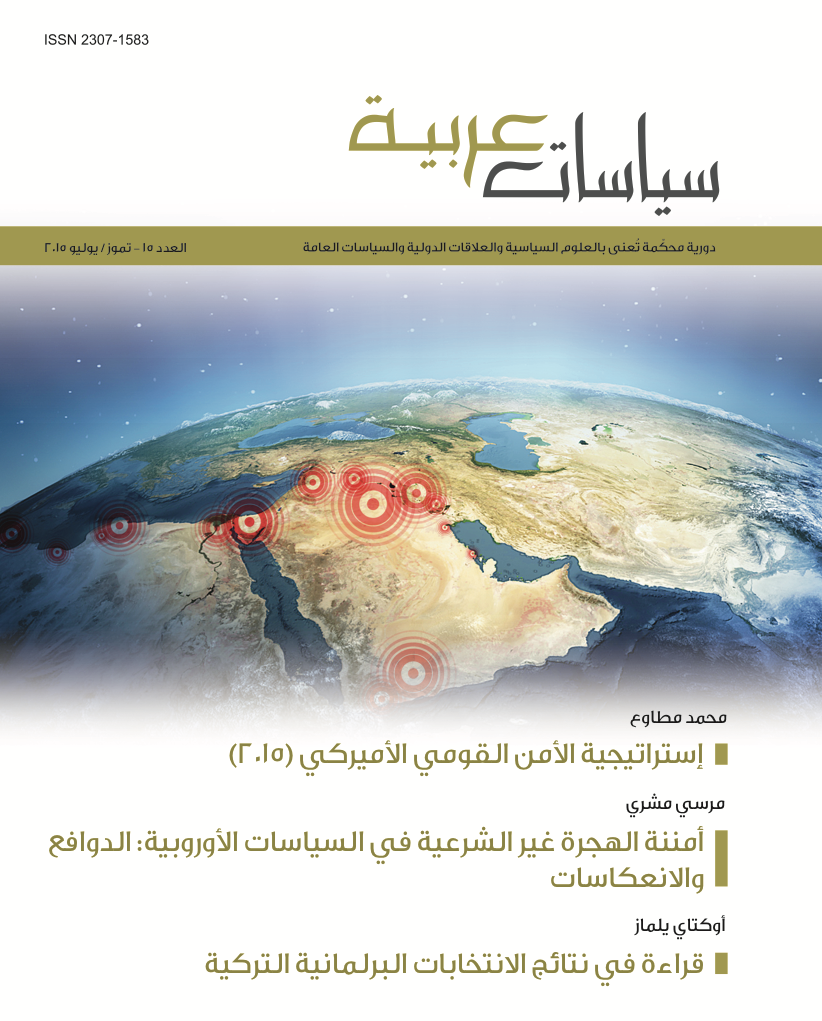
Issue 015
685 views 819 downloads 4 citationsVol. 3 No. 015 (2015)ACRPS has published issue 15 of the bi-monthly peer-reviewed academic journal Siyasat Arabia, a journal devoted to political science and international relations. This issue includes the following studies and articles: “American National Security Policy” (Mohammed Mutawa); “A Decentralized Unified Regime: A Possible Model for a Middle Ground in Somalia” (Afyare Elmi); “Russia and Turkey: Developing Relations and Competing Aspirations in the Arab Region” (Emad Kaddoura); “Is the Division of the Arab Mashreq States Possible?” (Nerouz Satik); “The Securitization of Illegal migration in European Policy: Motives and Implications” (Morsi Moshiri); “Collective Diplomacy between Respect for State Sovereignty and Intervention for Humanitarian Purposes” (Fatima Golmane); “Conformity and Divergence in the Position on the Palestinian Issue of the Five Permanent Members of the Security Council 1979-2003” (Rowaid Abu Amsha); “Hamas and the Adoption of the Law on Secret Evidence in the European Courts” (Adib Ziyadeh); “The Fourth Netanyahu Government: the Narrowest and Most Extreme” (Mohammed Muhareb); “A Reading of the Turkish Election Results” (Oktay Yilmaz); and “Views of the Palestinians inside Israel on the Performance of the Israeli Government” (Aas Atrash and Ameed Saabana).In the book review and notices section there are: Abdel-Rahman al-Siraj’s review of Hard Choices; Azzam Amin’s review of Comment Sortir de l'Emprise Djihadiste? Mustapha Ait Kharouach’s review of “The Spirit of Democracy: the Fight to Build Free Societies”; and Nerouz Satik’s review of “US policy and the Management of International Crises”. The journal also covers the most important milestones of democratic transformation in the Arab world and events in Palestine during May and June 2015.
-
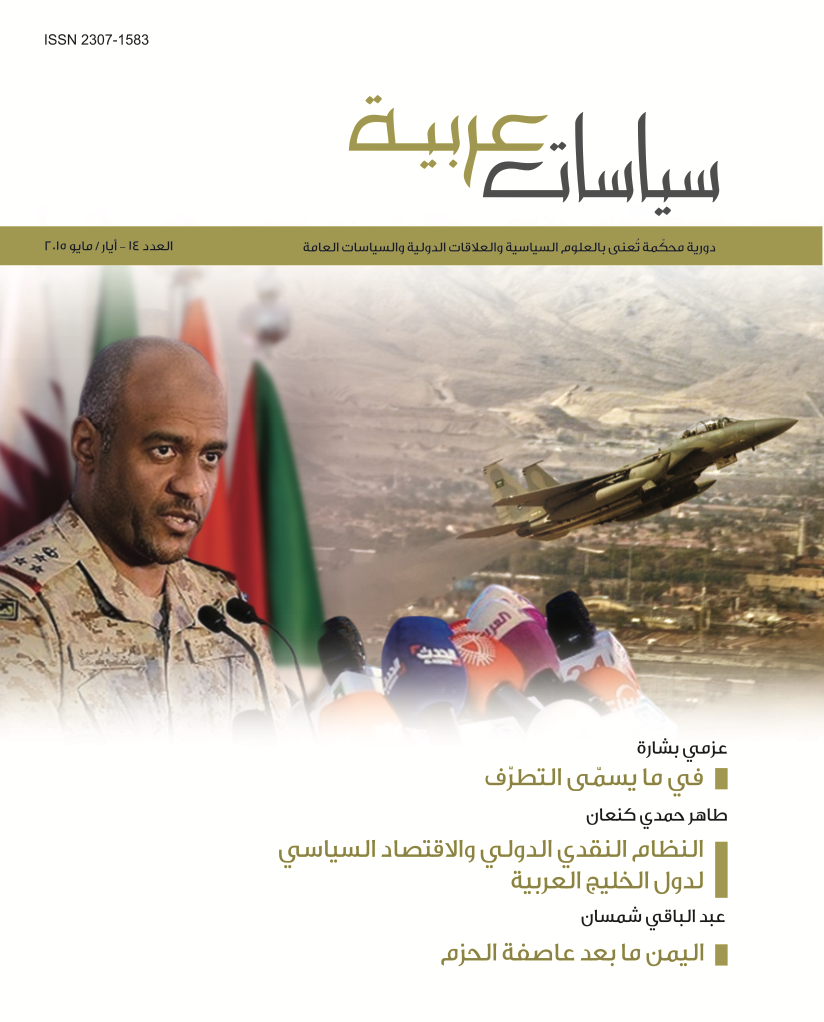
Issue 014
638 views 715 downloads 3 citationsVol. 3 No. 014 (2015)ACRPS has published issue 14 of the bi-monthly peer-reviewed academic journal Siyasat Arabia, a journal devoted to political science and international relations. This issue includes the following studies and articles: “On So-Called Extremism” (Azmi Bishara); “The International Monetary System and the Political Economy of the Arab Gulf States” (Taher Kanaan); “The Israeli Parliamentary Elections 2015: Towards the Formulation of the Hegemonic Party System” (Muhannad Mustafa); “The Sudanese Elections between Democratic Transformation and the Institution of One-Man Rule” (Elnour Hamad); “The Peaceful Rise of China” (Hikmat al-Abd al-Rahman); “Foreign Aid between Strategic Goals and Actors, and Domestic Effects in the Donor States” (Musa Alaya); “The Yemeni Assembly for Reform (al-Islah): the Current Scene” (Essam al-Qaysi); “Morocco and Decisive Storm: Transformations in Military Doctrine” (Ihsan al-Hafizi); “Yemen after Decisive Storm: Requirements for Reconstruction of the Political Field” (Abdulbaqi Shamsan); “The Future of the Houthi Movement” (Abdul Nasser Al Muwaddah); and “Trends in Arab Public Opinion on Russia”.In the section on book reviews and notices there are Hazim Nahar’s review of “The Question of the Syrian Kurds” and Al-Sadiq al-Faqih’s review of 22 Ideas to Fix the World. The journal also covers the most important milestones of democratic transformation and events in Palestine during March and April 2015. In the reports section there is the testimony of Rajih Badi, official spokesman of the Yemeni government, on “The political track in Yemen form the Gulf initiative to Decisive Storm”.
-
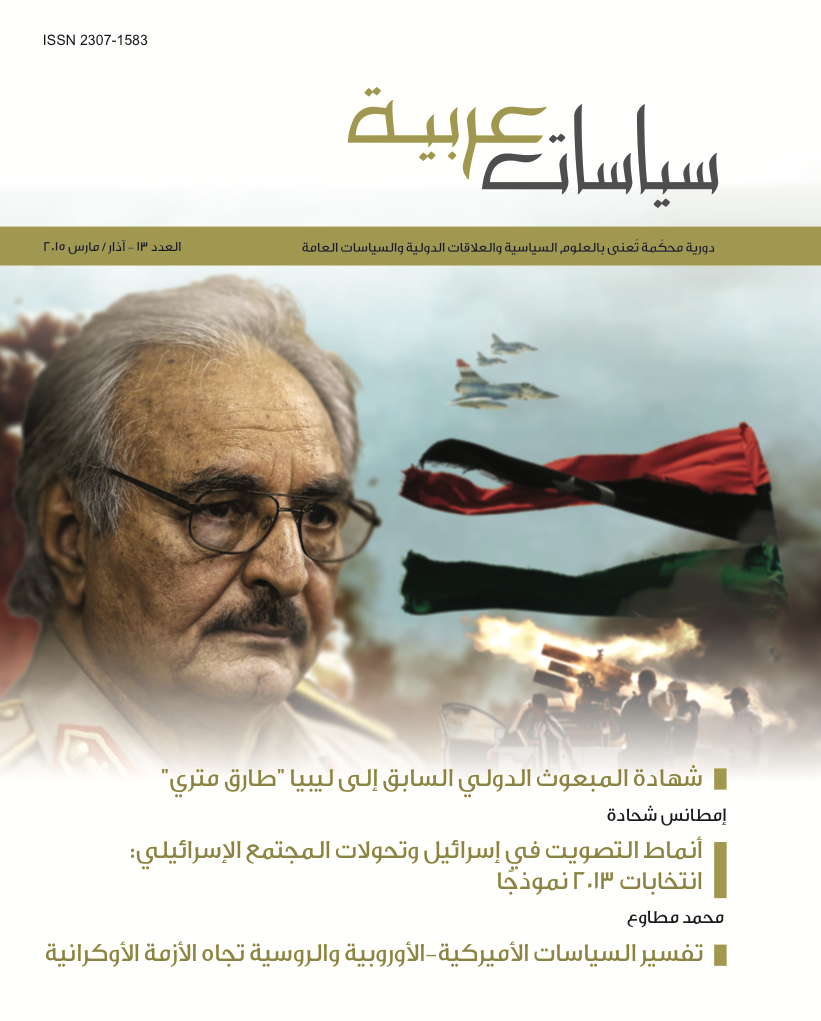
Issue 013
272 views 260 downloads 4 citationsVol. 3 No. 013 (2015)ACRPS has published issue 13 of the bi-monthly peer-reviewed academic journal Siyasat Arabia, a journal devoted to political science and international relations. This edition includes the following studies and articles: “Interpreting US-European and Russian Policy towards the Ukrainian Crisis” (Mohammed Mutawa); “The Constitutional Crisis in Libya: Dimensions of the Conflict between Political Components” (Khayri Omar); “The Coalition Government in Tunisia: Interpreting the Profiles, the Implications and the Challenges” (Anouar Jamaoui); “The Legacy of Mubarak Still Rules Egypt” (Abdou Moussa); “The WTO from the Perspective of Developing Countries” (Noureddine Daoudi); “Hamas between Efforts to Politicize the Court and the Requirements of Justice” (Adib Ziadeh); “The Shebaa Operation: A Restrained Response from Hezbollah” (Policy Analysis Unit); “Voting Patterns in Israel and Shifts in Israeli Society: the Model of the 2013 Elections” (Mtanes Shihadeh); “Trends in University Youth in Participation in the Algerian Presidential Elections” (Abdelhalim Mahour-Bacha); and “Trends in Palestinian Public Opinion towards Democracy” (Isra Batayneh).The section of book reviews features Nerouz Satik’s presentation of Muamar Khauli’s book Turkish-Russian Relations: From the Heritage of the Past to the Horizons of the Future; Baaliousaid Ahmed’s review of Qassem Hajjaj’s Dawn of the New Globalization; Khaled Walid Mahmoud’s review of Muhannad Mustafa’s book, The Israeli Academy as Institution: Knowledge, Politics and Economics; Muhannad Mustafa’s review of The Arab Spring, Democracy and Security: Domestic and International Repercussions, a book edited by Efraim Inbar. This issue also contains, in its reports section, testimony by former Special Representative of the UN Secretary General to Libya, Tarek Mitri.
-
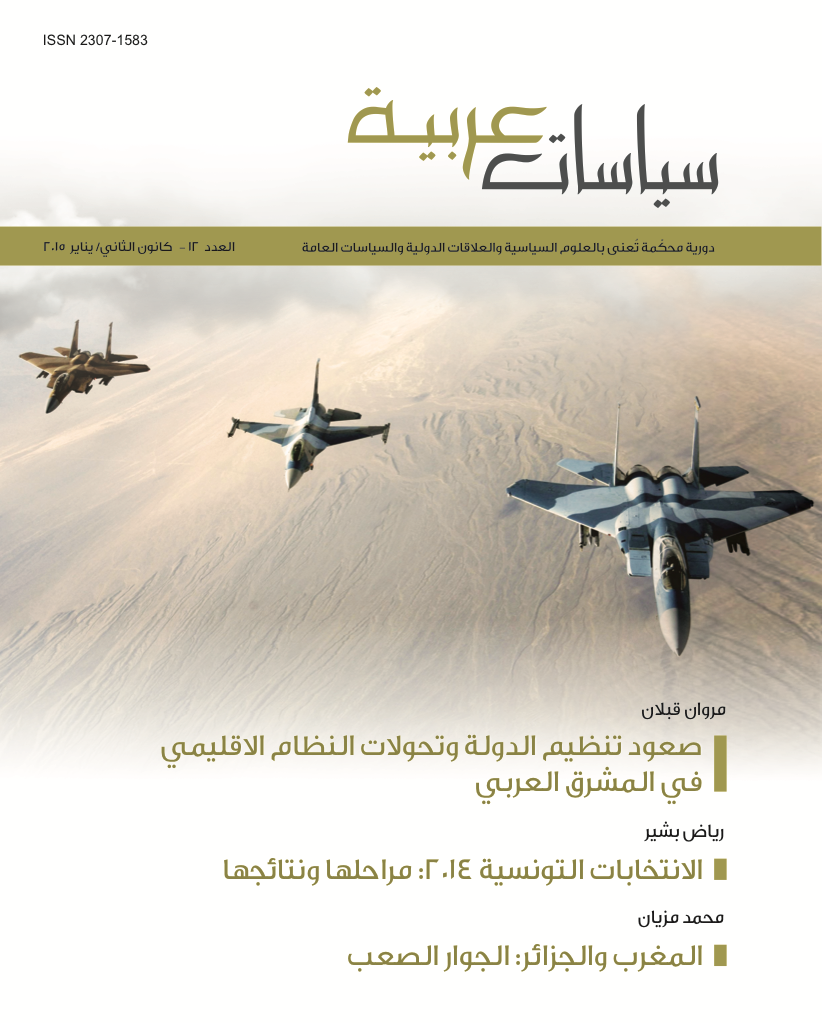
Issue 012
760 views 892 downloads 4 citationsVol. 3 No. 012 (2015)ACRPS has published issue 12 of the bi-monthly peer-reviewed academic journal Siyasat Arabia for political science, international relations, and public policy. This edition includes the articles: "The Rise of ISIL and Shifts in the Regional Order in the Levant" (Marwan Kabalan); “US-Iranian Military Coordination against ISIL: A Step towards Alliance!” (ACRPS Policy Analysis Unit); "Regional Failure in the Mix of External Powers and Armed Factions" (Mishari Hamad Ruwaih); “The 2014 Tunisian Elections: Phases and Outcomes” (Riad Bashir); "Morocco and Algeria: Uneasy Neighbors” (Mohamed Meziane); "Morocco’s Strategy of Economic Diplomacy: An Expanded Field with Multiple Actors" (Yusuf Sidqi); "Israeli Knesset Elections: Netanyahu's Position Eroded, the Right's Power Redoubled" (ACRPS Policy Analysis Unit); "Ceasefire Negotiations between Israel and Hamas in the Light of Operation Protective Edge" (Ashraf Badr); "The Coming Eastern Alliance: The Shanghai Cooperation Organization and the Trend towards Universalism" (Abdelhak Dahmane); "External Influences in the Wrangling over Yemen" (Ali Hassan Muqbil Sha’than); "The Russian Position on Arab Revolutions: The Cases of Libya, Egypt and Syria” (Nawar Jalil Hashem and Amjad Zein El Abidine Tohme); and "Trends in Arab Public Opinion toward the United States of America" (Mohammed al-Masri).In addition, the twelfth issue of Siyasat Arabia features a review of the report: "Government Spending in 2014 in the Republic of Iraq" by Abdel Wahab al-Qassab; a book review entitled "Pre-fabricated Books and the Promotion of Experts of Limited Experience: Interpreting The Jihadis Return” by HamzehMustafa; a review of Wael Hallaq’s The Impossible State: Islam, Politics, and Modernity's Moral Predicament" by Khalid Walid Mahmoud. The journal also covers the most important milestones of democratic transformation in the Arab world and events in Palestine during November and December 2014, along with two event reports, the first on the ACRPS Conference "From Peoples' Revolutions to an Arena of Regional and International Conflict: The Rise of ISIL and Renewed American Involvement", and the second on a seminar in Beijing on Sudan and South Sudan.
-
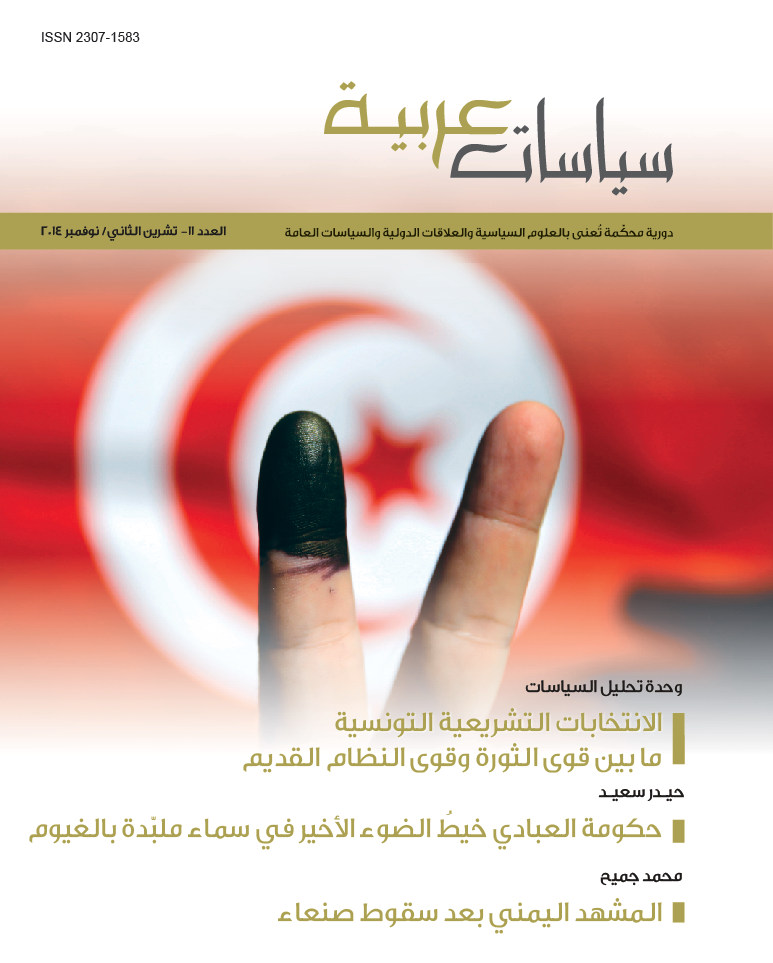
Issue 011
665 views 794 downloads 3 citationsVol. 2 No. 011 (2014)ACRPS has published issue 11 of the bi-monthly peer-reviewed academic journal Siyasat Arabia, a journal devoted to political science and international relations. The articles in this edition include: “Tunisia’s Legislative Elections: Specificities, Results and their Meaning” (Mahmoud Muhareb); “Yemen After the Fall of Sanaa” (Mohammed Jomaih); “Insiders and Outsiders in the New Libya” (Alison Pargeter); “Algeria’s 2014 Presidential Elections and the Difficulties of the Transitional Phase” (Naji Abdelnour); “The Welfare State in Egypt, 1995-2005” (Ahmad Ezzedine Mohammed); “Morocco’s Sixth Parliamentary Experience: An Analysis” (Mahmoud Saleh al Karawi); “Turkey and the Question of Military Intervention” (Emad Y. Kaddoura); “The Abbadi Government: A Silver Lining in a Cloudy Sky” (by Haider Saeed); “The Tunisian Parliamentary Elections: a Vote between Revolutionary Forces and the Old Regime” (ACRPS Policy Analysis Unit); and “The Military Campaign against the Islamic State in Iraq and the Levant: Arab Public Opinion” (ACRPS Arab Opinion Unit). Books reviewed in this edition included Saleh al Jabboury’s The Palestine Crisis: Its Political and Military Secrets, by Abdulwahhab al Qassab; Mahmoud Muhareb’s review of Military Intelligence Comes to Light; Hamzeh Mustafa’s review of The Kurds, Language and Politics: a Study in Linguistic Structures and Identity Policies by Akil Mahfoud; and Khaled Walid Mahmoud’s review of M’hammed Djabroun’s The Concept of the Islamic State: the Crisis of Foundations and the Inevitably of Modernity. This edition of Siyasat Arabia highlights the most important transformations toward democratic transition unfolding in the Arab world, as well as developments in Palestine throughout September and October 2014.
-
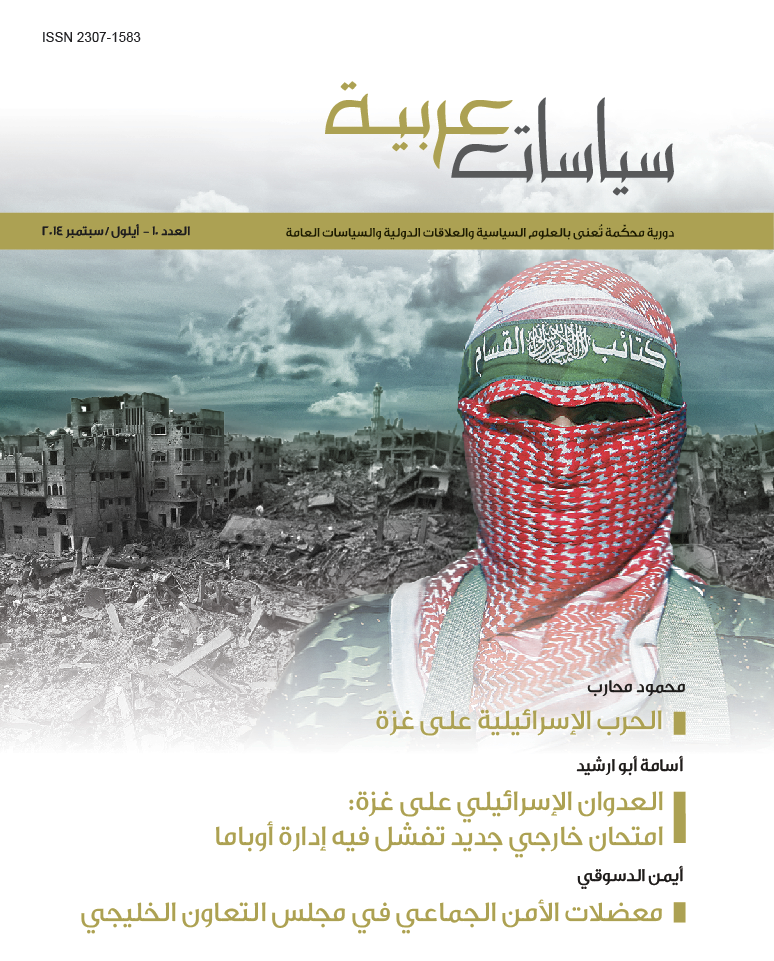
Issue 010
595 views 734 downloads 3 citationsVol. 2 No. 010 (2014)ACRPS has published issue 10 of the bi-monthly peer-reviewed academic journal Siyasat Arabia, a journal devoted to political science and international relations. This edition includes the articles: “The Israeli War on Gaza” (Mahmoud Muhareb); “The Israeli Assault on Gaza: Another International Test Failed by the Obama Administration” and “Syria on Gaza: Incongruity in the Regime’s Resistance Discourse” by the ACRPS’ Policy Analysis Unit; “American Policies Regarding Democratic Transformation in Europe in 1989 and in the Arab World in 2011” (Ghassan El-Ezzi); “A Context for the Arsaal Crisis: the Fallout from the Armed Confrontations” (Hamzeh Almoustafa); “Collective Security Dilemmas in the Gulf Cooperation Council” (Ayman El-Desouky); “Does Erdogan’s Victory Herald the Start of a New Era for Turkey?” (ACRPS Policy Analysis Unit); “Determinants of Moroccan Policy towards the States of West and Sub-Saharan Africa” (Yahya Boulahya); “The Road to Mosul’s Fall” (Haider Saeed); and “Trends in Arab Public Opinion Towards the Palestinian Issue and the Arab-Israeli Conflict” (Mohammad al-Masri).In addition to the above, the issue features two book reviews: “China: New World, New Human Being” (Abdel Majid el-Sakhiri), and “Sudan’s Missing National Unity” (Elnour Hamad). Finally, the issue includes documentation of key milestones of democratic transformation in the Arab world and of developments in Palestine July-August 2014.
-
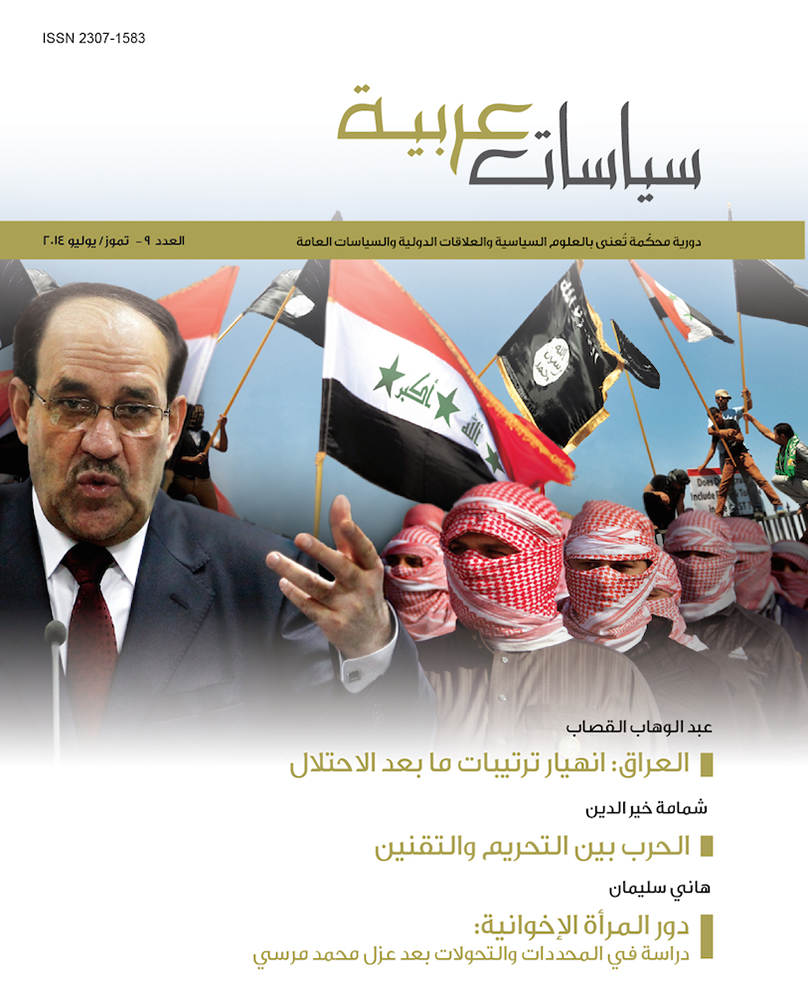
Issue 009
1413 views 869 downloads 4 citationsVol. 2 No. 009 (2014)ACRPS has published issue 9 of the bi-monthly peer-reviewed academic journal Siyasat Arabia, a journal devoted to political science, international relations, and public policy. This edition includes the articles: “Iraq: the End of the Post-Invasion Concord” (Abdulwahab Al Qassab); “The 2014 Parliamentary Elections in Iraq: An Analytical View of the Results Compared to Predictions” (Humaid Al Hashemi); “War: Legalization Versus Banning” (Shumama Kheireddine); “The Centrality of Geography at the Eastern Gate to Europe: Ukraine as a Flashpoint of Conflict” (Emad Kaddoura); “The Role of Women in the Muslim Brotherhood: a Review of the Factors and Transformations Following the Ouster of Mohammed Morsi” (Hani Sulieman); “Political Modernity and Political Modernization: a Theoretical Approach to Overcoming the Gap” (Khaled Yamout); “Ideology and Identity of the Nation-State in the Aftermath of the Revolutions: from the Congruence of State and Nation to the Citizen State” (Hassan Tareq); “Regression Analysis of the Model of the Impact of Oil Production on Democracy Understood through the Curse of Resources” (Abdelhak Dahmane and Driss Jaouhara ); “Syria’s Presidential Elections Dash all Remaining Hopes of a Political Solution” and “Understanding the American Government’s Response to the Palestinian Consensus Government” both by the ACRPS’ Policy Analysis Unit; and “Attitudes of Syrian Refugees and Displaced Persons towards the Presidential Elections and Wider Current Affairs in Syria” a publication by the Arab Opinion Index team.In addition to the above articles, the ninth issue of Siyasat Arabia features two book reviews: Mohammed Taifouri’s review of The Spirit of Democracy: The Struggle to Build Free Societies; and Alaa Bayoumi’s review of Rage Against the Machine: Political Opposition to Authoritarianism in Egypt written by Holger Albrecht. There are four book presentations: Khaled Mahmoud’s review of Turkey and Russia: from the Tradition of the Past to the Horizons of the Future; Nerouz Satik’s review of Protest Movements in the Arab Homeland: Egypt, Morocco, Lebanon and Bahrain; Ziad Muna reviewed both Scott Anderson’s Lawrence in Arabia: War, Deceit, Imperial Folly and the Making of the Modern Middle East, and The Saudi Arabian Nationalist Movement: 1953-1973 by Sayed Ali Al Awami. Finally, this issue of Siyasat Arabia also includes a chronological breakdown of significant steps taken toward democratization in the Arab World, as well as a background briefing on Palestinian affairs through May and June, 2014. Alongside these regular features, it also includes the proceedings of the ACRPS academic symposium “The Ukraine Crisis: Causes, Outcomes, and Implications for the Arab Region.”
-
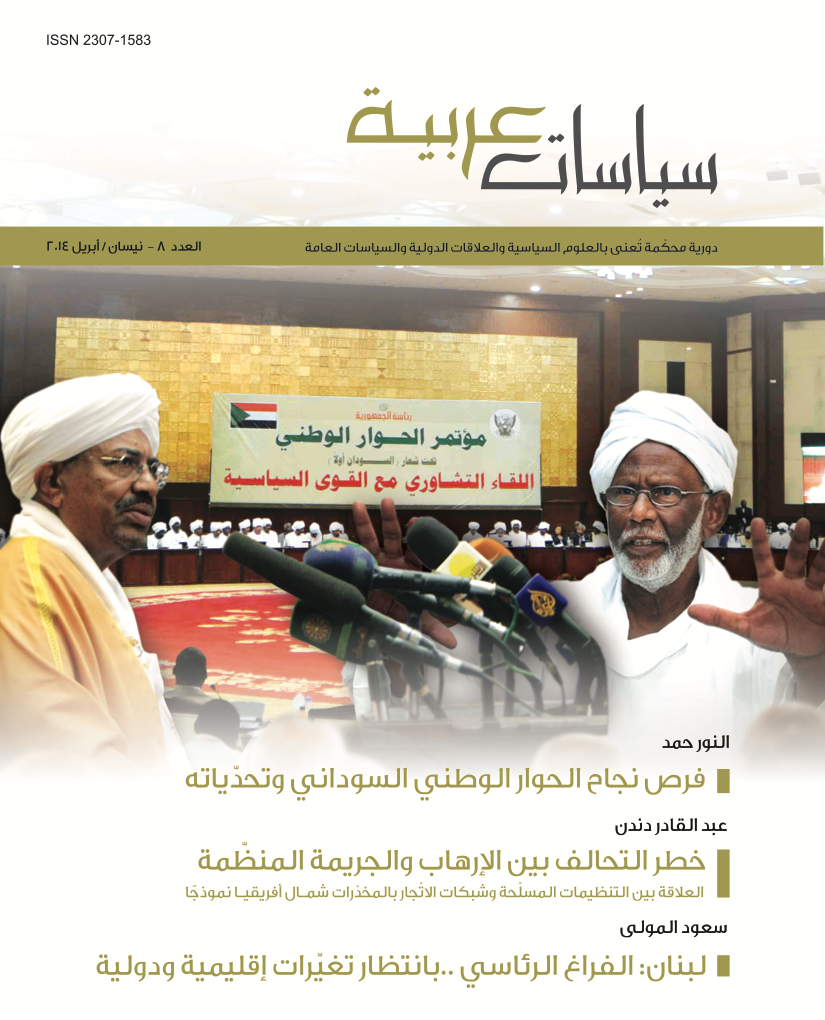
Issue 008
762 views 898 downloads 4 citationsVol. 2 No. 008 (2014)ACRPS has published issue 8 of the bi-monthly peer-reviewed academic journal Siyasat Arabia, a journal devoted to political science, international relations, and public policy. This issue contains the following articles: “Israel and the Boycott Movement” (Mahmoud Muhareb); “Eurasian Russia and the Issues of the Arab Levant” (Mohammed Adel Shreih); “International Law: Present Reality and the Prospects for Global Jurisdiction in Light of Globalization” (Roderigue Elia Abi Khalil); “Sudan’s National Dialogue: Opportunities for Success and Challenges” (Elnour Hamad); “Lebanon: The Presidential Vacuum Awaits Regional and International Changes” (Saoud al-Mawla); “Non-state Violent Actors: An Examination of the Conceptual and Theoretical Frameworks” (Scheherazade Admam); “The Threat Posed by an Alliance of Terrorism and Organized Crime: Relations between Armed Groups and Drug Trafficking Networks in the Case of North Africa” (Abdelkader Dandan); “The Yemeni Spring and the Challenges of Development” (Qais al-Aryani); “Political Opposition in Morocco between Containment and Exclusion” (Noureddine Elhouti); “Local Government Elections in Turkey: Voters Show their Cunning” (Marwan Kabalan); “Palestinian Reconciliation: Driving Factors and Prospects” (ACRPS Policy Analysis Unit); “Yemeni and Palestinian Public Opinion on Topical Issues of National Concern” (Mohammed al-Masri). In its book reviews section, this issue contains three reviews: Saleh Soliman Abdelazim’s review of National Intellectual Capital and the Financial Crisis in Indonesia, Malaysia, The Philippines, and Thailand; Khaled Waleed Mahmoud’s review of “the Plight of Palestine and its Secrets: Correcting the myth that there were no orders”; and Naiema Abou Mostafa’s review of The Daily Struggle for Palestinian Women in the Realm of Life. There are two book presentations: Nerouz Satik’s review of The Geostrategic Repercussions of the Arab Revolutions; and Ziad Muna’s review of Prisoners of the White House: The Isolation of American Presidents and the Crisis of Leadership. Finally, this issue of Siyasat Arabia also includes a chronological breakdown of significant steps taken toward democratization in the Arab Homeland, as well as a background briefing on Palestinian affairs from March to April 2014.
-
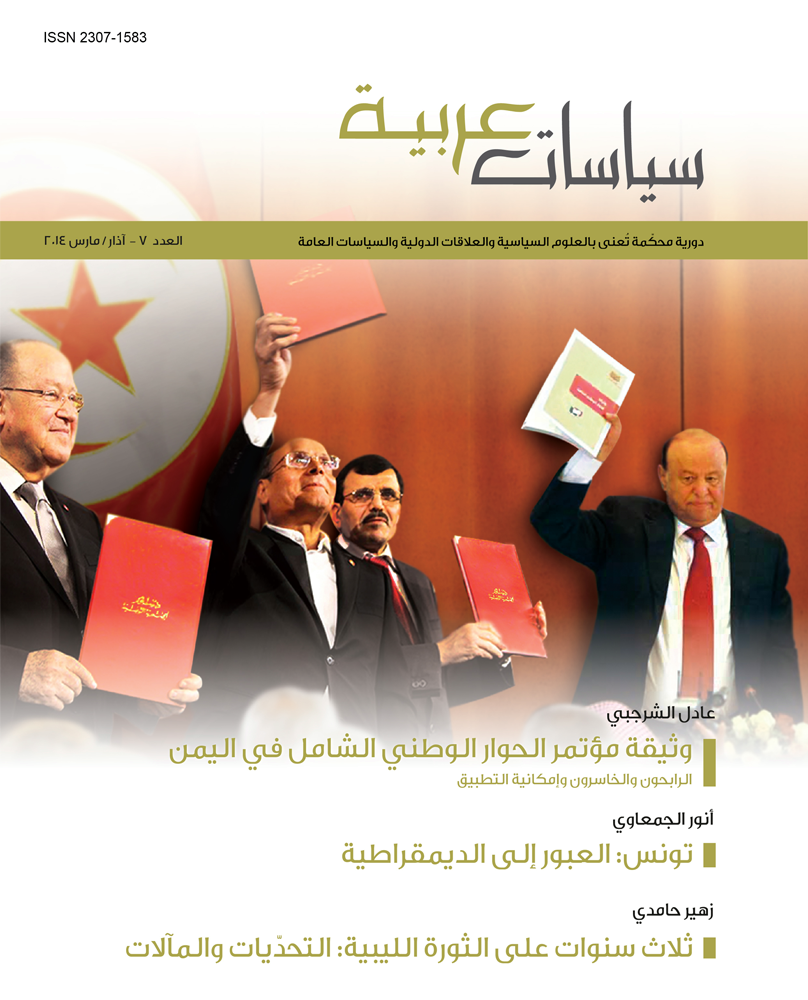
Issue 007
394 views 423 downloads 6 citationsVol. 2 No. 007 (2014)ACRPS has published issue 7 of the bi-monthly peer-reviewed academic journal Siyasat Arabia, a journal devoted to political science and international relations. This issue includes the following articles: “The Charter of the Comprehensive Conference for National Reconciliation in Yemen” (Adel al-Shargabi); “The Other Bank: The Ethiopian Vision of the Conflict over the Nile’s Waters” (Ahmed Abu Zaid); “The War in Sinai: Fighting Terrorism or Strategic Shifts in Cooperation and Hostility?” (Ismail al-Iskandarani); “Hamas and Egypt: the Impasse and Outcomes of the Relationship” (Khalid Walid Mahmoud and Ayat Hamdan); “US policy in the Middle East: a Discussion of the Conceptions of the Washington Institute for Near East Policy” (Mohammed al-Masri); “Tunisia: the Passage to Democracy” (Anouar Jamaoui); “Paths and Outcomes of the Moroccan Spring: the February 20 movement and Moroccan specifics in dealing with political protest” (Zouheir Hamedi); “Banned Discrimination in International Law” (Mohammad Yusuf Alwan); “Geneva 2: A Negotiation Track without Results” (ACRPS Policy Analysis Unit); “The Confrontation with ISIL: Reasons and Possible Results” (Hamzeh al-Mustafa); “Moral Hazard and the US-Iran Talks” (Suhaim Al Thani); and “Public Opinion and Democracy” (ACRPS Public Opinion Unit).The issue includes the following book reviews: “Freedom – Equality – Social Assimilation: The Theory of Justice in the Sustainable Model of Liberalism” (Khalid Walid Mahmoud); “Global Justice or Global Revenge? International Criminal Justice at the Crossroads” (Mohamed Taifouri); “Encyclopedia of Egypt and the Palestinian issue 1917-1952” (Naiema Abou Mostafa); “Balance: The Economics of Great Powers from Ancient Rome to Modern America” (Suhaim Al Thani). A further five books were presented by Ziad Muna: “Corporate Europe: How Big Business Sets Policies on Food, Climate and War “; “The International Human Rights Movement: A History”; “Reporting Disasters - Famine, Aid, Politics and the Media”; “Light on the Impasse of the Palestinian Political Elite”; and “Wadie Haddad – Revolutionary or Terrorist?”.
-
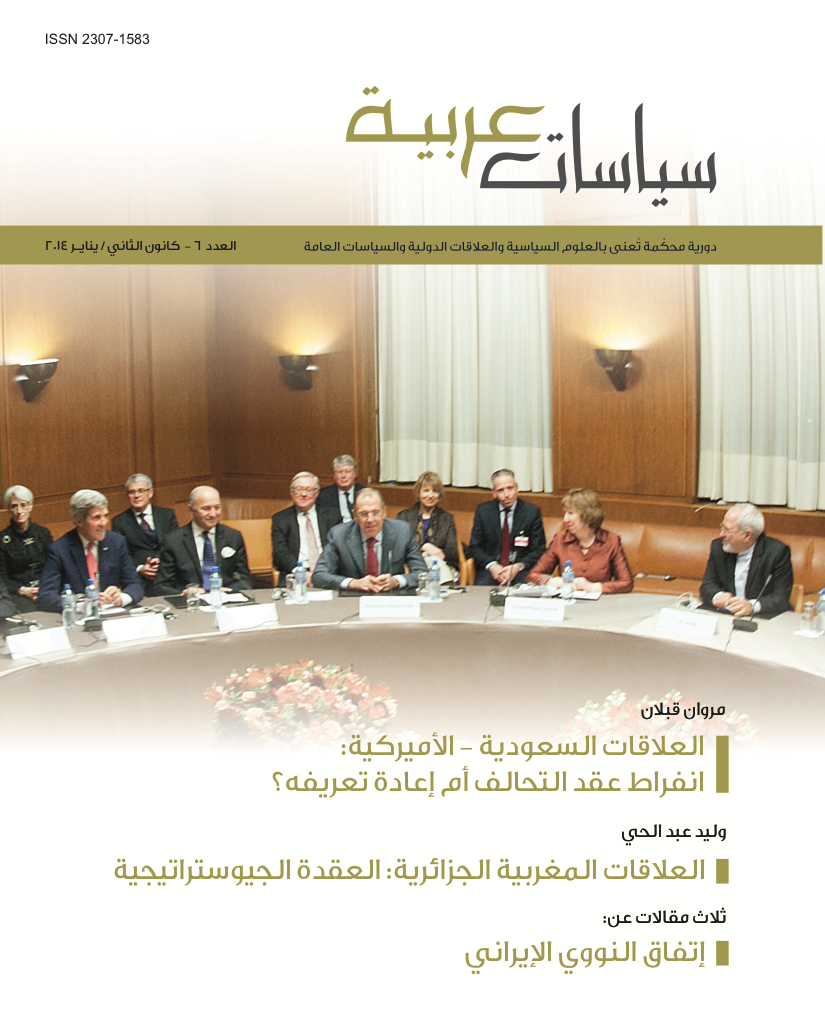
Issue 006
1008 views 1168 downloads 13 citationsVol. 2 No. 006 (2014)ACRPS has published issue 6 of the bi-monthly peer-reviewed academic journal Siyasat Arabia, a journal devoted to political science and international relations. This issue features the following studies and articles: “Saudi-American Relations: Alliance Unraveling or Redefined?” (Marwan Kabalan); “Unprecedented Settler Attacks are the Netanyahu Government’s Sole Project” (Mahmoud Muhareb); “Moroccan-Algerian Relations: The Geo-Strategic Knot” (Walid Abdulhay); “How will the Conflict between Erdogan and Gulen Affect the Turkish Political Scene?” (ACRPS Policy Analysis Unit); “The Iranian Nuclear Agreement: Necessity, Self-Interest, and a Change in Tune” (Fatima Samadi); “Iran and the Geneva Agreement: Legitimacy Renewed or Meeting the Latest Challenge?” (Mahjoob Zweiri); “Regional and International Implications of the Iranian Nuclear Agreement” (Ibrahim Sharqieh); “Confessionalism and Civil War’s Fuse in Yemen” (Anwar ben Qassem al-Khodari); “The Political Scene in Tunisia: The Long Road to Concord” (Anouar Jamaoui); “The Ramifications of Designating the Muslim Brotherhood as Terrorist Group” (ACRPS Policy Analysis Unit); “Are State and Society in Egypt Ready for Transitional Justice and National Reconciliation?” (Rawia Tawfik); “Egyptian Media Strategies During Mohammad Morsi’s Rule and Following the Coup” (Osama al-Rashidi); “The Role of the International Criminal Court in Punishing Crimes of Aggression in Light of the Kampala Amendments” (Shumama Kheireddine); “Brazil and the Arab Spring Revolutions” (Sodfa Mohammed Mahmoud); and “Public Opinion Trends Regarding State Institutions” (Mohammed al-Masri).The book review section features a number of reviews, including Salma Mousa’s review of Soldiers, Spies and Statesmen: Egypt’s Road to Revolt; a review by Khaled al-Aswar of the second part of Egypt and its Islamists after the January 25 revolution; and Mona Sukkarieh’s review of “Theories of International Relations”. There are four book presentations by Ziad Muna: Hitler’s Hatred for the Jews: Stereotype and Reality; British Empire: Resistance, Persecution, Revolutions; Fortress Israel; and Of Empires and Citizens. The issue also contains reports on the ACRPS’s Second Annual Conference of Arab Research Centers, “The Question of Palestine and the Future of the Palestinian National Project”, and another on an ACRPS seminar “The Plan for Democratic Transformation in Syria.” The journal also chronicles the most significant milestones of democratic transition in the Arab world, and the latest Palestinian developments.
-
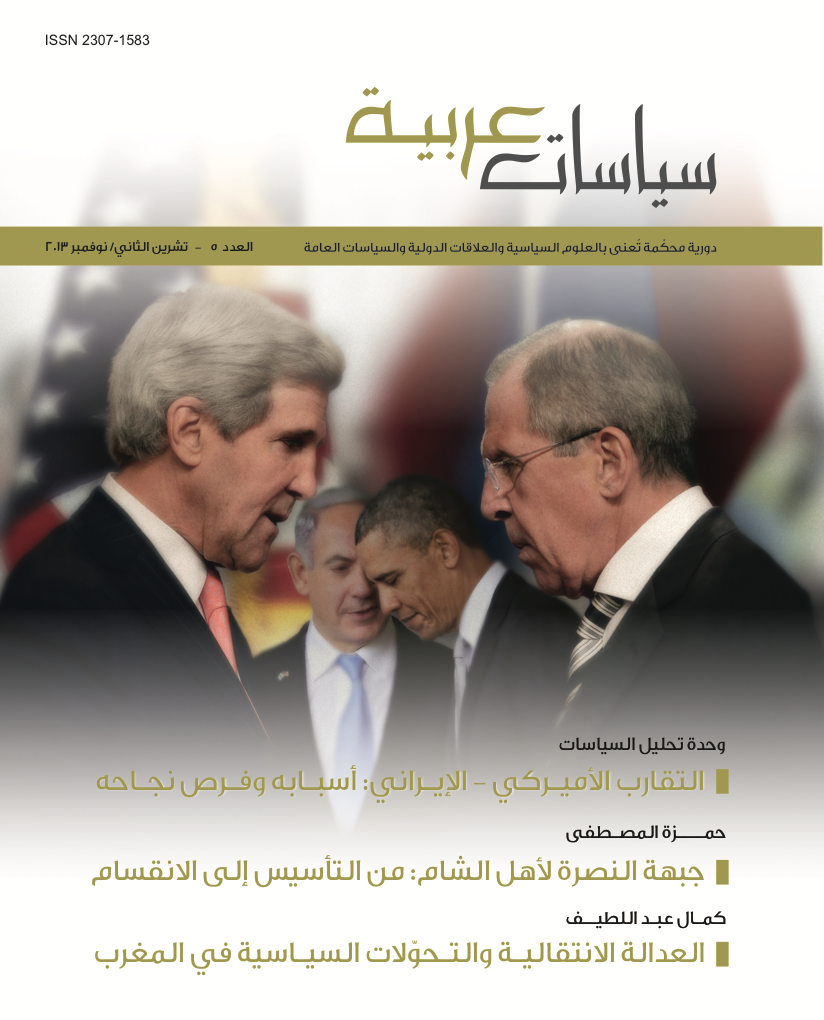
Issue 005
875 views 950 downloads 9 citationsVol. 1 No. 005 (2013)ACRPS has published issue 5 of the bi-monthly peer-reviewed academic journal Siyasat Arabia, a journal devoted to political science and international relations. This issue features the following studies and articles: “The Russian-American Agreement for Syrian Chemical Weapons Disarmament” (Saleh al-Naamani); “The Chemical Deal: The Way Out Obama Wants” (ACRPS Policy Analysis Unit); “After the Chemical Deal: An Attempt to Rehabilitate al-Assad?” (ACRPS Policy Analysis Unit); “The American-Iranian Rapprochement: Background and Prospects for its Success” (ACRPS Policy Analysis Unit); “Israeli Concerns over Possible US-Iranian Rapprochement” (ACRPS Policy Analysis Unit); “Relations between Iran, Syria, and Hezbollah and their Impact upon the Lebanese State” (Marwa Albadri); “The Morale Factor in Gulf Cooperation Council States and its Impact on the Assessment of State Strength” (Nawar Hashem); “The Nusra Front: From its Founding to Current Divisions” (Hamzeh al-Mustafa); ”Egyptian Soft Power: Between Ascendancy and Retreat” (Ahmad Abu Zeid); “Transitional Justice and Political Transformations in Morocco” (Kamal Abdellatif); “Pillars of China’s Foreign Policy in Africa” (Tawfiq Abdulsadeq); “Cyber-attacks and the Internet” (Khaled Walid Mahmoud); “Resolving Environmental Disputes According to International Law” (Lhoucine Chakrani); and “Public Opinion and the Proliferation of Nuclear Weapons” (Mohammed al-Masri). book review section features Hamzeh al-Moustafa’s review of Dr. Azmi Bishara’s Syria’s Via Dolorosa to Freedom by Hamzeh al-Mustafa; and Khaled al-Aswar’s review of the book Egypt and its Islamists after the January 25 Revolution. Suhaim Al Thani’s presents A Line in the Sand and Walid Khaled Ahmed reviews The Hashemite Union in British Documents. There is also a report on the seminar on US-Iranian rapprochement. The journal also chronicles the most significant milestones of democratic transition in the Arab world and the latest Palestinian developments.
-
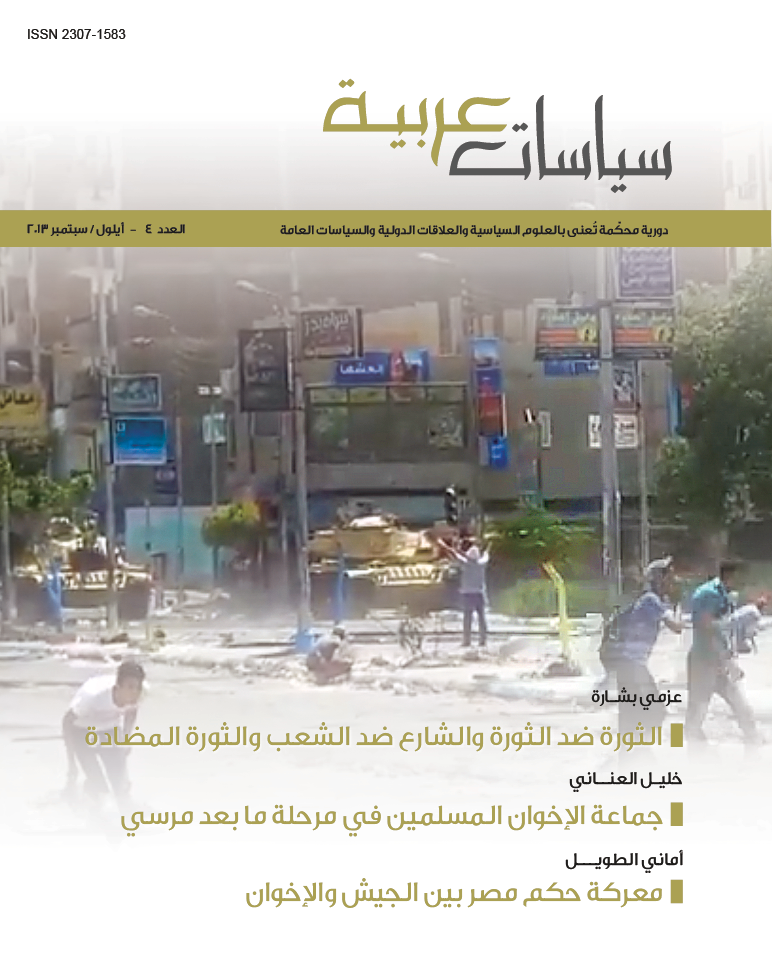
Issue 004
805 views 1004 downloads 7 citationsVol. 1 No. 004 (2013)ACRPS has published issue 4 of the bi-monthly peer-reviewed academic journal Siyasat Arabia, a journal devoted to political science and international relations. This edition features a special focus on Egyptian affairs given the continuous political developments in Egypt after June 30. The research papers included are: "Revolution against Revolution, the Street against the People, and Counter-Revolution" (Azmi Bishara); "The Muslim Brotherhood in the Post-Morsi Phase" (Khalil al-Anani); "Governance in Egypt: Between the Army and the Muslim Brotherhood" (Amani al-Tawil); "From an Election to a Coup: A Reading of June 30" (Hani Awwad); "Why Israel is Celebrating the Military Coup in Egypt" (Saleh Al Nuaimi); "The Security Institutions and the Revolutionary Movement in Egypt" (Marwa Fikri; "The Egyptian Coup: Historic Comparisons" (Zouheir Hamedi); "January 2011 through July 2013: The Egyptian Army in the Heart of the Storm" (Bashir AbdelFattah); "The Tunisian ‘Tamarrod' Movement: Limits and Prospects" (Anouar Jamaoui); "Explaining Military Responses to Revolutions" (Zoltan Barani); "The Syrian Problem Amidst the Maze of Regional and International Polarization" (ACRPS Syrian Studies Unit); and "Presidential Elections in Iran: Significations and Challenges" (Rachid Yalouh).The Arab Opinion Index section contains "Egypt: Demonstrations as an Alternative Research Tool as Political Parties Lose Popularity" written by Mohammad al-Masri. There are reviews of the following books: Class Conflict in Contemporary Egypt, reviewed by Nerouz Satik; How and When I Stopped Being Jewish, written by Shlomo Sand, now translated into Arabic, reviewed by Mahmoud Muhareb; January 25: Testimonies and Studies reviewed by Khaled Walid Mahmoud; and The Revenge of Geography reviewed by Suhaim Al Thani. The journal also chronicles the most significant milestones of democratic transition in the Arab world, particularly in Egypt, summarizing the Human Rights Watch report on the crackdown on the Rabiaa al-Adawiya Square sit-in, and presents the latest Palestinian developments over recent months.