Vol. 1 No. 002 (2012): Issue 002
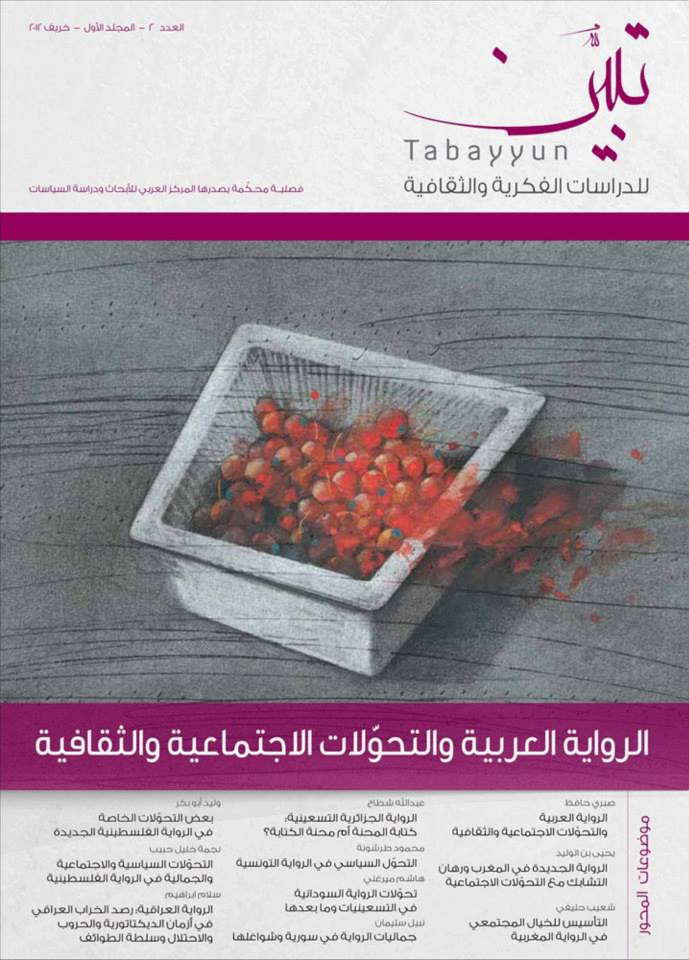
غلاف العدد 2 من دورية تبيّن

Issue 2 of Tabayyun (2012) includes the following studies and articles: “The Arabic Novel: Social and Cultural Transformations” (Sabri Hafez); “The New Novel in Morocco and the Challenge of Engagement with Social Change” (Yahya bin al-Walid); “The Construction of Societal Imagery in the Moroccan Novel” (Chouaib Halifi); “The Algerian Novel in the 1990s: Writing Tragedy or the Tragedy of Writing?” (Abdellah Chattah); “Political Transformation in the Tunisian novel” (Mahmoud Tarchouna); “The Transformations of the Sudanese Novel in the 1990s and Beyond” (Hashim Mirghani); “The Aesthetics and Concerns of the Novel in Syria” (Nabil Suleiman); “Changes in the New Palestinian Novel” (Walid Abu Bakr); “The Political, Social, and Aesthetic Transformations in the Palestinian Novel on the Eve of the Twenty-First Century” (Najma Khalil Habib); “The Iraqi Novel: Recording the Destruction of Iraq in Times of Dictatorship, Wars, Occupation, and Sectarian Rule” (Salam Ibrahim); “The Fate of Philosophy in the Arab world: Philosophy as Taught and Learnt in the Lebanese University” (Mouchir Basil Aoun); “Research Experiment of the Laboratory for Moroccan Studies” (Abdelhamid Hénia); “The Teaching of Philosophy in Moroccan Colleges: The Faculty of Arts and Humanities at Ben M’sik as Example” (Mohamed el-Sheikh); “Reality First: Testimony of the Novel” (Fawaz Haddad); “Faysal Darraj in the Theory of the Novel and the Arabic Novel” (Wafiq Slaitin); “A Reading of the Book, Politics, Law, and Community in Islamic Thought: The Taymiyyan Moment” (Abdel Rahman Iyas); “The Fields of Sloterdijk: Spaces of Coexistence” (Editorial Board of Tabayyun); “Lord of Many Homes: In Celebration of the Life and Works of Kamal al-Salibi (May 2-3, 2012 – AUB)” (Abdul Rahim Abu Husayn); “The Novel: History and Theory” (Thaer Deeb).

Published: 2012-05-01

Studies

  • The Arabic Novel: Social and Cultural Transformations

    Author: Sabri Hafez
    07-36

    This article deals with the Arabic novel in times of social and cultural transformations over the last quarter of a century. It takes into account the significance of the transformations in...

  • The New Novel in Morocco and the Challenge of Engagement with Social Change

    Author: Yahya bin al-Walid
    37-50

    This study presents an investigation into new trends of the Moroccan novel, particularly new novels and those by young writers, towards the so-called “social component” in a kind of renewed...

  • The Construction of Societal Imagery in the Moroccan Novel

    Author: Chouaib Halifi
    51-66

    Moroccan fiction has managed to construct a social imagery that reflects the aesthetics of the novel and a diversity of subjects and which is no longer the monopoly of the traditional elites or...

  • The Algerian Novel in the 1990s: Writing Tragedy or the Tragedy of Writing?

    Author: Abdellah Chattah
    67-84

    How can literature approach the Algerian tragedy? How can criticism deal with such literature? How can literature at such moments turn a blind eye to its tragic present and engage with the...

  • Political Transformation in the Tunisian novel

    Author: Mahmoud Tarchouna
    85-100

    Just prior to and shortly after Tunisia’s revolution, many Tunisian novels came out addressing social, economic, and cultural transformations. This study selects four of them which specifically...

  • The Transformations of the Sudanese Novel in the 1990s and Beyond

    Author: Hashim Mirghani
    101-112

    Among the themes characteristic of the post 1990s Sudanese novel are: the use of many narrative techniques with a deep awareness of the features of this narrative genre; the prominence of...

  • The Aesthetics and Concerns of the Novel in Syria

    Author: Nabil Suleiman
    113-133

    Movement on the scene of the Syrian novel reached a peak over the last two decades. There were many new names and there was much shifting to novels in new genres. If this scene is marked by...

  • Changes in the New Palestinian Novel

    Author: Walid Abu Bakr
    135-150

    This study observes the near complete break between the Palestinian novel written some years ago and much of what is being written today, particularly by young novelists. The author categorizes...

  • The Political, Social, and Aesthetic Transformations in the Palestinian Novel on the Eve of the Twenty-First Century

    Author: Najma Khalil Habib
    151-174

    Palestine is strongly present in the Arabic novel; just as Arab concerns are strongly present in the Palestinian novel. Nevertheless, there are some differences marking out the Palestinian...

  • The Iraqi Novel: Recording the Destruction of Iraq in Times of Dictatorship, Wars, Occupation, and Sectarian Rule

    Author: Salam Ibrahim
    175-198

    The Iraqi experience differs to other Arab experiences in the region because of the nature of its political and social developments since the creation of the Iraqi state in 1921: bloody...

  • The Fate of Philosophy in the Arab world: Philosophy as Taught and Learnt in the Lebanese University

    Author: Mouchir Basil Aoun
    201-222

    This study links the theoretical with the practical in its approach to the teaching and learning of philosophy in Lebanon as an exemplar for the Arab world. Philosophy in the Arab world is in...

  • Research Experiment of the Laboratory for Moroccan Studies

    Author: Abdelhamid Hénia
    223-240

    This study presents a testimony highlighting the practical aspects of the experience of the Laboratory for Moroccan Studies from the Laboratory’s Director for 15 years. A research institution...

  • The Teaching of Philosophy in Moroccan Colleges: The Faculty of Arts and Humanities at Ben M’sik as Example

    Author: Mohamed el-Sheikh
    241-257

    The presence of philosophy in Morocco is threatened by conservative thinking and technocratic management that has formed an alliance with theology and technology. In contrast, philosophy is...

Discussions

  • Reality First: Testimony of the Novel

    Author: Fawaz Haddad
    279-288

    Inside every one of us is a narrator who loves to tell stories. For some, the pleasure of storytelling exceeds the pleasure of listening. Equally, each of us has at least one novel ready to...

  • Faysal Darraj in the Theory of the Novel and the Arabic Novel

    Author: Wafiq Slaitin
    289-298

    This reading considers, reviews, questions, and draws conclusions on its subject on the basis of three pillars which enable the reconstruction of the read and teach the important articulations...

  • A Reading of the Book, Politics, Law, and Community in Islamic Thought: The Taymiyyan Moment

    Author: Abdel Rahman Iyas
    299-304

    Islam, like other religions, rests on narratives. The way in which this narrated tradition is received or understood by a generation, or the way it is modified, may determine the meaning of what...

  • The Fields of Sloterdijk: Spaces of Coexistence

    Author: Editorial Board of Tabayyun
    305-310

    Sloterdijk thinks that contemporary philosophers ought to think in a way full of risks, make themselves capture the excessive complexities of the age, and renounce our modern humanistic and...

Reports

  • Lord of Many Homes: In Celebration of the Life and Works of Kamal al-Salibi (May 2-3, 2012 – AUB)

    Author: Abdul Rahim Abu Husayn
    313-318

    The American University of Beirut honored the late historian Professor Kamal al-Salibi with a memorial celebration and academic symposium organized by the Department of History and Archaeology...

From the Library

  • The Novel: History and Theory

    Author: Thaer Deeb
    261-275

    Franco Moretti is a rare, if not unique, scholar: a supreme literary critic, a connoisseur of books and ideas, a fine writer with a witty side, and a repository of the left’s passion for...